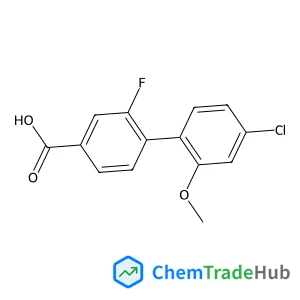
4-(4-Chloro-2-methoxyphenyl)-3-fluorobenzoic acid
CAS Number:
1261970-23-3
Molecular Formula:
C14H10ClFO3
Xiaoyong Zhang, Bin Yang, Yaling Zhang, Ke Wang, Jinying Yuan, Lei Tao, Yen Wei
In recent years, fluorescent organic nanoparticles (FONs) based on aggregation induced emission (AIE) dyes have received increasing attention for their potential in biology and biochemistry. In this contribution, a novel one-pot method for the fabrication of AIE-based FONs was developed via a combination of reversible addition–fragmentation chain-transfer (RAFT) polymerization and Schiff base reaction for the first time. During this procedure, an aldehyde functionalized hydrophobic tetraphenylethene AIE dye (named TPEA) reacted with the amine group of an amino-ended methacrylamide monomer by the Schiff base reaction, and the vinyl group in the monomer synchronously participated in RAFT polymerization together with a PEGMA monomer to form a new fluorescent copolymer. The as-prepared copolymer tended to self-assemble into FONs with the hydrophobic AIE core covered by a hydrophilic PEG shell, and the molar fractions of TPEA and PEG in the copolymer were about 20% and 80%, respectively, with 29 200 g mol−1 (Mn) and a narrow polydispersity index (PDI) (∼1.30). The prepared amphiphilic copolymer nanoparticles (named TPEA-PEG) exhibited good fluorescence features and excellent dispersibility in aqueous solution. More importantly, these FONs presented a spherical morphology, uniform size (∼100 nm), and excellent biocompatibility, making them promising candidates for bioimaging applications.
E. Sheremet, R. D. Rodriguez, T. Weiss, M. Nesterov, O. D. Gordan, L. L. Sveshnikova, T. A. Duda, V. A. Gridchin, V. M. Dzhagan, M. Hietschold, D. R. T. Zahn
DOI: 10.1039/C4CP05087H
Laura E. McWilliams, Nicholas A. Valley, Sumi N. Wren, Geraldine L. Richmond
DOI: 10.1039/C5CP02931G
R. A. Karaballi, A. Nel, S. Krishnan, J. Blackburn, C. L. Brosseau
DOI: 10.1039/C4CP05077K
Chen Chen, Jin-Yang Li, Li Wang, Dan-Feng Lu, Zhi-Mei Qi
DOI: 10.1039/C4CP05092D
Hui Wang, Chen Li, Weizhou Wang, Wei Jun Jin
DOI: 10.1039/C5CP03076E
Alexander Weiss, Nele Reimer, Norbert Stock, Michael Tiemann, Thorsten Wagner
DOI: 10.1039/C5CP01988E
Eric Osei-Agyemang, Jean-Francois Paul, Romain Lucas, Sylvie Foucaud, Sylvain Cristol
DOI: 10.1039/C5CP03031E
Daniel C. Rodrigues, Michele L. de Souza, Klester S. Souza, Diego P. dos Santos, Gustavo F. S. Andrade, Marcia L. A. Temperini
DOI: 10.1039/C4CP05080K
Kirsten Harth, Larissa M. Shepherd, James Honaker, Ralf Stannarius
DOI: 10.1039/C5CP04193G
Lauren Takahashi, Keisuke Takahashi
DOI: 10.1039/C5CP03382A
2-(2-Chloroacetamido)-3-phenylpropanoic acid (CAS: 7765-11-9) is generally consi...
2-(Benzyloxy)-5-bromobenzoic acid can be handled safely if appropriate precautio...
(4-Methyl-1,2,5-oxadiazol-3-yl)methanamine hydrochloride is a chemical compound ...
2-(5-Hexylthiophen-2-yl)-4,4,5,5-tetramethyl-1,3,2-dioxaborolane (CAS: 917985-54...
While 4-(8-Methyl-9H-1,3-dioxolo[4,5-h][2,3]benzodiazepin-5-yl)benzenamine (CAS:...
The market for tert-butyl 3-hydroxy-4,5,7,8-tetrahydro-2H-pyrazolo[3,4-d]azepine...
Waste containing 3,5-Diamino-1H-pyrazole-4-carbonitrile (CAS: 6844-58-2) should ...
(6-Fluoro-3-pyridinyl)boronic acid can be synthesized through the reaction of 6-...
Dibenzyl carbonimidoylbiscarbamate (CAS: 10065-79-9) finds applications in vario...
The market for (beta,beta,2,3,4,5,6-~2~H_7_)Phenylalanine (CAS: 74228-83-4) is g...

Polymer Chemistry welcomes submissions in all areas of polymer science that have a strong focus on macromolecular chemistry. Manuscripts may cover a broad range of fields, yet no direct application focus is required.