












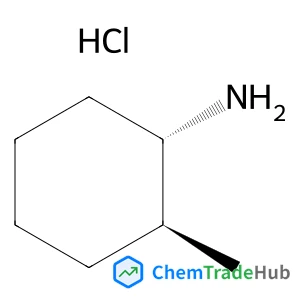
(1R,2R)-2-Methylcyclohexanamine hydrochloride (1:1)
CAS Number:
39558-31-1
Molecular Formula:
C7H16ClN
Nino J. M. Wullems, Erik Gubbels, Yefen Yao, Bart A. J. Noordover
The synthesis of renewable 2,5-furandicarboxylic acid-based cross-linked poly(ester amide)s via the polymerization of a 2,5-furandicarboxylic acid based bis(2-oxazoline) monomer (2,5-bis(4,5-dihydrooxazol-2-yl)furan, 2,5-FDCAox) with sebacic acid is reported in this work. It is demonstrated that the amide groups in the 2,5-furandicarboxamide moiety are susceptible to participation in a branching reaction with 2-oxazoline rings. The corresponding enhanced reaction rate decreases the curing times for the preparation of cross-linked polymers compared to systems containing the isophthalic acid based alternative, 1,3-bis(4,5-dihydrooxazol-2-yl)benzene (IAox). The increased tendency to form branches or cross-links in 2,5-FDCAox based systems is attributed to the occurrence of intra-molecular hydrogen bonding of the 2,5-furandicarboxamide moiety. Such an intra-molecular hydrogen bond increases the nucleophilicity of the furanic amide group and makes it more susceptible to participation in an addition reaction with a 2-oxazoline ring. Furthermore, it is demonstrated that the rate of the branching reaction can be enhanced by the addition of triphenyl phosphite as catalyst, resulting in a further decrease of the curing times of the poly(ester amide)s synthesized in this study. Preliminary coating studies indicate that 2,5-furandicarboxylic acid based cross-linked poly(ester amide)s synthesized via the 2-oxazoline ring opening addition reactions with dicarboxylic acids are good candidates for the development of fully renewable cross-linked poly(ester amide)s.
Kristen N. Johnson, K. W. Hipps, Ursula Mazur
DOI: 10.1039/D0CP04109B
Yi Gao
DOI: 10.1039/C9CP05562B
Roman Y. Pishchalnikov, Igor A. Yaroshevich, Tatiana A. Slastnikova, Aleksandr A. Ashikhmin, Alexey V. Stepanov, Ekaterina A. Slutskaya, Thomas Friedrich
DOI: 10.1039/C9CP04508B
Brielle L. Van Orman, Hoi-Ting Wu, Ryan R. Julian
DOI: 10.1039/D0CP04111D
Luisa Prasetyo, Toshihide Horikawa, Naoki Takashima, D. D. Do, D. Nicholson
DOI: 10.1039/C9CP05118J
Suvesh Manoj Lalwani, Chikaodinaka I. Eneh
DOI: 10.1039/D0CP03696J
Maxime Godfroy, Mahmoud Khalil, Claude Niebel, Thibaut Jarrosson, Dominique Foix, Valérie Flaud, Françoise Serein-Spirau, Romain Viennois, Michel Granier, Mickaël Beaudhuin
DOI: 10.1039/C9CP03864G
Zuzana Melnikova-Kominkova, Katerina Jurkova, Vaclav Vales, Karolina Drogowska-Horná, Otakar Frank, Martin Kalbac
DOI: 10.1039/C9CP04993B
DOI: 10.1039/D0CP03889J
Amlan J. Kalita, Shahnaz S. Rohman, Chayanika Kashyap, Sabnam S. Ullah, Ankur K. Guha
DOI: 10.1039/D0CP03436C
(5-Sulfamoyl-3-pyridinyl)boronic acid is primarily used in chemical synthesis, p...
Benzyl 2-methyl-2-(methylsulfonyl)-4-pentenoate is typically synthesized via est...
When handling 8-Fluoroquinolin-6-ol (CAS: 209353-22-0), it is important to use p...
1,3-Dibromo-5-(2-methyl-2-propanyl)benzene (CAS: 129316-09-2) is a crystalline c...
Ethyl 7-chloro-4-oxo-1-(1,3-thiazol-2-yl)-1,4-dihydro-1,8-naphthyridine-3-carbox...
When handling Delta-7-Avenasterol (CAS: 23290-26-8), it is important to wear app...
Proper handling involves the use of personal protective equipment such as gloves...
When handling 2-Methyl-2-proanyl 4-[(2-aminophenyl)amino]-1-piperidinecarboxylat...
N-Methyl-4-chlorobenzylamine hydrochloride (CAS: 65542-24-7) is a organic compou...
[2-(Dodecyloxy)ethoxy]acetic acid (CAS: 27306-90-7) is generally considered safe...

Polymer Chemistry welcomes submissions in all areas of polymer science that have a strong focus on macromolecular chemistry. Manuscripts may cover a broad range of fields, yet no direct application focus is required.
![2-(5-Bromo-1H-pyrrolo[2,3-B]pyridin-3-YL)acetic acid structure](https://static.chemtradehub.com/structs/106/1060795-03-0-0589.webp "2-(5-Bromo-1H-pyrrolo[2,3-B]pyridin-3-YL)acetic acid structure")






