












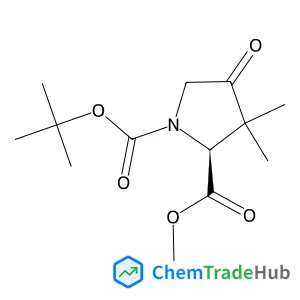
2-Methyl 1-(2-methyl-2-propanyl) (2S)-3,3-dimethyl-4-oxo-1,2-pyrrolidinedicarboxylate
CAS Number:
478698-30-5
Molecular Formula:
C13H21NO5
Luisa Prasetyo, Toshihide Horikawa, Naoki Takashima, D. D. Do, D. Nicholson
The transition from partial wetting to complete wetting for methanol adsorbed on a highly graphitized thermal carbon black, Carbopack F, over a range of temperature from the triple point at 185 K to 298 K, was investigated using Monte Carlo simulation and high-resolution experiments. At 190 K, (above the triple point) both the experimental and simulated adsorption isotherms cut the P/P0 axis at a finite loading; a feature of partial wetting that has not been recognized previously in the literature. This occurs because most O- and H-atoms in the second layer of the adsorbate point towards the adsorbent surface to form hydrogen bonds with molecules in the first layer and therefore the interface between the bilayer adsorbed film and the gas phase consists mainly of methyl groups, preventing the system from forming higher layers. At temperatures above 263 K, methanol adsorption increases with pressure and wets the surface as the pressure approaches the bulk coexistence pressure P0. This is because the O–H and O–CH3 bonds of methanol in the region above the second layer have random orientation, and adsorption in higher layers takes place via hydrogen bonding. From extensive simulations of methanol adsorption on adsorbents of different strength over a wide temperature range, a parametric map has been constructed which identifies the regions of non-wetting, partial wetting and complete wetting. For a given surface strength, wetting is favoured at higher temperatures, and at a given temperature there is a transition from non-wetting on weakly adsorbing substrates to either partial wetting or to complete wetting on strong adsorbents at temperatures below or above the roughening temperature Tr of 260 K.
Daeha Seo, Choong Il Yoo, Bong Hyun Chung, Im Sik Chung, Hyunjoon Song
DOI: 10.1039/B820220F
Feng Wang, Wataru Ueda
DOI: 10.1039/B817118A
Hikaru Yanai, Takeo Taguchi
DOI: 10.1039/B817599C
Jian-Yong Liu, Eugeny A. Ermilov, Beate Röder, Dennis K. P. Ng
DOI: 10.1039/B821630D
Magdalena A. Skopek, Mohamoud A. Mohamoud, Karl S. Ryder, A. Robert Hillman
DOI: 10.1039/B819084D
Yongfeng Zhou, Deyue Yan
DOI: 10.1039/B814560C
Dragoslav Vidovic, Glesni A. Pierce, Simon Aldridge
DOI: 10.1039/B816042B
(5-Sulfamoyl-3-pyridinyl)boronic acid is primarily used in chemical synthesis, p...
Benzyl 2-methyl-2-(methylsulfonyl)-4-pentenoate is typically synthesized via est...
When handling 8-Fluoroquinolin-6-ol (CAS: 209353-22-0), it is important to use p...
1,3-Dibromo-5-(2-methyl-2-propanyl)benzene (CAS: 129316-09-2) is a crystalline c...
Ethyl 7-chloro-4-oxo-1-(1,3-thiazol-2-yl)-1,4-dihydro-1,8-naphthyridine-3-carbox...
When handling Delta-7-Avenasterol (CAS: 23290-26-8), it is important to wear app...
Proper handling involves the use of personal protective equipment such as gloves...
When handling 2-Methyl-2-proanyl 4-[(2-aminophenyl)amino]-1-piperidinecarboxylat...
N-Methyl-4-chlorobenzylamine hydrochloride (CAS: 65542-24-7) is a organic compou...
[2-(Dodecyloxy)ethoxy]acetic acid (CAS: 27306-90-7) is generally considered safe...

Physical Chemistry Chemical Physics (PCCP) is an international journal co-owned by 19 physical chemistry and physics societies from around the world. This journal publishes original, cutting-edge research in physical chemistry, chemical physics and biophysical chemistry. To be suitable for publication in PCCP, articles must include significant innovation and/or insight into physical chemistry; this is the most important criterion that reviewers and Editors will judge against when evaluating submissions. The journal has a broad scope and welcomes contributions spanning experiment, theory, computation and data science. Topical coverage includes spectroscopy, dynamics, kinetics, statistical mechanics, thermodynamics, electrochemistry, catalysis, surface science, quantum mechanics, quantum computing and machine learning. Interdisciplinary research areas such as polymers and soft matter, materials, nanoscience, energy, surfaces/interfaces, and biophysical chemistry are welcomed if they demonstrate significant innovation and/or insight into physical chemistry. Joined experimental/theoretical studies are particularly appreciated when complementary and based on up-to-date approaches.
![4,10-Dihydroxy-3H-pyrano[3,4,5-kl]xanthen-3-one structure](https://static.chemtradehub.com/structs/125/1259330-61-4-de48.webp "4,10-Dihydroxy-3H-pyrano[3,4,5-kl]xanthen-3-one structure")




