


Structural peculiarities of keto-carotenoids in water-soluble proteins revealed by simulation of linear absorption
Literature Information
Publication Date
2019-11-05
DOI
10.1039/C9CP04508B
Impact Factor
3.676
Authors
Roman Y. Pishchalnikov, Igor A. Yaroshevich, Tatiana A. Slastnikova, Aleksandr A. Ashikhmin, Alexey V. Stepanov, Ekaterina A. Slutskaya, Thomas Friedrich
View Original
Abstract
To prevent irreversible damage caused by an excess of incident light, the photosynthetic machinery of many cyanobacteria uniquely utilizes the water-soluble orange carotenoid protein (OCP) containing a single keto-carotenoid molecule. This molecule is non-covalently embedded into the two OCP domains which are interconnected by a flexible linker. The phenomenon of OCP photoactivation, causing significant changes in carotenoid absorption in the orange and red form of OCP, is currently being thoroughly studied. Numerous additional spectral forms of natural and synthetic OCP-like proteins have been unearthed. The optical properties of carotenoids are strongly determined by the interaction of their electronic states with vibrational modes, the surrounding protein matrix, and the solvent. In this work, the effects of the pigment–protein interaction and vibrational relaxation in OCP were studied by computational simulation of linear absorption. Taking into account Raman spectroscopy data and applying the multimode Brownian oscillator model as well as the cumulant expansion technique, we have calculated a set of characteristic microparameters sufficient to demarcate different carotenoid states in OCP forms, using the model carotenoids spheroidene and spheroidenone in methanol/acetone solution as benchmarks. The most crucial microparameters, which determine the effect of solvent and protein environment, are the Huang–Rhys factors and the frequencies of CC and C–C stretching modes, the low-frequency mode and the FWHM due to inhomogeneous line broadening. Considering the difference of linear absorption between spheroidene and spheroidenone, which remarkably resembles the photoinduced changes of OCP absorption, and applying quantum chemical calculations, we discuss structural and functional determinants of carotenoid binding proteins.
Recommended Journals

Journal of Chemical Sciences

NDT & E International

Biocatalysis and Biotransformation

Bioorganic & Medicinal Chemistry

Herald of the Russian Academy of Sciences

Chinese Journal of Chemistry

Critical Reviews in Solid State and Materials Sciences

Medicinal Chemistry Research

Journal of the Indian Institute of Science

Acta Metallurgica Sinica-English Letters
Related Literature
Reversible photoisomerisability and particle size changes of mill-dispersed azobenzene crystals in water
2009-01-27
Communication
DOI: 10.1039/B820022J
Fluorophore-cored dendrimers for patterns in metalloprotein sensing
Siriporn Jiwpanich, Britto S. Sandanaraj, S. Thayumanavan
2009-01-05
Communication
DOI: 10.1039/B815263B
Marriage of porphyrin chemistry with metal-catalysed reactions
Hiroshi Shinokubo, Atsuhiro Osuka
2009-01-14
Feature Article
DOI: 10.1039/B817941G
A robust procedure for the functionalization of gold nanorods and noble metal nanoparticles
Benjamin Thierry, Jane Ng, Tina Krieg, Hans J. Griesser
2009-02-11
Communication
DOI: 10.1039/B820137D
Fluorescent gold nanoparticles-based fluorescence sensor for Cu2+ ions
Wenbin Chen, Xijuan Tu, Xiangqun Guo
2009-02-11
Communication
DOI: 10.1039/B820145E
Microwave synthesis of Cr nanowires on polymeric substrate
Daeseob Shim, Seung-Ho Jung, Eun-Ha Kim, Dong-Myung Yoon, Kun-Hong Lee, Soo-Hwan Jeong
2008-12-24
Communication
DOI: 10.1039/B816534C
The generation and trapping of enantiopure bromonium ions
D. Christopher Braddock, Stephen A. Hermitage, Lilian Kwok, Rebecca Pouwer, Joanna M. Redmond, Andrew J. P. White
2009-01-06
Communication
DOI: 10.1039/B816914D
You might also like
Compound Q&A
What are the main uses of (5-Sulfamoyl-3-pyridinyl)boronic acid (CAS: 951233-61-7)?
(5-Sulfamoyl-3-pyridinyl)boronic acid is primarily used in chemical synthesis, p...
951233-61-7(5-Sulfamoyl-3-pyrid...
Compound Q&A
How is Benzyl 2-methyl-2-(methylsulfonyl)-4-pentenoate (CAS: 1942858-50-5) typically synthesized?
Benzyl 2-methyl-2-(methylsulfonyl)-4-pentenoate is typically synthesized via est...
1942858-50-5Benzyl 2-methyl-2-(m...
Compound Q&A
What precautions should be taken when handling 8-Fluoroquinolin-6-ol (CAS: 209353-22-0)?
When handling 8-Fluoroquinolin-6-ol (CAS: 209353-22-0), it is important to use p...
209353-22-08-Fluoroquinolin-6-o...
Compound Q&A
What are the physical and chemical properties of 1,3-Dibromo-5-(2-methyl-2-propanyl)benzene (CAS: 129316-09-2)?
1,3-Dibromo-5-(2-methyl-2-propanyl)benzene (CAS: 129316-09-2) is a crystalline c...
129316-09-21,3-Dibromo-5-(2-met...
Compound Q&A
What industries use Ethyl 7-chloro-4-oxo-1-(1,3-thiazol-2-yl)-1,4-dihydro-1,8-naphthyridine-3-carboxylate (CAS: 174726-87-5)?
Ethyl 7-chloro-4-oxo-1-(1,3-thiazol-2-yl)-1,4-dihydro-1,8-naphthyridine-3-carbox...
174726-87-5Ethyl 7-chloro-4-oxo...
Compound Q&A
What precautions should be taken when handling Delta-7-Avenasterol (CAS: 23290-26-8)?
When handling Delta-7-Avenasterol (CAS: 23290-26-8), it is important to wear app...
23290-26-8Delta-7-Avenasterol
Compound Q&A
What precautions should be taken when handling N-({(5R)-3-[3-Fluoro-4-(4-morpholinyl)phenyl]-2-oxo-1,3-oxazolidin-5-yl}methyl)acetamide (CAS: 872992-20-6)?
Proper handling involves the use of personal protective equipment such as gloves...
872992-20-6N-({(5R)-3-[3-Fluoro...
Compound Q&A
What precautions should be taken when handling 2-Methyl-2-proanyl 4-[(2-aminophenyl)amino]-1-piperidinecarboxylate (CAS: 79099-00-6)?
When handling 2-Methyl-2-proanyl 4-[(2-aminophenyl)amino]-1-piperidinecarboxylat...
79099-00-62-Methyl-2-propanyl ...
Compound Q&A
What is N-Methyl-4-chlorobenzylamine hydrochloride (CAS: 65542-24-7)?
N-Methyl-4-chlorobenzylamine hydrochloride (CAS: 65542-24-7) is a organic compou...
65542-24-7N-Methyl-4-chloroben...
Compound Q&A
Is [2-(Dodecyloxy)ethoxy]acetic acid (CAS: 27306-90-7) safe?
[2-(Dodecyloxy)ethoxy]acetic acid (CAS: 27306-90-7) is generally considered safe...
27306-90-7[2-(Dodecyloxy)ethox...
Source Journal
Physical Chemistry Chemical Physics

CiteScore:
5.5
Self-citation Rate:
10.3%
Articles per Year:
3036
Physical Chemistry Chemical Physics (PCCP) is an international journal co-owned by 19 physical chemistry and physics societies from around the world. This journal publishes original, cutting-edge research in physical chemistry, chemical physics and biophysical chemistry. To be suitable for publication in PCCP, articles must include significant innovation and/or insight into physical chemistry; this is the most important criterion that reviewers and Editors will judge against when evaluating submissions. The journal has a broad scope and welcomes contributions spanning experiment, theory, computation and data science. Topical coverage includes spectroscopy, dynamics, kinetics, statistical mechanics, thermodynamics, electrochemistry, catalysis, surface science, quantum mechanics, quantum computing and machine learning. Interdisciplinary research areas such as polymers and soft matter, materials, nanoscience, energy, surfaces/interfaces, and biophysical chemistry are welcomed if they demonstrate significant innovation and/or insight into physical chemistry. Joined experimental/theoretical studies are particularly appreciated when complementary and based on up-to-date approaches.
Recommended Compounds
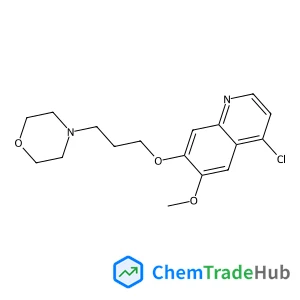
4-(3-((4-Chloro-6-methoxyquinolin-7-yl)oxy)propyl)morpholine
CAS Number:
205448-32-4
Molecular Formula:
C17H21ClN2O3
Recommended Suppliers




Disclaimer
This page provides academic journal information for reference and research purposes only. We are not affiliated with any journal publishers and do not handle publication submissions. For publication-related inquiries, please contact the respective journal publishers directly.
If you notice any inaccuracies in the information displayed, please contact us at support@chemtradehub.com. We will promptly review and address your concerns.