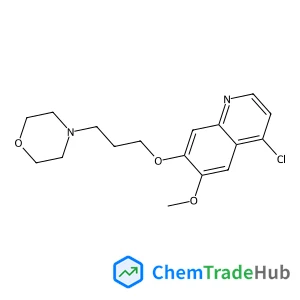
4-(3-((4-Chloro-6-methoxyquinolin-7-yl)oxy)propyl)morpholine
CAS Number:
205448-32-4
Molecular Formula:
C17H21ClN2O3
Zuzana Melnikova-Kominkova, Katerina Jurkova, Vaclav Vales, Karolina Drogowska-Horná, Otakar Frank, Martin Kalbac
The efficient manipulation of the optoelectronic properties of layered semiconductors is essential for future applications of these unique materials. Here, we demonstrate that single-layer, large-area graphene can serve as a conductive spacer between an electrolyte solution and single-layer MoS2. In situ Raman and photoluminescence (PL) spectroscopies were employed to monitor the charge transfer from graphene to MoS2. The Raman G and 2D bands were used to quantify the carrier concentration in graphene. The high efficiency of the charge transfer via graphene in a broad carrier concentration range of ±2.1 × 1013 cm−2 was documented by the extreme sensitivity of the MoS2 Raman mode to the electron-doping (shift rate of ∼2.5 cm−1/1 × 1013 cm−2 electron concentration) and the high sensitivity of the PL yield, which drops by more than one and two orders of magnitude in the hole and electron doping regimes, respectively. The easy implementation, and the lithography-free effectiveness of the setup, in terms of the achievable carrier concentration range and the charge-transfer efficiency, could be an asset in near-future research and in the development of optoelectronic devices.

Polycyclic Aromatic Compounds

Journal of Asian Natural Products Research

Colloid Journal

Critical Reviews in Solid State and Materials Sciences

Bioorganic & Medicinal Chemistry Letters

Main Group Chemistry

Bioorganic & Medicinal Chemistry

Journal of the Indian Institute of Science

Journal of Chemical Sciences

Atomization and Sprays
DOI: 10.1039/B820022J
Denise Zacher, Jianing Liu, Klaus Huber, Roland A. Fischer
DOI: 10.1039/B819580C
Yongfeng Zhou, Deyue Yan
DOI: 10.1039/B814560C
Wenbin Chen, Xijuan Tu, Xiangqun Guo
DOI: 10.1039/B820145E
Sumito Tokuji, Yuji Takahashi, Hideyuki Shinmori, Hiroshi Shinokubo, Atsuhiro Osuka
DOI: 10.1039/B819284G
Kyung-Chang Seo, Young-Geol Kwon, Dae-Hee Kim, In-Sook Jang, Jin-Won Cho, Sung-Kee Chung
DOI: 10.1039/B821058F
Tamas Szabo, Ali Siavosh-Haghighi, Carol A. Deakyne, John E. Adams, Jerry L. Atwood
DOI: 10.1039/B819276F
Yong Yan, Xiang Lin, Sihai Yang, Alexander J. Blake, Anne Dailly, Neil R. Champness, Peter Hubberstey, Martin Schröder
DOI: 10.1039/B900013E
(5-Sulfamoyl-3-pyridinyl)boronic acid is primarily used in chemical synthesis, p...
Benzyl 2-methyl-2-(methylsulfonyl)-4-pentenoate is typically synthesized via est...
When handling 8-Fluoroquinolin-6-ol (CAS: 209353-22-0), it is important to use p...
1,3-Dibromo-5-(2-methyl-2-propanyl)benzene (CAS: 129316-09-2) is a crystalline c...
Ethyl 7-chloro-4-oxo-1-(1,3-thiazol-2-yl)-1,4-dihydro-1,8-naphthyridine-3-carbox...
When handling Delta-7-Avenasterol (CAS: 23290-26-8), it is important to wear app...
Proper handling involves the use of personal protective equipment such as gloves...
When handling 2-Methyl-2-proanyl 4-[(2-aminophenyl)amino]-1-piperidinecarboxylat...
N-Methyl-4-chlorobenzylamine hydrochloride (CAS: 65542-24-7) is a organic compou...
[2-(Dodecyloxy)ethoxy]acetic acid (CAS: 27306-90-7) is generally considered safe...

Physical Chemistry Chemical Physics (PCCP) is an international journal co-owned by 19 physical chemistry and physics societies from around the world. This journal publishes original, cutting-edge research in physical chemistry, chemical physics and biophysical chemistry. To be suitable for publication in PCCP, articles must include significant innovation and/or insight into physical chemistry; this is the most important criterion that reviewers and Editors will judge against when evaluating submissions. The journal has a broad scope and welcomes contributions spanning experiment, theory, computation and data science. Topical coverage includes spectroscopy, dynamics, kinetics, statistical mechanics, thermodynamics, electrochemistry, catalysis, surface science, quantum mechanics, quantum computing and machine learning. Interdisciplinary research areas such as polymers and soft matter, materials, nanoscience, energy, surfaces/interfaces, and biophysical chemistry are welcomed if they demonstrate significant innovation and/or insight into physical chemistry. Joined experimental/theoretical studies are particularly appreciated when complementary and based on up-to-date approaches.
![4-Fluoro-2-(4-{[(3S,4R)-4-(2-hydroxy-2-propanyl)-3-pyrrolidinyl]amino}-6,7-dimethoxy-2-quinazolinyl)phenol hydrochloride (1:1) structure](https://static.chemtradehub.com/structs/143/1431697-96-9-619c.webp "4-Fluoro-2-(4-{[(3S,4R)-4-(2-hydroxy-2-propanyl)-3-pyrrolidinyl]amino}-6,7-dimethoxy-2-quinazolinyl)phenol hydrochloride (1:1) structure")