












Unexpectedly strong Xe binding by host–guest interaction
Literature Information
Publication Date
2019-11-15
DOI
10.1039/C9CP05562B
Impact Factor
3.676
Authors
Yi Gao
View Original
Abstract
A unique noncovalent interaction between XeO3 and 18-crown-6 has been studied by density functional theory. The calculated results show that there exists an extremely strong binding force between both species, reaching 36.44 kcal mol−1, which is comparable to the strong cation–π interaction. Detailed analyses on relaxed force constants, electrostatic potentials and the independent gradient model, etc. suggest that both quite strong aerogen bondings (Xe⋯O) and relatively weak unconventional H-bondings (C–H⋯O) coexist, and the complex is a typical heterodimer with multiple binding sites. Further studies found that XeO3 takes a quick rotary motion relative to 18-crown-6 in the complex due to low rotary barrier. Another two guest molecules, KrO3 and ArO3, are also discussed.
Recommended Journals
Related Literature
Enantioselective self-assembly of chiralcalix[4]arene acid with amines
Yan-Song Zheng, Shu-Yun Ran, Yu-Jian Hu, Xian-Xian Liu
2009-01-29
Communication
DOI: 10.1039/B817974C
Supramolecular self-assembly of amphiphilic hyperbranched polymers at all scales and dimensions: progress, characteristics and perspectives
Yongfeng Zhou, Deyue Yan
2009-01-13
Feature Article
DOI: 10.1039/B814560C
Dye displacement assay for saccharide detection with boronate hydrogels‡
Winson M. J. Ma, Marta P. Pereira Morais, François D’Hooge, Jean M. H. van den Elsen, Jonathan P. L. Cox, Tony D. James, John S. Fossey
2008-12-19
Communication
DOI: 10.1039/B814379J
Verification of specific G-quadruplex structure by using a novel cyanine dye supramolecular assembly: I. Recognizing mixed G-quadruplex in human telomeres
Junfeng Xiang, Yalin Tang, Guangzhi Xu
2009-01-12
Communication
DOI: 10.1039/B820101C
Enantiopure imidazolinium-dithiocarboxylates as highly selective novel organocatalysts
Oksana Sereda, Amélie Blanrue, René Wilhelm
2008-12-24
Communication
DOI: 10.1039/B817991C
Formation and dissolution of hen egg white lysozyme amyloid fibrils in protic ionic liquids
Nolene Byrne, C. Austen Angell
2009-02-02
Communication
DOI: 10.1039/B817590J
Versatile, efficient derivatization of polysiloxanesvia click technology
Ferdinand Gonzaga, Gilbert Yu, Michael A. Brook
2009-02-05
Communication
DOI: 10.1039/B821788B
Polyester-graft-phosphorylcholine prepared by ring-opening polymerization and click chemistry
Beth M. Cooper, Delphine Chan-Seng, Debasis Samanta, Xiongfei Zhang, Sangram Parelkar, Todd Emrick
2008-12-17
Communication
DOI: 10.1039/B817600K
Catalytic skeletal reorganization of enynes through electrophilicactivation of alkynes: double cleavage of C–C double and triple bonds
Sang Ick Lee, Naoto Chatani
2008-11-18
Feature Article
DOI: 10.1039/B812466C
Unsuspected mesomorphism in “tail-free” cyclopalladated 3,5-disubstituted-2-(2′-pyridyl)pyrroles
Daniela Pucci, Iolinda Aiello, Alessia Aprea, Anna Bellusci, Alessandra Crispini, Mauro Ghedini
2009-02-20
Communication
DOI: 10.1039/B818603K
You might also like
Compound Q&A
What are the main uses of (5-Sulfamoyl-3-pyridinyl)boronic acid (CAS: 951233-61-7)?
(5-Sulfamoyl-3-pyridinyl)boronic acid is primarily used in chemical synthesis, p...
951233-61-7(5-Sulfamoyl-3-pyrid...
Compound Q&A
How is Benzyl 2-methyl-2-(methylsulfonyl)-4-pentenoate (CAS: 1942858-50-5) typically synthesized?
Benzyl 2-methyl-2-(methylsulfonyl)-4-pentenoate is typically synthesized via est...
1942858-50-5Benzyl 2-methyl-2-(m...
Compound Q&A
What precautions should be taken when handling 8-Fluoroquinolin-6-ol (CAS: 209353-22-0)?
When handling 8-Fluoroquinolin-6-ol (CAS: 209353-22-0), it is important to use p...
209353-22-08-Fluoroquinolin-6-o...
Compound Q&A
What are the physical and chemical properties of 1,3-Dibromo-5-(2-methyl-2-propanyl)benzene (CAS: 129316-09-2)?
1,3-Dibromo-5-(2-methyl-2-propanyl)benzene (CAS: 129316-09-2) is a crystalline c...
129316-09-21,3-Dibromo-5-(2-met...
Compound Q&A
What industries use Ethyl 7-chloro-4-oxo-1-(1,3-thiazol-2-yl)-1,4-dihydro-1,8-naphthyridine-3-carboxylate (CAS: 174726-87-5)?
Ethyl 7-chloro-4-oxo-1-(1,3-thiazol-2-yl)-1,4-dihydro-1,8-naphthyridine-3-carbox...
174726-87-5Ethyl 7-chloro-4-oxo...
Compound Q&A
What precautions should be taken when handling Delta-7-Avenasterol (CAS: 23290-26-8)?
When handling Delta-7-Avenasterol (CAS: 23290-26-8), it is important to wear app...
23290-26-8Delta-7-Avenasterol
Compound Q&A
What precautions should be taken when handling N-({(5R)-3-[3-Fluoro-4-(4-morpholinyl)phenyl]-2-oxo-1,3-oxazolidin-5-yl}methyl)acetamide (CAS: 872992-20-6)?
Proper handling involves the use of personal protective equipment such as gloves...
872992-20-6N-({(5R)-3-[3-Fluoro...
Compound Q&A
What precautions should be taken when handling 2-Methyl-2-proanyl 4-[(2-aminophenyl)amino]-1-piperidinecarboxylate (CAS: 79099-00-6)?
When handling 2-Methyl-2-proanyl 4-[(2-aminophenyl)amino]-1-piperidinecarboxylat...
79099-00-62-Methyl-2-propanyl ...
Compound Q&A
What is N-Methyl-4-chlorobenzylamine hydrochloride (CAS: 65542-24-7)?
N-Methyl-4-chlorobenzylamine hydrochloride (CAS: 65542-24-7) is a organic compou...
65542-24-7N-Methyl-4-chloroben...
Compound Q&A
Is [2-(Dodecyloxy)ethoxy]acetic acid (CAS: 27306-90-7) safe?
[2-(Dodecyloxy)ethoxy]acetic acid (CAS: 27306-90-7) is generally considered safe...
27306-90-7[2-(Dodecyloxy)ethox...
Source Journal
Physical Chemistry Chemical Physics

CiteScore:
5.5
Self-citation Rate:
10.3%
Articles per Year:
3036
Physical Chemistry Chemical Physics (PCCP) is an international journal co-owned by 19 physical chemistry and physics societies from around the world. This journal publishes original, cutting-edge research in physical chemistry, chemical physics and biophysical chemistry. To be suitable for publication in PCCP, articles must include significant innovation and/or insight into physical chemistry; this is the most important criterion that reviewers and Editors will judge against when evaluating submissions. The journal has a broad scope and welcomes contributions spanning experiment, theory, computation and data science. Topical coverage includes spectroscopy, dynamics, kinetics, statistical mechanics, thermodynamics, electrochemistry, catalysis, surface science, quantum mechanics, quantum computing and machine learning. Interdisciplinary research areas such as polymers and soft matter, materials, nanoscience, energy, surfaces/interfaces, and biophysical chemistry are welcomed if they demonstrate significant innovation and/or insight into physical chemistry. Joined experimental/theoretical studies are particularly appreciated when complementary and based on up-to-date approaches.
Recommended Compounds
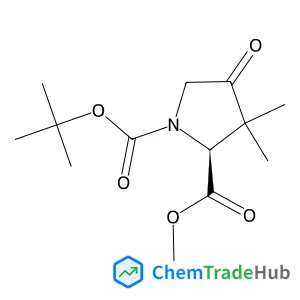
2-Methyl 1-(2-methyl-2-propanyl) (2S)-3,3-dimethyl-4-oxo-1,2-pyrrolidinedicarboxylate
CAS Number:
478698-30-5
Molecular Formula:
C13H21NO5
Recommended Suppliers





Disclaimer
This page provides academic journal information for reference and research purposes only. We are not affiliated with any journal publishers and do not handle publication submissions. For publication-related inquiries, please contact the respective journal publishers directly.
If you notice any inaccuracies in the information displayed, please contact us at support@chemtradehub.com. We will promptly review and address your concerns.