












Differentiation of peptide isomers by excited-state photodissociation and ion–molecule interactions
Literature Information
Publication Date
2020-10-07
DOI
10.1039/D0CP04111D
Impact Factor
3.676
Authors
Brielle L. Van Orman, Hoi-Ting Wu, Ryan R. Julian
View Original
Abstract
Solvochromatic effects are most frequently associated with solution-phase phenomena. However, in the gas phase, the absence of solvent leads to intramolecular solvation that can be driven by strong forces including hydrogen bonds and ion–dipole interactions. Here we examine whether isomerization of a single residue in a peptide results in structural changes sufficient to shift the absorption of light by an appended chromophore. By carrying out the experiments inside a mass spectrometer, we can easily monitor photodissociation yield as a readout for chromophore excitation. A series of peptides of different lengths, charge states, and position and identity of the isomerized residue were examined by excitation with both 266 and 213 nm light. The results reveal that differences in intramolecular solvation do lead to solvochromatic shifts in many cases. In addition, the primary product following photoexcitation is a radical. Ion–molecule reactions with this radical and adventitious oxygen were monitored and also found to vary as a function of isomeric state. In this case, differences in intramolecular solvation alter the availability of the reactive radical. Overall, the results reveal that small changes in a single amino acid can influence the overall structural ensemble sufficient to alter the efficiency of multiple gas-phase reactions.
Related Literature
Exploring the limits of encapsulation within hexameric pyrogallol[4]arene nano-capsules‡
Tamas Szabo, Ali Siavosh-Haghighi, Carol A. Deakyne, John E. Adams, Jerry L. Atwood
2009-01-09
Communication
DOI: 10.1039/B819276F
Enantioselective desymmetrisation of citric acid catalysed by the substrate-tolerant petrobactin biosynthetic enzyme AsbA
Daniel Oves-Costales, Lijiang Song, Gregory L. Challis
2009-02-16
Communication
DOI: 10.1039/B823147H
Chemistry and structural determination of botcinolides, botcinins, and botcinic acids
Isamu Shiina, Hiroki Fukui
2008-12-03
Feature Article
DOI: 10.1039/B814375G
Chiral detection at a liquid–liquid interface
Ritu Kataky, Paula Lopes
2009-02-18
Communication
DOI: 10.1039/B822685G
Aluminananowire forests via unconventional anodization and super-repellency plus low adhesion to diverse liquids
Xiaolong Wang, Miao Chen, Feng Zhou, Weimin Liu, Qunji Xue
2009-02-02
Communication
DOI: 10.1039/B818633B
Reaction energies computed with density functional theory correspond with a whole organism effect; modelling the Ames test for mutagenicity‡
Andrew G. Leach, Rebecca Cann, Simone Tomasi
2009-01-06
Communication
DOI: 10.1039/B818744D
Anion receptors that contain metals as structural units
Valeria Amendola, Luigi Fabbrizzi
2008-12-03
Feature Article
DOI: 10.1039/B808264M
Novel ⊕N(←L)2 species with two lone pairs on nitrogen: systems isoelectronic to carbodicarbenes
Dhilon S. Patel, Prasad V. Bharatam
2009-01-05
Communication
DOI: 10.1039/B816595E
You might also like
Compound Q&A
What are the main uses of (5-Sulfamoyl-3-pyridinyl)boronic acid (CAS: 951233-61-7)?
(5-Sulfamoyl-3-pyridinyl)boronic acid is primarily used in chemical synthesis, p...
951233-61-7(5-Sulfamoyl-3-pyrid...
Compound Q&A
How is Benzyl 2-methyl-2-(methylsulfonyl)-4-pentenoate (CAS: 1942858-50-5) typically synthesized?
Benzyl 2-methyl-2-(methylsulfonyl)-4-pentenoate is typically synthesized via est...
1942858-50-5Benzyl 2-methyl-2-(m...
Compound Q&A
What precautions should be taken when handling 8-Fluoroquinolin-6-ol (CAS: 209353-22-0)?
When handling 8-Fluoroquinolin-6-ol (CAS: 209353-22-0), it is important to use p...
209353-22-08-Fluoroquinolin-6-o...
Compound Q&A
What are the physical and chemical properties of 1,3-Dibromo-5-(2-methyl-2-propanyl)benzene (CAS: 129316-09-2)?
1,3-Dibromo-5-(2-methyl-2-propanyl)benzene (CAS: 129316-09-2) is a crystalline c...
129316-09-21,3-Dibromo-5-(2-met...
Compound Q&A
What industries use Ethyl 7-chloro-4-oxo-1-(1,3-thiazol-2-yl)-1,4-dihydro-1,8-naphthyridine-3-carboxylate (CAS: 174726-87-5)?
Ethyl 7-chloro-4-oxo-1-(1,3-thiazol-2-yl)-1,4-dihydro-1,8-naphthyridine-3-carbox...
174726-87-5Ethyl 7-chloro-4-oxo...
Compound Q&A
What precautions should be taken when handling Delta-7-Avenasterol (CAS: 23290-26-8)?
When handling Delta-7-Avenasterol (CAS: 23290-26-8), it is important to wear app...
23290-26-8Delta-7-Avenasterol
Compound Q&A
What precautions should be taken when handling N-({(5R)-3-[3-Fluoro-4-(4-morpholinyl)phenyl]-2-oxo-1,3-oxazolidin-5-yl}methyl)acetamide (CAS: 872992-20-6)?
Proper handling involves the use of personal protective equipment such as gloves...
872992-20-6N-({(5R)-3-[3-Fluoro...
Compound Q&A
What precautions should be taken when handling 2-Methyl-2-proanyl 4-[(2-aminophenyl)amino]-1-piperidinecarboxylate (CAS: 79099-00-6)?
When handling 2-Methyl-2-proanyl 4-[(2-aminophenyl)amino]-1-piperidinecarboxylat...
79099-00-62-Methyl-2-propanyl ...
Compound Q&A
What is N-Methyl-4-chlorobenzylamine hydrochloride (CAS: 65542-24-7)?
N-Methyl-4-chlorobenzylamine hydrochloride (CAS: 65542-24-7) is a organic compou...
65542-24-7N-Methyl-4-chloroben...
Compound Q&A
Is [2-(Dodecyloxy)ethoxy]acetic acid (CAS: 27306-90-7) safe?
[2-(Dodecyloxy)ethoxy]acetic acid (CAS: 27306-90-7) is generally considered safe...
27306-90-7[2-(Dodecyloxy)ethox...
Source Journal
Physical Chemistry Chemical Physics

CiteScore:
5.5
Self-citation Rate:
10.3%
Articles per Year:
3036
Physical Chemistry Chemical Physics (PCCP) is an international journal co-owned by 19 physical chemistry and physics societies from around the world. This journal publishes original, cutting-edge research in physical chemistry, chemical physics and biophysical chemistry. To be suitable for publication in PCCP, articles must include significant innovation and/or insight into physical chemistry; this is the most important criterion that reviewers and Editors will judge against when evaluating submissions. The journal has a broad scope and welcomes contributions spanning experiment, theory, computation and data science. Topical coverage includes spectroscopy, dynamics, kinetics, statistical mechanics, thermodynamics, electrochemistry, catalysis, surface science, quantum mechanics, quantum computing and machine learning. Interdisciplinary research areas such as polymers and soft matter, materials, nanoscience, energy, surfaces/interfaces, and biophysical chemistry are welcomed if they demonstrate significant innovation and/or insight into physical chemistry. Joined experimental/theoretical studies are particularly appreciated when complementary and based on up-to-date approaches.
Recommended Compounds
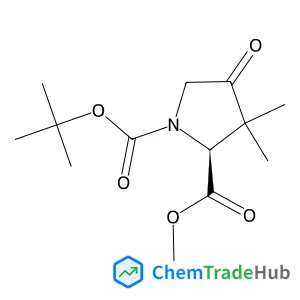
2-Methyl 1-(2-methyl-2-propanyl) (2S)-3,3-dimethyl-4-oxo-1,2-pyrrolidinedicarboxylate
CAS Number:
478698-30-5
Molecular Formula:
C13H21NO5
Recommended Suppliers



Disclaimer
This page provides academic journal information for reference and research purposes only. We are not affiliated with any journal publishers and do not handle publication submissions. For publication-related inquiries, please contact the respective journal publishers directly.
If you notice any inaccuracies in the information displayed, please contact us at support@chemtradehub.com. We will promptly review and address your concerns.