












Thiol-Michael “click” chemistry: another efficient tool for head functionalization of giant surfactants
Literature Information
Publication Date
2014-08-21
DOI
10.1039/C4PY01103A
Impact Factor
5.582
Authors
Yiwen Li, Hao Su, Xueyan Feng, Zhao Wang, Kai Guo, Qiang Fu, Stephen Z. D. Cheng
View Original
Abstract
One of the challenges in the precise synthesis of giant surfactants lies in the homogenous functionalization of a head with bulky ligands. In this article, we report the use of thiol-Michael “click” chemistry as a facile, modular and robust approach to address this issue. A giant surfactant with acryloxyl-functionalized POSS (ACPOSS) head was conveniently constructed from commercially available acrylo POSS and polystyrene (PS). Functional thiols with different sizes, such as 2-mercaptoethanol, 1H,1H,2H,2H-perfluoro-1-decanethiol, 1-thio-β-D-glucose tetraacetate (sugar-SH), and 2-naphthalenethiol, were attached onto the head of the ACPOSS-PS conjugate by thiol-Michael and thiol–ene reactions. It was found that while both the methods offer a straightforward and highly efficient approach to prepare uniform and precise giant surfactants with small thiol ligands, only the former proceeds without apparent side reactions when large and bulky thiols, such as sugar-SH and 2-naphthalenethiol, are used. The former method also eliminates the need for UV irradiation or heat initiation. Therefore, the mild condition, high efficiency, and broad functional group tolerance of thiol-Michael chemistry should further expand the scope of POSS-based giant surfactants with unparalleled possibilities for head surface chemistry manipulation, which provides numerous opportunities for nanofabrication by the direct self-assembly of giant surfactants.
Related Literature
Low-frequency depolarized Raman-spectral density of liquid water from femtosecond optical Kerr-effect measurements: Lineshape analysis of restricted translational modes
Kathrin Winkler, Jörg Lindner, Peter Vöhringer
2002-05-01
Paper
DOI: 10.1039/B200299J
EPR spectra and structure of bis-chlorinated dimethyl ether radical cation, CH2ClOCH2Cl+
Yoshiteru Itagaki, Peng Wang, Masaru Shiotani, Akinori Hasegawa
2002-05-16
Paper
DOI: 10.1039/B200440B
The PFI-ZEKE photoelectron spectrum of m-fluorophenol and its aqueous complexes: Comparing intermolecular vibrations in rotational isomers
Keigo Yosida, Kazunari Suzuki, Shun-ichi Ishiuchi, Makoto Sakai, Masaaki Fujii, Caroline E. H. Dessent, Klaus Müller-Dethlefs
2002-05-14
Paper
DOI: 10.1039/B201107G
A Mössbauer study of In–Fe2O3/HZSM-5 catalysts for the selective catalytic reduction of NO by methane
Xiaodong Wang, Xuqun Zhao, Jianyi Shen, Xiaoying Sun, Tao Zhang, Liwu Lin
2002-05-15
Paper
DOI: 10.1039/B110515A
High pressure investigations of (n-alkanes + ether) mixtures‡
Urszula Domańska, Piotr Morawski
2002-04-30
Paper
DOI: 10.1039/B200711H
Active sites in sol–gel prepared silica-alumina for photoinduced non-oxidative methane coupling
Hisao Yoshida, Norimitsu Matsushita, Yuko Kato, Tadashi Hattori
2002-04-22
Paper
DOI: 10.1039/B111101A
Development of kinetic models for the formation and degradation of unsaturated hydrocarbons at high temperature
2002-05-02
Paper
DOI: 10.1039/B110563A
Site selective hydroxylation of the MgO surface
O. Diwald, M. Sterrer, E. Knözinger
2002-05-14
Paper
DOI: 10.1039/B110334B
Laser powered homogeneous pyrolysis of ethyne, propyne, and propadiene initiated by methyl radicals: formation and degradation of hydrocarbons at 800–950 K
Karlheinz Hoyermann, Bettina Jürges
2002-05-01
Paper
DOI: 10.1039/B111643F
Template extraction from porous clay heterostructures: Influence on the porosity and the hydrothermal stability of the materials
M. Benjelloun, P. Cool, P. Van Der Voort, E. F. Vansant
2002-05-13
Paper
DOI: 10.1039/B108361A
You might also like
Compound Q&A
How should waste containing (6-Bromo-2-naphthyl)oxy](dimethyl)(2-methyl-2-propanyl)silane be handled?
Waste containing (6-Bromo-2-naphthyl)oxy](dimethyl)(2-methyl-2-propanyl)silane (...
100751-65-3[(6-Bromo-2-naphthyl...
Compound Q&A
How is 7-Fluoro-4-isoquinolinecarboxylic acid (CAS: 1841081-40-0) typically synthesized?
7-Fluoro-4-isoquinolinecarboxylic acid can be synthesized via a multi-step proce...
1841081-40-07-Fluoro-4-isoquinol...
Compound Q&A
What are the physical and chemical properties of 2,3,5,6-Tetrabromothieno[3,2-b]thiophene (CAS: 124638-53-5)?
2,3,5,6-Tetrabromothieno[3,2-b]thiophene is a crystalline compound with a high m...
124638-53-52,3,5,6-Tetrabromoth...
Compound Q&A
Is 1-[4-(Benzylamino)-7,8-dihydro-5H-pyrano[4,3-d]pyrimidin-2-yl]-2-methyl-1H-indole-4-carboxamide (CAS: 1542705-92-9) safe?
1-[4-(Benzylamino)-7,8-dihydro-5H-pyrano[4,3-d]pyrimidin-2-yl]-2-methyl-1H-indol...
1542705-92-91-[4-(Benzylamino)-7...
Compound Q&A
What is the market or research trend for imidazo[5,1-d]-1,2,3,5-tetrazine-8-carboxylic acid, 3,4-dihydro-3-methyl-4-oxo- (CAS: 113942-30-6)?
The market for imidazo[5,1-d]-1,2,3,5-tetrazine-8-carboxylic acid, 3,4-dihydro-3...
113942-30-6Imidazo[5,1-d]-1,2,3...
Compound Q&A
What is 3-(Triisopropylsilyl)propiolaldehyde (CAS: 163271-80-5)?
3-(Triisopropylsilyl)propiolaldehyde is a synthetic organic compound with the CA...
163271-80-53-(Triisopropylsilyl...
Compound Q&A
What regulatory guidelines apply to 6-Nitro-2H-1,4-benzoxazin-3(4H)-one (CAS: 81721-87-1)?
6-Nitro-2H-1,4-benzoxazin-3(4H)-one (CAS: 81721-87-1) is subject to various regu...
81721-87-16-Nitro-2H-1,4-benzo...
Compound Q&A
How should waste containing (3-Fluorophenyl)(4-{[(2-methyl-2-propanyl)oxy]carbonyl}-1-piperazinyl)acetic acid (CAS: 885272-91-3) be handled?
Waste containing (3-Fluorophenyl)(4-{[(2-methyl-2-propanyl)oxy]carbonyl}-1-piper...
885272-91-3(3-Fluorophenyl)(4-{...
Compound Q&A
What are the physical and chemical properties of N,N'-4,4'-Biphenyldiyldiisonicotinamide (CAS: 55119-40-9)?
N,N'-4,4'-Biphenyldiyldiisonicotinamide is a white crystalline solid with a mole...
55119-40-9N,N'-4,4'-Biphenyldi...
Compound Q&A
What industries use 6-Bromo-8-fluoro-2-quinazolinol (CAS: 1036756-15-6)?
6-Bromo-8-fluoro-2-quinazolinol is primarily used in the pharmaceutical industry...
1036756-15-66-Bromo-8-fluoro-2-q...
Source Journal
Polymer Chemistry

CiteScore:
8.6
Self-citation Rate:
7.3%
Articles per Year:
457
Polymer Chemistry welcomes submissions in all areas of polymer science that have a strong focus on macromolecular chemistry. Manuscripts may cover a broad range of fields, yet no direct application focus is required.
Recommended Compounds


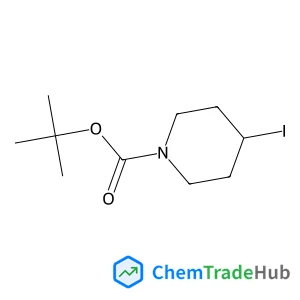
2-Methyl-2-propanyl 4-iodo-1-piperidinecarboxylate
CAS Number:
301673-14-3
Molecular Formula:
C10H18INO2
Recommended Suppliers





Disclaimer
This page provides academic journal information for reference and research purposes only. We are not affiliated with any journal publishers and do not handle publication submissions. For publication-related inquiries, please contact the respective journal publishers directly.
If you notice any inaccuracies in the information displayed, please contact us at support@chemtradehub.com. We will promptly review and address your concerns.