












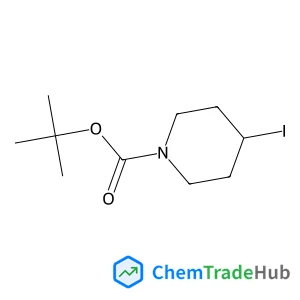
2-Methyl-2-propanyl 4-iodo-1-piperidinecarboxylate
CAS Number:
301673-14-3
Molecular Formula:
C10H18INO2
Xiaodong Wang, Xuqun Zhao, Jianyi Shen, Xiaoying Sun, Tao Zhang, Liwu Lin
The selective catalytic reduction of NO by CH4 was compared over In–Fe2O3/HZSM-5 catalysts prepared by impregnation and co-impregnation methods. It was found that the catalyst preparation method greatly affected the catalyst activity. The impregnated catalyst was very active, but the co-impregnated one showed poor activity. The In–Fe2O3/HZSM-5 catalysts were investigated by Mössbauer spectroscopy. The results showed that indium cations entered into the iron oxide lattice in the co-impregnated catalyst, while the impregnated catalyst exhibited a more stable structure, when both of the catalysts were treated severely in the reaction atmosphere. Characterization by means of combined in situ temperature programmed reduction (TPR)-Mössbauer spectroscopy further revealed that the performances of the two catalysts were different in the TPR processes.
Hyunki Yeo, Suman Debnath, Baiju P. Krishnan
DOI: 10.1039/D3LP00213F
Ryan Zowada, Reza Foudazi
DOI: 10.1039/D3LP00117B
William A. Maza, James A. Ridenour, Brian L. Chaloux, Albert Epshteyn, Jeffrey C. Owrutsky
DOI: 10.1039/D3VA00223C
Yaqi Hu, Zhong Liang, Yabin Zhang
DOI: 10.1039/D3EY00225J
Dariana R. Vega-Santander, Rodinson Arrieta-Pérez, Daniela Rivera-Mirabal, Gabriela Del Valle-Pérez, Miguel Sepúlveda-Pagán, Juan C. Muñoz-Senmache, Yomaira J. Pagán-Torres, Arturo J. Hernández-Maldonado
DOI: 10.1039/D3VA00282A
Greta Biale, Lorenzo Fiorentini, Diego Carnaroglio, Marco Mattonai
DOI: 10.1039/D3VA00216K
Libin Zeng, Jiali Wang, Can Yang
DOI: 10.1039/D3VA00239J
Chae Jeong-Potter, Martha A. Arellano-Treviño, W. Wilson McNeary, Alexander J. Hill, Daniel A. Ruddy, Anh T. To
DOI: 10.1039/D3EY00254C
Henrique de Medeiros Back, Daphiny Pottmaier, Camilla Kneubl Andreusi, Orestes Estevam Alarcon
DOI: 10.1039/D3VA00106G
Waste containing (6-Bromo-2-naphthyl)oxy](dimethyl)(2-methyl-2-propanyl)silane (...
7-Fluoro-4-isoquinolinecarboxylic acid can be synthesized via a multi-step proce...
2,3,5,6-Tetrabromothieno[3,2-b]thiophene is a crystalline compound with a high m...
1-[4-(Benzylamino)-7,8-dihydro-5H-pyrano[4,3-d]pyrimidin-2-yl]-2-methyl-1H-indol...
The market for imidazo[5,1-d]-1,2,3,5-tetrazine-8-carboxylic acid, 3,4-dihydro-3...
3-(Triisopropylsilyl)propiolaldehyde is a synthetic organic compound with the CA...
6-Nitro-2H-1,4-benzoxazin-3(4H)-one (CAS: 81721-87-1) is subject to various regu...
Waste containing (3-Fluorophenyl)(4-{[(2-methyl-2-propanyl)oxy]carbonyl}-1-piper...
N,N'-4,4'-Biphenyldiyldiisonicotinamide is a white crystalline solid with a mole...
6-Bromo-8-fluoro-2-quinazolinol is primarily used in the pharmaceutical industry...

Physical Chemistry Chemical Physics (PCCP) is an international journal co-owned by 19 physical chemistry and physics societies from around the world. This journal publishes original, cutting-edge research in physical chemistry, chemical physics and biophysical chemistry. To be suitable for publication in PCCP, articles must include significant innovation and/or insight into physical chemistry; this is the most important criterion that reviewers and Editors will judge against when evaluating submissions. The journal has a broad scope and welcomes contributions spanning experiment, theory, computation and data science. Topical coverage includes spectroscopy, dynamics, kinetics, statistical mechanics, thermodynamics, electrochemistry, catalysis, surface science, quantum mechanics, quantum computing and machine learning. Interdisciplinary research areas such as polymers and soft matter, materials, nanoscience, energy, surfaces/interfaces, and biophysical chemistry are welcomed if they demonstrate significant innovation and/or insight into physical chemistry. Joined experimental/theoretical studies are particularly appreciated when complementary and based on up-to-date approaches.
![2,2'-{2,2-Propanediylbis[(2,6-dibromo-4,1-phenylene)oxy]}diethanol structure](https://static.chemtradehub.com/structs/416/4162-45-2-b3d6.webp "2,2'-{2,2-Propanediylbis[(2,6-dibromo-4,1-phenylene)oxy]}diethanol structure")


