












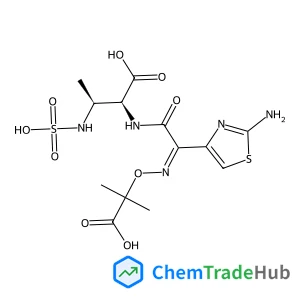
Aztreonam USP Related Compound A (Open-ring Aztreonam)
CAS Number:
87500-74-1
Molecular Formula:
C13H19N5O9S2
Huan Wang, Guangyu Zha, Hong Du, Lilong Gao, Xiaodong Li, Zhiquan Shen, Weipu Zhu
We report a facile strategy to fabricate ultrathin hydrogel films via a layer-by-layer (LbL) technique and “click” chemistry. Poly[oligo(ethylene glycol)fumarate]-co-poly[dodecyl bis(2-hydroxyethyl)methylammonium fumarate] (POEGDMAM) containing multi-enes and poly[oligo(ethylene glycol)mercaptosuccinate] (POEGMS) containing multi-thiols were synthesized by polycondensation, which were used as precursors for a LbL thiol–ene “click” reaction under ambient conditions without any metal catalyst or light irradiation. Due to the presence of ammonium groups with long alkyl chains in the POEGDMAM, the ultrathin hydrogel films exhibited excellent antibacterial activity against both Staphylococcus aureus and Escherichia coli, which was enhanced by increasing the number of layers. These kinds of biocompatible, antibacterial, ultrathin hydrogel films are promising candidates for biomedical applications.
Nicole L. Morozowich, Jessica L. Nichol, Ryan J. Mondschein, Harry R. Allcock
DOI: 10.1039/C2PY00570K
Guoqi Xiao, Bing Yan, Rui Ma, Wen Juan Jin, Xing Qiang Lü, Li Qin Ding, Chu Zeng, Lei Lei Chen, Feng Bao
DOI: 10.1039/C0PY00385A
Lian R. Hutchings, Richard L. Thompson
DOI: 10.1039/C0PY00362J
Adrian Sulistio, Anton Blencowe, Adrian Widjaya, Xiaoqing Zhang, Greg Qiao
DOI: 10.1039/C1PY00436K
Hsiang-Wei Lin, Wen-Ya Lee, Chien Lu, Chih-Jung Lin, Hung-Chin Wu, Yu-Wei Lin, Byungcheol Ahn, Yecheol Rho, Moonhor Ree
DOI: 10.1039/C2PY00583B
Robert Luxenhofer, Rudolf Zentel, María J. Vicent
DOI: 10.1039/C0PY00406E
Pierre Chambon, Lin Chen, Steve Furzeland, Derek Atkins, Jonathan V. M. Weaver, Dave J. Adams
DOI: 10.1039/C0PY00369G
Stéphanie Foltran, Lise Maisonneuve, Eric Cloutet, Benoit Gadenne, Carine Alfos, Thierry Tassaing, Henri Cramail
DOI: 10.1039/C2PY00476C
Niels M. B. Smeets, Rachel W. K. Lam, Raul P. Moraes, Timothy F. L. McKenna
DOI: 10.1039/C2PY00469K
Mark Long, Suzanne H. Rogers, David W. Thornthwaite, Francis R. Livens, Steve P. Rannard
DOI: 10.1039/C0PY00275E
3-Fluoro-2-methylbenzylamine is an organic compound with the CAS number 771573-3...
Tert-butyl 2-(oxetan-3-ylidene)acetate is considered safe for its intended uses ...
Proper personal protective equipment (PPE) such as gloves, goggles, and a lab co...
2-Ethyl-4-methyl-1,3-thiazole is commonly synthesized via the reaction of thiour...
This compound should be stored in a cool, dry place away from direct sunlight an...
L-Lysine Acetate Salt (CAS: 52315-92-1) is subject to various regulatory guideli...
6-Fluoro-3-hydroxy-2-pyrazinecarboxamide (CAS: 259793-96-9) is generally conside...
1,1'-Sulfonylbis(1H-imidazole) is a crystalline solid with a molecular weight of...
4-Methyl-7-nitro-1H-indole-3-carbonitrile (CAS: 289483-82-5) is primarily used i...
Waste containing 5-Bromo-3-indolyl-beta-galactoside (CAS: 97753-82-7) should be ...

Polymer Chemistry welcomes submissions in all areas of polymer science that have a strong focus on macromolecular chemistry. Manuscripts may cover a broad range of fields, yet no direct application focus is required.

![(2E)-4-[(1R,2S,8R,19S,21R)-14-Hydroxy-11-isopropenyl-8,23,23-trimethyl-5-(3-methyl-2-buten-1-yl)-16,20-dioxo-3,7,22-trioxaheptacyclo[17.4.1.1~8,12~.0~2,17~.0~2,21~.0~4,15~.0~6,13~]pentacosa-4(15),5,13
,17-tetraen-21-yl]-2-methyl-2-butenoic acid structure](https://static.chemtradehub.com/structs/173/173867-04-4-d2d3.webp "(2E)-4-[(1R,2S,8R,19S,21R)-14-Hydroxy-11-isopropenyl-8,23,23-trimethyl-5-(3-methyl-2-buten-1-yl)-16,20-dioxo-3,7,22-trioxaheptacyclo[17.4.1.1~8,12~.0~2,17~.0~2,21~.0~4,15~.0~6,13~]pentacosa-4(15),5,13
,17-tetraen-21-yl]-2-methyl-2-butenoic acid structure")





