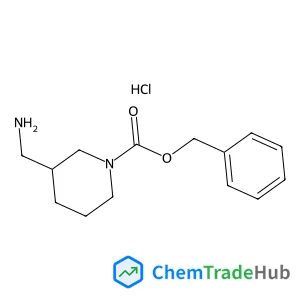
Benzyl 3-(aminomethyl)piperidine-1-carboxylate hydrochloride
CAS Number:
1186663-23-9
Molecular Formula:
C14H21ClN2O2
Lian R. Hutchings, Richard L. Thompson
Numerous applications require specific properties at polymer surfaces that differ from the bulk. Herein we describe the novel synthesis of a series of multi-end functionalised poly(styrene) and poly(isoprene) additives carrying 1 to 3 fluoroalkyl (CF) groups. The additives were prepared by endcapping the living chain ends of polymers prepared via living anionic polymerisation. The resulting polymers have been used as additives to render the surface of polymer films hydrophobic/lipophobic and we have characterised these polymer films using static contact angle measurements with water as the contact fluid. We have found that the additive molecular weight, the number of CF groups, additive concentration and annealing conditions have a significant impact upon the resulting surface properties. Increasing the additive concentration and/or number of CF groups resulted in higher contact angles whereas increasing the molecular weight of additive reduced contact angles and surface hydrophobicity. It has been discovered that these additives undergo rapid adsorption to the surface of a thin film in the time taken to produce the film by spin coating and the result is significantly enhanced surface properties. Annealing polystyrene films above the glass transition temperature revealed some interesting behaviour in so much that it demonstrated that on many occasions it is preferable to anneal films containing very small quantities of additive rather than to simply add greater quantities of additive. In addition to contact angles measurements, Rutherford backscattering (RBS) analysis has been carried out on examples of modified poly(isoprene) films to quantitatively analyse the effect of additive molecular weight and number of fluoroalkyl groups on the near surface elemental composition of the modified thin films and confirming the relationship (described above) between these additive molecular parameters and surface adsorption. Finally, we have described a model which compares the behaviour of the additives in thin films to surfactants in solution.
Xi-Ling Xu, Xiao-Jiao Deng, Hong-Guang Xu, Wei-Jun Zheng
DOI: 10.1039/C5CP04482K
Ana Vila Verde, Mark Santer, Reinhard Lipowsky
DOI: 10.1039/C5CP05726D
Chenyu Zou, Sumathy Raman
DOI: 10.1039/C5CP06108C
Leila Rajabi, S. C. Hendy
DOI: 10.1039/C5CP04448K
Guojing Wang, Jiecui Liao, Chienhua Chen, Shasha Lv, Chuanqing Shi
DOI: 10.1039/C5CP05036G
Daniel Höche, Carsten Blawert, Sviatlana V. Lamaka, Nico Scharnagl, Chamini Mendis
DOI: 10.1039/C5CP05577F
G. K. S. Prameela, B. V. N. Phani Kumar, A. Pan, V. K. Aswal, J. Subramanian, A. B. Mandal, S. P. Moulik
DOI: 10.1039/C5CP04910E
Robert S. Weatherup
DOI: 10.1039/C5CP04058B
Arya Shafiefarhood, Joseph Clay Hamill, Luke Michael Neal, Fanxing Li
DOI: 10.1039/C5CP05583K
Ruirui Han, Hongmei Ji, Tao Sun, Jin Zhao, Ningna Chen, Jing Chen, Xuefeng Guo, Wenhua Hou, Weiping Ding
DOI: 10.1039/C5CP06555K
3-Fluoro-2-methylbenzylamine is an organic compound with the CAS number 771573-3...
Tert-butyl 2-(oxetan-3-ylidene)acetate is considered safe for its intended uses ...
Proper personal protective equipment (PPE) such as gloves, goggles, and a lab co...
2-Ethyl-4-methyl-1,3-thiazole is commonly synthesized via the reaction of thiour...
This compound should be stored in a cool, dry place away from direct sunlight an...
L-Lysine Acetate Salt (CAS: 52315-92-1) is subject to various regulatory guideli...
6-Fluoro-3-hydroxy-2-pyrazinecarboxamide (CAS: 259793-96-9) is generally conside...
1,1'-Sulfonylbis(1H-imidazole) is a crystalline solid with a molecular weight of...
4-Methyl-7-nitro-1H-indole-3-carbonitrile (CAS: 289483-82-5) is primarily used i...
Waste containing 5-Bromo-3-indolyl-beta-galactoside (CAS: 97753-82-7) should be ...

Polymer Chemistry welcomes submissions in all areas of polymer science that have a strong focus on macromolecular chemistry. Manuscripts may cover a broad range of fields, yet no direct application focus is required.
![2-Methyl-2-propanyl [(2S)-1-hydroxy-3-(4-hydroxyphenyl)-2-propanyl]carbamate structure](https://static.chemtradehub.com/structs/833/83345-46-4-eec2.webp "2-Methyl-2-propanyl [(2S)-1-hydroxy-3-(4-hydroxyphenyl)-2-propanyl]carbamate structure")