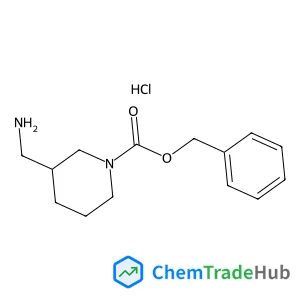
Benzyl 3-(aminomethyl)piperidine-1-carboxylate hydrochloride
CAS Number:
1186663-23-9
Molecular Formula:
C14H21ClN2O2
Mark Long, Suzanne H. Rogers, David W. Thornthwaite, Francis R. Livens, Steve P. Rannard
Radio thin layer chromatography (R-TLC) and liquid scintillation counting, of fractions collected from conventional gel permeation chromatography (GPC), have been used to study the fate of 14C-labelled initiators in the ambient methanolic ATRP of 2-hydroxypropyl methacrylate at different targeted number average degrees of polymerisation. Benzyl 2-bromoisobutyrate was synthesised in unlabelled form and with 14C-labels at different locations to establish no adverse effects of the radiolabel. Target chain lengths of 10, 25 and 50 monomer units were synthesised and comparison of GPC and R-TLC showed a significant under-utilisation of the initiator with approximately 16% clearly observable at high monomer conversion (>97%). New chains appeared to be initiated at monomer conversions >90% and as late as 300 minutes after polymerisation had commenced. Purification by repeated precipitation was shown to be superior to flash chromatography for the ability to remove residual unreacted or terminated initiator although increased fractionation could be seen with each repeat.
P. Vaqueiro, R. A. R. Al Orabi, G. Guélou, A. V. Powell, R. I. Smith, J.-P. Song, D. Wee, M. Fornari
DOI: 10.1039/C5CP06192J
Bing Li, Hongfeng Li, Peng Chen, Wenbin Sun, Cheng Wang, Ting Gao, Pengfei Yan
DOI: 10.1039/C5CP05888K
Daniel Avram, Bogdan Cojocaru, Adriana Urda, Ion Tiseanu, Mihaela Florea, Carmen Tiseanu
DOI: 10.1039/C5CP03458B
V. Balos, M. Bonn, J. Hunger
DOI: 10.1039/C5CP90226F
Rongjin Huang, Wei Wang, Laifeng Li
DOI: 10.1039/C5CP03948G
Federico A. O. Rasse-Suriani, M. Paula Denofrio, Juan G. Yañuk, M. Micaela Gonzalez, Ezequiel Wolcan, Marco Seifermann, Rosa Erra-Balsells, Franco M. Cabrerizo
DOI: 10.1039/C5CP05866J
Biswajit Biswas, Prashant Chandra Singh
DOI: 10.1039/C5CP04744G
Andrew D. Ballantyne, Gregory C. H. Forrest, Gero Frisch, Jennifer M. Hartley, Karl S. Ryder
DOI: 10.1039/C5CP05748E
David Zanuy, Jordi Poater, Miquel Solà, Ian W. Hamley
DOI: 10.1039/C5CP04269K
Mohammad Alaghemandi
DOI: 10.1039/C5CP05125H
3-Fluoro-2-methylbenzylamine is an organic compound with the CAS number 771573-3...
Tert-butyl 2-(oxetan-3-ylidene)acetate is considered safe for its intended uses ...
Proper personal protective equipment (PPE) such as gloves, goggles, and a lab co...
2-Ethyl-4-methyl-1,3-thiazole is commonly synthesized via the reaction of thiour...
This compound should be stored in a cool, dry place away from direct sunlight an...
L-Lysine Acetate Salt (CAS: 52315-92-1) is subject to various regulatory guideli...
6-Fluoro-3-hydroxy-2-pyrazinecarboxamide (CAS: 259793-96-9) is generally conside...
1,1'-Sulfonylbis(1H-imidazole) is a crystalline solid with a molecular weight of...
4-Methyl-7-nitro-1H-indole-3-carbonitrile (CAS: 289483-82-5) is primarily used i...
Waste containing 5-Bromo-3-indolyl-beta-galactoside (CAS: 97753-82-7) should be ...

Polymer Chemistry welcomes submissions in all areas of polymer science that have a strong focus on macromolecular chemistry. Manuscripts may cover a broad range of fields, yet no direct application focus is required.