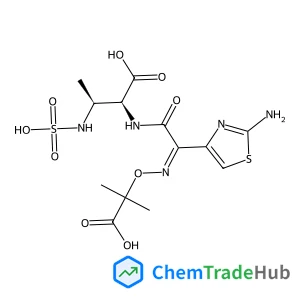
Aztreonam USP Related Compound A (Open-ring Aztreonam)
CAS Number:
87500-74-1
Molecular Formula:
C13H19N5O9S2
Guoqi Xiao, Bing Yan, Rui Ma, Wen Juan Jin, Xing Qiang Lü, Li Qin Ding, Chu Zeng, Lei Lei Chen, Feng Bao
A monometallic (Ni2+, 1) and a bimetallic (Ni2+-Sm3+, 2) complexes based on the Salen-type Schiff-base ligand H22L (H22L = N,N′-bis(3-methoxysalicylidene)ethylene-1,2-diamine) were synthesized and characterized by FT-IR, ESI-MS and X-ray crystallography. The catalysis results showed that the two complexes with different active species, could efficiently catalyze the bulk solvent-free melt ring-opening polymerization (ROP) of L-lactide with moderate molecular weights and narrow molecular weight distributions. Especially, for the bimetallic complex 2, the involvement of rare ions effectively passivated the catalytic behavior on the ROP of L-lactide, while was in favor of the increase of polymeric molecular weights (Mn) and the polymerization controllability.

Journal of Medical Biochemistry

CrystEngComm

Angewandte Chemie International Edition

Faraday Discussions

Environmental Toxicology and Pharmacology

Mini-Reviews in Medicinal Chemistry

Coloration Technology

Journal of Enzyme inhibition and Medicinal Chemistry

Current Pharmaceutical Biotechnology

Green Chemistry
Bo Wang, Songmei Li, Xiaoyu Wu, Jianhua Liu, Wenming Tian
DOI: 10.1039/C5CP04820F
Ioan Bâldea
DOI: 10.1039/C5CP05476A
Linqi Shi, Jiabao Cui, Fei Zhao, Dejun Wang, Tengfeng Xie, Yanhong Lin
DOI: 10.1039/C5CP05935F
David Zanuy, Jordi Poater, Miquel Solà, Ian W. Hamley
DOI: 10.1039/C5CP04269K
Yuxiang Han, Xiao Zheng, Mengqi Fu, Dong Pan, Xing Li, Yao Guo, Jianhua Zhao, Qing Chen
DOI: 10.1039/C5CP06139C
Yicong Ma, Sajal K. Ghosh, Sambhunath Bera, Zhang Jiang, Christian M. Schlepütz, Evguenia Karapetrova, Laurence B. Lurio, Sunil K. Sinha
DOI: 10.1039/C5CP04703J
Silvia Carlotto, Mauro Sambi, Andrea Vittadini
DOI: 10.1039/C5CP06844D
F. J. Aoiz, M. Brouard, S. D. S. Gordon, B. Nichols, V. Walpole
DOI: 10.1039/C5CP03273C
A. de la Lande, C. Meier
DOI: 10.1039/C5CP01194A
Audrey Laventure, Guillaume De Grandpré, Armand Soldera, Olivier Lebel, Christian Pellerin
DOI: 10.1039/C5CP06630A
3-Fluoro-2-methylbenzylamine is an organic compound with the CAS number 771573-3...
Tert-butyl 2-(oxetan-3-ylidene)acetate is considered safe for its intended uses ...
Proper personal protective equipment (PPE) such as gloves, goggles, and a lab co...
2-Ethyl-4-methyl-1,3-thiazole is commonly synthesized via the reaction of thiour...
This compound should be stored in a cool, dry place away from direct sunlight an...
L-Lysine Acetate Salt (CAS: 52315-92-1) is subject to various regulatory guideli...
6-Fluoro-3-hydroxy-2-pyrazinecarboxamide (CAS: 259793-96-9) is generally conside...
1,1'-Sulfonylbis(1H-imidazole) is a crystalline solid with a molecular weight of...
4-Methyl-7-nitro-1H-indole-3-carbonitrile (CAS: 289483-82-5) is primarily used i...
Waste containing 5-Bromo-3-indolyl-beta-galactoside (CAS: 97753-82-7) should be ...

Polymer Chemistry welcomes submissions in all areas of polymer science that have a strong focus on macromolecular chemistry. Manuscripts may cover a broad range of fields, yet no direct application focus is required.
![2-[({[(2-Methyl-2-propanyl)oxy]carbonyl}amino)methyl]isonicotinic acid structure](https://static.chemtradehub.com/structs/473/473924-63-9-973b.webp "2-[({[(2-Methyl-2-propanyl)oxy]carbonyl}amino)methyl]isonicotinic acid structure")