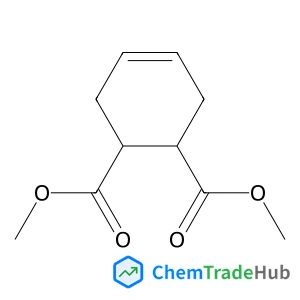
4-Cyclohexene-1,2-dicarboxylic acid, 1,2-dimethyl ester, (1R,2R)-rel-
CAS Number:
17673-68-6
Molecular Formula:
C10H14O4
V. J. Cunningham, L. P. D. Ratcliffe, A. Blanazs, N. J. Warren, A. J. Smith, O. O. Mykhaylyk, S. P. Armes
Amphiphilic diblock copolymer nano-objects can be readily prepared using reversible addition–fragmentation chain transfer (RAFT) polymerization. For example, poly(glycerol monomethacrylate) (PGMA) chain transfer agents (CTA) can be chain-extended using 2-hydroxypropyl methacrylate (HPMA) via RAFT aqueous dispersion polymerization to form well-defined spheres, worms or vesicles at up to 25% solids. The worm morphology is of particular interest, since multiple inter-worm contacts lead to the formation of soft free-standing gels, which undergo reversible degelation on cooling to sub-ambient temperatures. However, the critical gelation temperature (CGT) for such thermo-responsive gels is ≤20 °C, which is relatively low for certain biomedical applications. In this work, a series of new amphiphilic diblock copolymers are prepared in which the core-forming block comprises a statistical mixture of HPMA and di(ethylene glycol) methyl ether methacrylate (DEGMA), which is a more hydrophilic monomer than HPMA. Statistical copolymerizations proceeded to high conversion and low polydispersities were achieved in all cases (Mw/Mn < 1.20). The resulting PGMA-P(HPMA-stat-DEGMA) diblock copolymers undergo polymerization-induced self-assembly at 10% w/w solids to form free-standing worm gels. SAXS studies indicate that reversible (de)gelation occurs below the CGT as a result of a worm-to-sphere transition, with further cooling to 5 °C affording weakly interacting copolymer chains with a mean aggregation number of approximately four. This corresponds to almost molecular dissolution of the copolymer spheres. The CGT can be readily tuned by varying the mean degree of polymerization and the DEGMA content of the core-forming statistical block. For example, a CGT of 31 °C was obtained for PGMA59-P(HPMA91-stat-DEGMA39). This is sufficiently close to physiological temperature (37 °C) to suggest that these new copolymer gels may offer biomedical applications as readily-sterilizable scaffolds for mammalian cells, since facile cell harvesting can be achieved after a single thermal cycle.
Anna Kuffel, Jan Zielkiewicz
DOI: 10.1039/C2CP40105C
Piter S. Miedema, Peter Ngene, Ad M. J. van der Eerden, Tsu-Chien Weng, Dennis Nordlund, Dimosthenis Sokaras, Roberto Alonso-Mori, Amélie Juhin, Petra E. de Jongh, Frank M. F. de Groot
DOI: 10.1039/C2CP24025D
Milka Nussbaum, Yaron Paz
DOI: 10.1039/C2CP23202B
Laura Roldán, Sabino Armenise, Yanila Marco, Enrique García-Bordejé
DOI: 10.1039/C2CP23609E
G. Ennas, A. Scano, E. Agostinelli, D. Fiorani
DOI: 10.1039/C2CP22473A
Bo Yang, Xue-Qing Gong
DOI: 10.1039/C2CP23755E
Viktor V. Kostjukov, Adrian A. Hernandez Santiago, Fernando Rojas Rodriguez, Salvador Rosas Castilla, John A. Parkinson, Maxim P. Evstigneev
DOI: 10.1039/C2CP40182G
Tanja Drobek, Tobias Balmer
DOI: 10.1039/C2CP40255F
E. Collini
DOI: 10.1039/C2CP24030K
3-Fluoro-2-methylbenzylamine is an organic compound with the CAS number 771573-3...
Tert-butyl 2-(oxetan-3-ylidene)acetate is considered safe for its intended uses ...
Proper personal protective equipment (PPE) such as gloves, goggles, and a lab co...
2-Ethyl-4-methyl-1,3-thiazole is commonly synthesized via the reaction of thiour...
This compound should be stored in a cool, dry place away from direct sunlight an...
L-Lysine Acetate Salt (CAS: 52315-92-1) is subject to various regulatory guideli...
6-Fluoro-3-hydroxy-2-pyrazinecarboxamide (CAS: 259793-96-9) is generally conside...
1,1'-Sulfonylbis(1H-imidazole) is a crystalline solid with a molecular weight of...
4-Methyl-7-nitro-1H-indole-3-carbonitrile (CAS: 289483-82-5) is primarily used i...
Waste containing 5-Bromo-3-indolyl-beta-galactoside (CAS: 97753-82-7) should be ...

Polymer Chemistry welcomes submissions in all areas of polymer science that have a strong focus on macromolecular chemistry. Manuscripts may cover a broad range of fields, yet no direct application focus is required.
![Benzyl spiro[indole-3,4'-piperidine]-1(2H)-carboxylate hydrochloride (1:1) structure](https://static.chemtradehub.com/structs/159/159635-46-8-8de0.webp "Benzyl spiro[indole-3,4'-piperidine]-1(2H)-carboxylate hydrochloride (1:1) structure")
![(2E)-4-[(1R,2S,8R,19S,21R)-14-Hydroxy-11-isopropenyl-8,23,23-trimethyl-5-(3-methyl-2-buten-1-yl)-16,20-dioxo-3,7,22-trioxaheptacyclo[17.4.1.1~8,12~.0~2,17~.0~2,21~.0~4,15~.0~6,13~]pentacosa-4(15),5,13
,17-tetraen-21-yl]-2-methyl-2-butenoic acid structure](https://static.chemtradehub.com/structs/173/173867-04-4-d2d3.webp "(2E)-4-[(1R,2S,8R,19S,21R)-14-Hydroxy-11-isopropenyl-8,23,23-trimethyl-5-(3-methyl-2-buten-1-yl)-16,20-dioxo-3,7,22-trioxaheptacyclo[17.4.1.1~8,12~.0~2,17~.0~2,21~.0~4,15~.0~6,13~]pentacosa-4(15),5,13
,17-tetraen-21-yl]-2-methyl-2-butenoic acid structure")