












![(2E)-4-[(1R,2S,8R,19S,21R)-14-Hydroxy-11-isopropenyl-8,23,23-trimethyl-5-(3-methyl-2-buten-1-yl)-16,20-dioxo-3,7,22-trioxaheptacyclo[17.4.1.1~8,12~.0~2,17~.0~2,21~.0~4,15~.0~6,13~]pentacosa-4(15),5,13
,17-tetraen-21-yl]-2-methyl-2-butenoic acid structure](https://static.chemtradehub.com/structs/173/173867-04-4-d2d3.webp "(2E)-4-[(1R,2S,8R,19S,21R)-14-Hydroxy-11-isopropenyl-8,23,23-trimethyl-5-(3-methyl-2-buten-1-yl)-16,20-dioxo-3,7,22-trioxaheptacyclo[17.4.1.1~8,12~.0~2,17~.0~2,21~.0~4,15~.0~6,13~]pentacosa-4(15),5,13
,17-tetraen-21-yl]-2-methyl-2-butenoic acid structure")
Ultra-thin SiO2 layers on TiO2: improved photocatalysis by enhancing products' desorption
Literature Information
Publication Date
2012-01-10
DOI
10.1039/C2CP23202B
Impact Factor
3.676
Authors
Milka Nussbaum, Yaron Paz
View Original
Abstract
A study on the photocatalytic degradation of contaminants (salicylic acid and stearic acid) on titanium dioxide films overcoated with a few monolayers of silica is presented herein. A rather uncommon situation was observed, where the presence of the thin silica layers decreased the degradation rate of stearic acid while increasing that of salicylic acid. The results were explained by addressing the effect in the presence of silica films on the desorption of the intermediate products formed in the degradation of salicylic acid. This finding, which may apply also to other aromatic compounds, may have implications on the design and operation of photocatalytic devices for indoor applications, since ultrathin layers of silica are known to be formed over time on the photocatalyst. An interesting effect of the thickness of the silica sub-nanometre layer on the degradation rate of salicylic acid was explained in terms of gradual changes in the isoelectric point. If optimized, this effect can be utilized to precisely control adsorption or desorption and accordingly to induce specificity in the photocatalytic degradation of contaminants. A methodology for preparing a molecularly imprinting photocatalyst with an inert ultrathin layer in between the imprinted sites was presented. It was found that overcoating the area in between the imprinted sites preserved the benevolent effect of imprinting. While at present the imprinting effect was moderate, there is a reason to believe that this effect can be improved considerably by controlling the type of inert overlayer.
Related Literature
Comment on “Bi-layering at ionic liquid surfaces: a sum – frequency generation vibrational spectroscopy – and molecular dynamics simulation-based study” by T. Iwahashi, T. Ishiyama, Y. Sakai, A. Morita, D. Kim and Y. Ouchi, Phys. Chem. Chem. Phys., 2020, 22, 12565
Moshe Deutsch, Olaf M. Magnussen, Julia Haddad, Diego Pontoni, Bridget M. Murphy, Benjamin M. Ocko
2021-02-17
Comment
DOI: 10.1039/D0CP04882H
Controlling microgel deformation via deposition method and surface functionalization of solid supports
Laura Hoppe Alvarez, Pia Lenssen, Ulrich Simon, Dominik Wöll
2021-02-15
Paper
DOI: 10.1039/D0CP06355J
The interplay between spatial and heliconical orientational order in twist-bend nematic materials
R. Saha, C. Welch, G. H. Mehl, J. Feng, C. Zhu, J. Gleeson
2021-02-03
Communication
DOI: 10.1039/D0CP06633H
Flexible to rigid: IR spectroscopic investigation of a rhenium-tricarbonyl-complex at a buried interface
Kerstin T. Oppelt, Laurent Sevéry, Mirjam Utters, S. David Tilley, Peter Hamm
2021-02-04
Paper
DOI: 10.1039/D0CP06546C
Isolated and assembled silver aggregates on the Si(001) surface: the initial stage of film formation
Kai Huang, Xiaohang Huang, Jun Nogami
2021-01-25
Paper
DOI: 10.1039/D0CP06353C
Charge transport properties of open-shell graphene fragments: a computational study of the phenalenyl tilings
Wei-Chih Chen, Ito Chao
2020-11-23
Paper
DOI: 10.1039/D0CP03140B
Identifying a Li-rich superionic conductor from charge–discharge structural evolution study: Li2MnO3
Xiaofeng Zhang, Feng Zheng, Shunqing Wu, Zizhong Zhu
2021-02-04
Paper
DOI: 10.1039/D0CP05874B
The dynamic behavior and intrinsic mechanism of CO2 absorption by amino acid ionic liquids
Feng Huo, Yandong Guo, Xiaodong Liang, Nicolas von Solms, Hongyan He
2020-11-13
Paper
DOI: 10.1039/D0CP05735E
On the origin of the electron accumulation layer at clean InAs(111) surfaces
Ivan I. Vrubel, Dmitry Yudin, Anastasiia A. Pervishko
2021-02-04
Paper
DOI: 10.1039/D0CP05632D
Shape changes and budding of giant vesicles induced by an internal chemical trigger: an interplay between osmosis and pH change
Gábor Holló, Ylenia Miele, Federico Rossi, István Lagzi
2021-02-03
Paper
DOI: 10.1039/D0CP05952H
You might also like
Compound Q&A
Is 6-(3-Fluorophenyl)picolinic acid (CAS: 887982-40-3) safe?
6-(3-Fluorophenyl)picolinic acid is generally considered safe for laboratory use...
887982-40-36-(3-Fluorophenyl)pi...
Compound Q&A
What industries use (3R)-3-Pyrrolidinol (CAS: 2799-21-5)?
(3R)-3-Pyrrolidinol is used in the pharmaceutical industry as a precursor for dr...
2799-21-5(3R)-3-Pyrrolidinol
Compound Q&A
What precautions should be taken when handling (4R,5R)-4,5-Diethoxycarbonyl-2,2-dimethyldioxolane (CAS: 59779-75-8)?
When handling (4R,5R)-4,5-Diethoxycarbonyl-2,2-dimethyldioxolane (CAS: 59779-75-...
59779-75-8(4R,5R)-4,5-Diethoxy...
Compound Q&A
How is 1-(6-Chloroimidazo[1,2-b]pyridazin-3-yl)ethanone (CAS: 90734-71-7) typically synthesized?
1-(6-Chloroimidazo[1,2-b]pyridazin-3-yl)ethanone is often synthesized via a mult...
90734-71-71-(6-Chloroimidazo[1...
Compound Q&A
What is the market or research trend for N-Ethyl-3,4-dimethylbenzylamine (CAS: 39180-83-1)?
The market for N-Ethyl-3,4-dimethylbenzylamine (CAS: 39180-83-1) remains steady,...
39180-83-1N-Ethyl-3,4-dimethyl...
Compound Q&A
What is Tert-butyl 3-(pyrrolidin-1-yl)azetidine-1-carboxylate (CAS: 1019008-21-9)?
Tert-butyl 3-(pyrrolidin-1-yl)azetidine-1-carboxylate is a chemical compound wit...
1019008-21-9Tert-butyl 3-(pyrrol...
Compound Q&A
What regulatory guidelines apply to 1-Bromo-3-chloro-2,4-dimethoxybenzene (CAS: 1228956-93-1)?
1-Bromo-3-chloro-2,4-dimethoxybenzene (CAS: 1228956-93-1) falls under the classi...
1228956-93-11-Bromo-3-chloro-2,4...
Compound Q&A
Is 8-Bromo-2-methyl-3,4-dihydroisoquinolin-1(2H)-one (CAS: 1368622-07-4) safe?
The safety of 8-Bromo-2-methyl-3,4-dihydroisoquinolin-1(2H)-one (CAS: 1368622-07...
1368622-07-48-Bromo-2-methyl-3,4...
Compound Q&A
Is Benzyl [(3S)-2,6-dioxo-3-piperidinyl]carbamate (CAS: 22785-43-9) safe?
Benzyl [(3S)-2,6-dioxo-3-piperidinyl]carbamate is generally safe when handled wi...
22785-43-9Benzyl [(3S)-2,6-dio...
Compound Q&A
How should 1-{[4-(4,4,5,5-Tetramethyl-1,3,2-dioxaborolan-2-yl)phenyl]sulfonyl}pyrrolidine (CAS: 928657-21-0) be stored?
1-{[4-(4,4,5,5-Tetramethyl-1,3,2-dioxaborolan-2-yl)phenyl]sulfonyl}pyrrolidine s...
928657-21-01-{[4-(4,4,5,5-Tetra...
Source Journal
Physical Chemistry Chemical Physics

CiteScore:
5.5
Self-citation Rate:
10.3%
Articles per Year:
3036
Physical Chemistry Chemical Physics (PCCP) is an international journal co-owned by 19 physical chemistry and physics societies from around the world. This journal publishes original, cutting-edge research in physical chemistry, chemical physics and biophysical chemistry. To be suitable for publication in PCCP, articles must include significant innovation and/or insight into physical chemistry; this is the most important criterion that reviewers and Editors will judge against when evaluating submissions. The journal has a broad scope and welcomes contributions spanning experiment, theory, computation and data science. Topical coverage includes spectroscopy, dynamics, kinetics, statistical mechanics, thermodynamics, electrochemistry, catalysis, surface science, quantum mechanics, quantum computing and machine learning. Interdisciplinary research areas such as polymers and soft matter, materials, nanoscience, energy, surfaces/interfaces, and biophysical chemistry are welcomed if they demonstrate significant innovation and/or insight into physical chemistry. Joined experimental/theoretical studies are particularly appreciated when complementary and based on up-to-date approaches.
Recommended Compounds
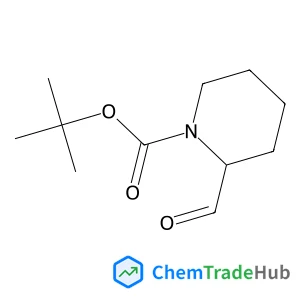
2-Methyl-2-propanyl (2R)-2-formyl-1-piperidinecarboxylate
CAS Number:
134526-69-5
Molecular Formula:
C11H19NO3
Recommended Suppliers






Disclaimer
This page provides academic journal information for reference and research purposes only. We are not affiliated with any journal publishers and do not handle publication submissions. For publication-related inquiries, please contact the respective journal publishers directly.
If you notice any inaccuracies in the information displayed, please contact us at support@chemtradehub.com. We will promptly review and address your concerns.