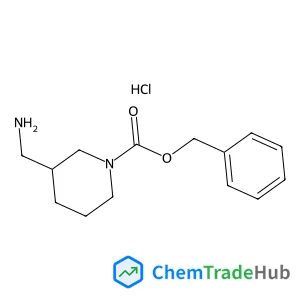
Benzyl 3-(aminomethyl)piperidine-1-carboxylate hydrochloride
CAS Number:
1186663-23-9
Molecular Formula:
C14H21ClN2O2
Tanja Drobek, Tobias Balmer
In this work we revisit the surface forces measured between two atomically flat mica surfaces submerged in a reservoir of potassium nitrate (KNO3) solution. We consider a comprehensive range of concentrations from 0.08 mM to 2.6 M. The significantly improved resolution available from the extended surface force apparatus (eSFA) allows the distinction of hydration structures and hydrated-ion correlations. Above concentrations of 0.3 mM, hydrated-ion correlations give rise to multiple collective transitions (4 ± 1 Å) in the electrical double layers upon interpenetration. These features are interpreted as the result of hydrated-ion ordering (e.g. layering), in contrast to the traditional interpretation invoking water layering. The hydrated-ion layer adjacent to the surface (i.e. outer Helmholtz layer) is particularly well defined and plays a distinctive role. It can be either collectively expelled in a 5.8 ± 0.3 Å film-thickness transition or collectively forced to associate with the surface by external mechanical work. The latter is observed as a characteristic 2.9 ± 0.3 Å film-thickness transition along with an abrupt decrease of surface adhesion at concentrations above 1 mM. At concentrations as low as 20 mM, attractive surface forces are measured in deviation to the DLVO theory. The hydration number in the confined electrolyte seems to be significantly below that of the bulk. A 1–3 nm thick ionic layer solidifies at the surfaces at concentrations >100 mM, i.e. below bulk saturation.
Chad M. Amb, Justin A. Kerszulis, Emily J. Thompson, Aubrey L. Dyer, John R. Reynolds
DOI: 10.1039/C0PY00405G
Xueyan Cao, Rui Guo, Mingwu Shen, Mengen Zhang, Meifang Zhu
DOI: 10.1039/C1PY00179E
Qi Chen, Ding Zhou, Jie Cao, Yu-Jian He, Bao-Hang Han
DOI: 10.1039/C1PY00012H
Karl T. Jackson, Mohammad G. Rabbani, Thomas E. Reich, Hani M. El-Kaderi
DOI: 10.1039/C1PY00374G
Hsun-Lien Lin, Tzong-Yuan Juang, Li-Hsin Chan, Rong-Ho Lee, Shenghong A. Dai, Ying-Ling Liu, Wen-Chiung Su, Ru-Jong Jeng
DOI: 10.1039/C0PY00157K
Harald Kirsebom, Bo Mattiasson
DOI: 10.1039/C1PY00014D
Zhaoyang Ye, Houyong Luo, Min Chen, Yan Zhou, Wensong Tan, Yan Xiao, Yan Zhang
DOI: 10.1039/C0PY00391C
Min Chen, Limin Wu
DOI: 10.1039/C0PY00284D
Debasis Pati, Ashif Y. Shaikh, Sayam Sen Gupta
DOI: 10.1039/C0PY00412J
Ozcan Altintas, Umit Tunca, Christopher Barner-Kowollik
DOI: 10.1039/C0PY00395F
3-Fluoro-2-methylbenzylamine is an organic compound with the CAS number 771573-3...
Tert-butyl 2-(oxetan-3-ylidene)acetate is considered safe for its intended uses ...
Proper personal protective equipment (PPE) such as gloves, goggles, and a lab co...
2-Ethyl-4-methyl-1,3-thiazole is commonly synthesized via the reaction of thiour...
This compound should be stored in a cool, dry place away from direct sunlight an...
L-Lysine Acetate Salt (CAS: 52315-92-1) is subject to various regulatory guideli...
6-Fluoro-3-hydroxy-2-pyrazinecarboxamide (CAS: 259793-96-9) is generally conside...
1,1'-Sulfonylbis(1H-imidazole) is a crystalline solid with a molecular weight of...
4-Methyl-7-nitro-1H-indole-3-carbonitrile (CAS: 289483-82-5) is primarily used i...
Waste containing 5-Bromo-3-indolyl-beta-galactoside (CAS: 97753-82-7) should be ...

Physical Chemistry Chemical Physics (PCCP) is an international journal co-owned by 19 physical chemistry and physics societies from around the world. This journal publishes original, cutting-edge research in physical chemistry, chemical physics and biophysical chemistry. To be suitable for publication in PCCP, articles must include significant innovation and/or insight into physical chemistry; this is the most important criterion that reviewers and Editors will judge against when evaluating submissions. The journal has a broad scope and welcomes contributions spanning experiment, theory, computation and data science. Topical coverage includes spectroscopy, dynamics, kinetics, statistical mechanics, thermodynamics, electrochemistry, catalysis, surface science, quantum mechanics, quantum computing and machine learning. Interdisciplinary research areas such as polymers and soft matter, materials, nanoscience, energy, surfaces/interfaces, and biophysical chemistry are welcomed if they demonstrate significant innovation and/or insight into physical chemistry. Joined experimental/theoretical studies are particularly appreciated when complementary and based on up-to-date approaches.