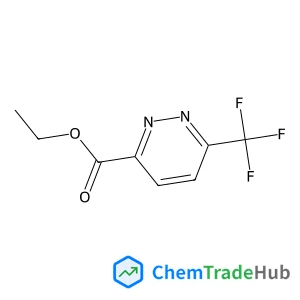
Ethyl 6-(trifluoromethyl)pyridazine-3-carboxylate
CAS Number:
1192155-06-8
Molecular Formula:
C8H7F3N2O2
Wenqiang Yao, Yongjun Li, Chun Feng, Guolin Lu, Xiaoyu Huang
A series of amphiphilic ABA triblock copolymers containing polyisobutylene (PIB) and poly(p-(2-(4-biphenyl)perfluorocyclobutoxy)phenyl methacrylate) (PBPFCBPMA) segments was synthesized via sequential living carbocationic polymerization and atom transfer radical polymerization (ATRP). Living carbocationic polymerization of isobutylene was initially performed at −78 °C in n-hexane–CH3Cl followed by end-capping with 1,3-butadiene to provide a well-defined diallyl-Cl-terminated PIB with a narrow molecular weight distribution (Mw/Mn = 1.26). The PIB functionalized at both ends was further transformed into Br-PIB-Br, an ATRP macroinitiator bearing one ATRP initiating group at each end. The target triblock copolymers of PBPFCBPMA-b-PIB-b-PBPFCBPMA with a relatively narrow molecular weight distribution (Mw/Mn ≤ 1.42) were obtained via ATRP of BPFCBPMA at 70 °C in tetrahydrofuran initiated by Br-PIB-Br. The self-assembly behavior of these triblock copolymers in n-hexane, acetone, and 1,1,1-trifluoroacetone was investigated by transmission electron microscopy. It was found that large spherical compound micelles with PIB blocks as coronas were formed in n-hexane, whereas large compound micelles with fluorine-containing PBPFCBPMA blocks as coronas were formed in acetone and 1,1,1-trifluoroacetone.
Xiaodan Li, Yi Gu
DOI: 10.1039/C1PY00379H
Cyrille Boyer, Aurelia Derveaux, Per B. Zetterlund, Michael R. Whittaker
DOI: 10.1039/C1PY00384D
Katja Nilles, Philipp Schattling
DOI: 10.1039/C0PY00314J
Luca Monfregola, Marilisa Leone, Vittoria Vittoria, Pietro Amodeo, Stefania De Luca
DOI: 10.1039/C0PY00341G
Yan Pang, Jinyao Liu, Yue Su, Jieli Wu, Lijuan Zhu, Deyue Yan, Bangshang Zhu
DOI: 10.1039/C1PY00053E
Min Ji, Hongli Liu, Xinlin Yang
DOI: 10.1039/C0PY00228C
David Uhrig
DOI: 10.1039/C0PY00185F
Guodong Jiang, Xiaodong Shen, Tingwei Wang
DOI: 10.1039/C0PY00389A
Neha Bhuchar, Zhicheng Deng, Kazuhiko Ishihara, Ravin Narain
DOI: 10.1039/C0PY00300J
3-Fluoro-2-methylbenzylamine is an organic compound with the CAS number 771573-3...
Tert-butyl 2-(oxetan-3-ylidene)acetate is considered safe for its intended uses ...
Proper personal protective equipment (PPE) such as gloves, goggles, and a lab co...
2-Ethyl-4-methyl-1,3-thiazole is commonly synthesized via the reaction of thiour...
This compound should be stored in a cool, dry place away from direct sunlight an...
L-Lysine Acetate Salt (CAS: 52315-92-1) is subject to various regulatory guideli...
6-Fluoro-3-hydroxy-2-pyrazinecarboxamide (CAS: 259793-96-9) is generally conside...
1,1'-Sulfonylbis(1H-imidazole) is a crystalline solid with a molecular weight of...
4-Methyl-7-nitro-1H-indole-3-carbonitrile (CAS: 289483-82-5) is primarily used i...
Waste containing 5-Bromo-3-indolyl-beta-galactoside (CAS: 97753-82-7) should be ...

Polymer Chemistry welcomes submissions in all areas of polymer science that have a strong focus on macromolecular chemistry. Manuscripts may cover a broad range of fields, yet no direct application focus is required.