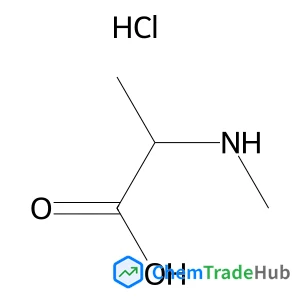
(R)-2-(Methylamino)propanoic acid hydrochloride
CAS Number:
1155878-14-0
Molecular Formula:
C4H10ClNO2
Yan Pang, Jinyao Liu, Yue Su, Jieli Wu, Lijuan Zhu, Deyue Yan, Bangshang Zhu
Novel thermo-responsive hyperbranched poly(amine-ester)s were designed and synthesized successfully in one-pot through proton-transfer polymerization of triethanolamine, trimethylolpropane, and glycidyl methacrylate with potassium hydride as a catalyst. The structure of the obtained polymers was confirmed by nuclear magnetic resonance, gel permeation chromatography, Fourier transformed infrared spectroscopy, and differential scanning calorimetery techniques. Thermal induced phase transition behaviors of hyperbranched poly(amine-ester)s were investigated by dynamic light scattering measurements, and the results indicated that these polymers had a tunable lower critical solution temperature (LCST) ranging from 37 to 57 °C. In vitro evaluation suggested that hyperbranched poly(amine-ester)s exhibited low cell cytotoxicity and efficient cell internalization against COS-7 cells. Moreover, doxorubicin (DOX) as a model drug was encapsulated into hyperbranched poly(amine-ester)s in aqueous solution above the LCST. In vitro release studies revealed that the loaded DOX displayed acid-triggered (pH ≈ 5.0) drug release behaviors. The DOX-loaded delivery system was investigated for proliferation inhibition of a Hela human cervical carcinoma cell line, and the DOX dose required for 50% cellular growth inhibition (IC50) was found to be 1.1 μg mL−1. All of these results suggest that thermo-responsive hyperbranched poly(amine-ester)s can be used to construct promising drug delivery systems for cancer therapy.
DOI: 10.1039/C5CP90218E
Daniel Avram, Bogdan Cojocaru, Adriana Urda, Ion Tiseanu, Mihaela Florea, Carmen Tiseanu
DOI: 10.1039/C5CP03458B
Chenyu Zou, Sumathy Raman
DOI: 10.1039/C5CP06108C
Rongjin Huang, Wei Wang, Laifeng Li
DOI: 10.1039/C5CP03948G
Jin-Yong Hong, Jeong Jae Wie, Yu Xu, Ho Seok Park
DOI: 10.1039/C5CP04203H
Andrew D. Ballantyne, Gregory C. H. Forrest, Gero Frisch, Jennifer M. Hartley, Karl S. Ryder
DOI: 10.1039/C5CP05748E
Gerrit-Jan Linker, Paul H. M. van Loosdrecht, Piet Th. van Duijnen, Ria Broer
DOI: 10.1039/C5CP05187H
Yukihiro Nakabayashi, Yoshio Nosaka
DOI: 10.1039/C5CP04531B
P. Antoniou, Z. Ma, P. Zhang
DOI: 10.1039/C5CP00610D
Manish Chopra, Niharendu Choudhury
DOI: 10.1039/C5CP90224J
3-Fluoro-2-methylbenzylamine is an organic compound with the CAS number 771573-3...
Tert-butyl 2-(oxetan-3-ylidene)acetate is considered safe for its intended uses ...
Proper personal protective equipment (PPE) such as gloves, goggles, and a lab co...
2-Ethyl-4-methyl-1,3-thiazole is commonly synthesized via the reaction of thiour...
This compound should be stored in a cool, dry place away from direct sunlight an...
L-Lysine Acetate Salt (CAS: 52315-92-1) is subject to various regulatory guideli...
6-Fluoro-3-hydroxy-2-pyrazinecarboxamide (CAS: 259793-96-9) is generally conside...
1,1'-Sulfonylbis(1H-imidazole) is a crystalline solid with a molecular weight of...
4-Methyl-7-nitro-1H-indole-3-carbonitrile (CAS: 289483-82-5) is primarily used i...
Waste containing 5-Bromo-3-indolyl-beta-galactoside (CAS: 97753-82-7) should be ...

Polymer Chemistry welcomes submissions in all areas of polymer science that have a strong focus on macromolecular chemistry. Manuscripts may cover a broad range of fields, yet no direct application focus is required.
![(2E)-4-[(1R,2S,8R,19S,21R)-14-Hydroxy-11-isopropenyl-8,23,23-trimethyl-5-(3-methyl-2-buten-1-yl)-16,20-dioxo-3,7,22-trioxaheptacyclo[17.4.1.1~8,12~.0~2,17~.0~2,21~.0~4,15~.0~6,13~]pentacosa-4(15),5,13
,17-tetraen-21-yl]-2-methyl-2-butenoic acid structure](https://static.chemtradehub.com/structs/173/173867-04-4-d2d3.webp "(2E)-4-[(1R,2S,8R,19S,21R)-14-Hydroxy-11-isopropenyl-8,23,23-trimethyl-5-(3-methyl-2-buten-1-yl)-16,20-dioxo-3,7,22-trioxaheptacyclo[17.4.1.1~8,12~.0~2,17~.0~2,21~.0~4,15~.0~6,13~]pentacosa-4(15),5,13
,17-tetraen-21-yl]-2-methyl-2-butenoic acid structure")