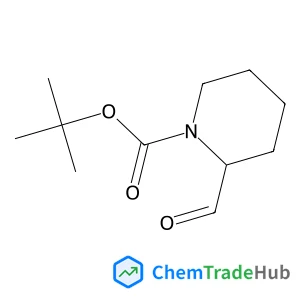
2-Methyl-2-propanyl (2R)-2-formyl-1-piperidinecarboxylate
CAS Number:
134526-69-5
Molecular Formula:
C11H19NO3
Min Ji, Hongli Liu, Xinlin Yang
The hollow poly(divinylbenzyl sulfonic acid) (P(DVB-SO3H)) polyelectrolyte (PE) microspheres with a shell-in-shell structure were prepared by selective etching of the silica core and third-layer with hydrofluoric acid from the corresponding SiO2/P(DVB-SO3H)/SiO2/P(DVB-SO3H) tetra-layer PE microspheres, which were synthesized by a combination of the controlled sol–gel hydrolysis of tetraethylorthosilicate (TEOS) for the preparation of silica core and third-layer, and the distillation precipitation polymerization of divinylbenzene (DVB) in acetonitrile for the construction of polydivinylbenzene (PDVB) layer with subsequent surface modification of the phenyl group to afford P(DVB-SO3H) PE second and outer shell-layer. The silica/poly(divinylbenzylsulfonate 4-vinylpyridinium) (SiO2/P(DVB-SO3−VPyH+) core-shell PE microspheres were prepared by the neutralization of 4-vinylpyridine (4-VPy) with sulfonic acid groups on the surface of SiO2/P(DVB-SO3H) core-shell microspheres, which were synthesized by the distillation precipitation polymerization of DVB in the presence of 3-(methacryloxy)propyl trimethacrylate (MPS)-modified silica nanoparticles as seeds to afford SiO2/PDVB core-shell microspheres with subsequent sulfonation of the phenyl groups of PDVB shell in concentrated sulfuric acid. SiO2/P(DVB-SO3H)/SiO2/P(DVB-SO3H) tetra-layer PE microspheres were synthesized by sulfonation of SiO2/P(DVB-SO3−VPyH+)/SiO2/PDVB tetra-layer microspheres in concentrated sulfuric acid, which were prepared by distillation precipitation polymerization of DVB with MPS-modified SiO2/P(DVB-SO3−VPyH+)/SiO2 tri-layer microspheres as seeds via coating of silica-layer onto SiO2/P(DVB-SO3−VPyH+) nanoparticles. The morphology and properties of the resultant microspheres, and the corresponding hollow P(DVB-SO3H) microspheres with a shell-in-shell structure were characterized by transmission electron microscopy (TEM), Fourier transform spectroscopy (FT-IR), and X-ray photoelectron spectroscopy (XPS).
Benjamin J. Bergner, Christine Hofmann, Adrian Schürmann, Daniel Schröder, Klaus Peppler, Peter R. Schreiner, Jürgen Janek
DOI: 10.1039/C5CP04505C
S. Ali, V. S. Myasnichenko, E. C. Neyts
DOI: 10.1039/C5CP06153A
A. de la Lande, C. Meier
DOI: 10.1039/C5CP01194A
Robert S. Weatherup
DOI: 10.1039/C5CP04058B
Anita Dawes, Nigel John Mason, Helen Jane Fraser
DOI: 10.1039/C5CP05299H
Linqi Shi, Jiabao Cui, Fei Zhao, Dejun Wang, Tengfeng Xie, Yanhong Lin
DOI: 10.1039/C5CP05935F
Ananda K. Ghosh, Zahidul Islam, Jonathan Krueger, Thelma Abeysinghe, Amnon Kohen
DOI: 10.1039/C5CP01246E
David Zanuy, Jordi Poater, Miquel Solà, Ian W. Hamley
DOI: 10.1039/C5CP04269K
Gil O. Rutter, David Quigley, Tiffany R. Walsh
DOI: 10.1039/C5CP05652G
3-Fluoro-2-methylbenzylamine is an organic compound with the CAS number 771573-3...
Tert-butyl 2-(oxetan-3-ylidene)acetate is considered safe for its intended uses ...
Proper personal protective equipment (PPE) such as gloves, goggles, and a lab co...
2-Ethyl-4-methyl-1,3-thiazole is commonly synthesized via the reaction of thiour...
This compound should be stored in a cool, dry place away from direct sunlight an...
L-Lysine Acetate Salt (CAS: 52315-92-1) is subject to various regulatory guideli...
6-Fluoro-3-hydroxy-2-pyrazinecarboxamide (CAS: 259793-96-9) is generally conside...
1,1'-Sulfonylbis(1H-imidazole) is a crystalline solid with a molecular weight of...
4-Methyl-7-nitro-1H-indole-3-carbonitrile (CAS: 289483-82-5) is primarily used i...
Waste containing 5-Bromo-3-indolyl-beta-galactoside (CAS: 97753-82-7) should be ...

Polymer Chemistry welcomes submissions in all areas of polymer science that have a strong focus on macromolecular chemistry. Manuscripts may cover a broad range of fields, yet no direct application focus is required.