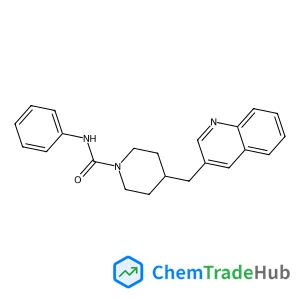
N-phenyl-4-(quinolin-3-ylmethyl)piperidine-1-carboxamide
CAS Number:
959151-50-9
Molecular Formula:
C22H23N3O
Adriano Sacco, Angelica Chiodoni, Valentina Cauda, Guido Saracco
Titanium dioxide (TiO2) and zinc oxide (ZnO) nanostructures have been widely used as photo-catalysts due to their low-cost, high surface area, robustness, abundance and non-toxicity. In this work, four TiO2 and ZnO-based nanostructures, i.e. TiO2 nanoparticles (TiO2 NPs), TiO2 nanotubes (TiO2 NTs), ZnO nanowires (ZnO NWs) and ZnO@TiO2 core–shell structures, specifically prepared with a fixed thickness of about 1.5 μm, are compared for the solar-driven water splitting reaction, under AM1.5G simulated sunlight. Complete characterization of these photo-electrodes in their structural and photo-electrochemical properties was carried out. Both TiO2 NPs and NTs showed photo-current saturation reaching 0.02 and 0.12 mA cm−2, respectively, for potential values of about 0.3 and 0.6 V vs. RHE. In contrast, the ZnO NWs and the ZnO@TiO2 core–shell samples evidence a linear increase of the photocurrent with the applied potential, reaching 0.45 and 0.63 mA cm−2 at 1.7 V vs. RHE, respectively. However, under concentrated light conditions, the TiO2 NTs demonstrate a higher increase of the performance with respect to the ZnO@TiO2 core–shells. Such material-dependent behaviours are discussed in relation with the different charge transport mechanisms and interfacial reaction kinetics, which were investigated through electrochemical impedance spectroscopy. The role of key parameters such as electronic properties, specific surface area and photo-catalytic activity in the performance of these materials is discussed. Moreover, proper optimization strategies are analysed in view of increasing the efficiency of the best performing TiO2 and ZnO-based nanostructures, toward their practical application in a solar water splitting device.

Molecular Diversity

Contact Lens & Anterior Eye

Faraday Discussions

Green Chemistry

Journal of Enzyme inhibition and Medicinal Chemistry

Current Pharmaceutical Biotechnology

Mini-Reviews in Medicinal Chemistry

Environmental Toxicology and Pharmacology

Advanced Engineering Materials

European Journal of Organic Chemistry
DOI: 10.1039/B203010A
Dezső Boda, David D. Busath, Bob Eisenberg, Douglas Henderson, Wolfgang Nonner
DOI: 10.1039/B203686J
Horst Hippler, Béla Viskolcz
DOI: 10.1039/B201883G
Weidong Zhou, D. P. Seccombe, R. P. Tuckett
DOI: 10.1039/B206093K
Douglas Henderson, Robert S. Eisenberg
DOI: 10.1039/B203184A
Laurent Joubert, Paul L. A. Popelier
DOI: 10.1039/B204485D
Martina Kieninger, Oscar N. Ventura
DOI: 10.1039/B204643A
N. Al-Rubaiey, R. Becerra, R. Walsh
DOI: 10.1039/B204508G
Patrick Gélin, Laurent Périer-Camby, Hélène Praliaud, Gérard Thomas
DOI: 10.1039/B206336K
Nicholas T. Wilson, Roy L. Johnston
DOI: 10.1039/B204460A
Waste containing 2-Ethyl-4-Methyl-1H-Imidazole-5-Carbaldehyde (CAS: 88634-80-4) ...
Triethoxy(octyl)silane (CAS: 1385031-14-0) is widely used in the pharmaceuticals...
Several alternatives to 3-iodo-7-nitro-1H-indazole (CAS: 864724-64-1) exist in t...
Yes, there are alternatives to Benzene, bis[(trimethoxysilyl)ethyl] (CAS: 266317...
Isothiazole-3-carbonitrile (CAS: 1452-17-1) is generally considered safe when us...
(3-Chlorophenyl)methanol (CAS: 873-63-2) is considered low to moderately toxic. ...
(2S,3S)-2-Hydroxy-3-({[(2-methyl-2-propanyl)oxy]carbonyl}amino)-3-(2-naphthyl)pr...
Proper handling of methyl 2-(bromomethyl)-5-methoxybenzoate requires the use of ...
6,8-Dibromoimidazo[1,2-a]pyridine-2-carboxylic acid (CAS: 904805-36-3) is an aro...
3-Amino-5-bromo-2-pyridinecarbonitrile is considered safe when handled under pro...

Physical Chemistry Chemical Physics (PCCP) is an international journal co-owned by 19 physical chemistry and physics societies from around the world. This journal publishes original, cutting-edge research in physical chemistry, chemical physics and biophysical chemistry. To be suitable for publication in PCCP, articles must include significant innovation and/or insight into physical chemistry; this is the most important criterion that reviewers and Editors will judge against when evaluating submissions. The journal has a broad scope and welcomes contributions spanning experiment, theory, computation and data science. Topical coverage includes spectroscopy, dynamics, kinetics, statistical mechanics, thermodynamics, electrochemistry, catalysis, surface science, quantum mechanics, quantum computing and machine learning. Interdisciplinary research areas such as polymers and soft matter, materials, nanoscience, energy, surfaces/interfaces, and biophysical chemistry are welcomed if they demonstrate significant innovation and/or insight into physical chemistry. Joined experimental/theoretical studies are particularly appreciated when complementary and based on up-to-date approaches.