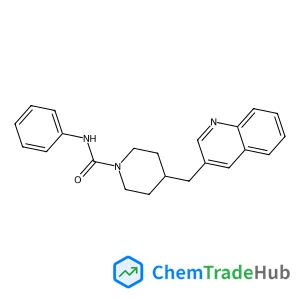
N-phenyl-4-(quinolin-3-ylmethyl)piperidine-1-carboxamide
CAS Number:
959151-50-9
Molecular Formula:
C22H23N3O
Douglas Henderson, Robert S. Eisenberg
Many biological ion channels preferentially conduct large ions over small ions. Here we propose a simple mechanism for this large-particle selectivity. Size selectivity is examined using a hard-sphere model of a binary fluid in a two-compartment system that represents a bath and the selective section of a channel (filter). The solvent is assigned a small repulsive excess chemical potential in the filter. Under these conditions, larger solutes are absorbed into the filter in greater numbers than small solutes because of a negative pressure difference between the filter and the bath. To model the selectivity of ion channels, we extend the model to a hard-sphere electrolyte and a filter that contains, in addition to particles exchanged with the bath, structural ions that are confined to the filter and introduce charge selectivity. This system also selects for the larger ions. For this system, the pressure in the filter varies greatly as a function of bath concentration. Because this would result in large forces acting on the channel protein, we also consider a constant-pressure system and allow the volume to vary. In that case, we observe ion concentration-dependent increases in filter volume and ion density that result in conductance properties observed in some channels.
Konrad Swiderski, Andrew McLean, Charles M. Gordon, D. H. Vaughan
DOI: 10.1039/B315781D
Paul L. Burn, Graham R. Webster
DOI: 10.1039/B312936E
T. H. Samuel Tan, David T. Hickman, Jordi Morral, Ian G. Beadham, Jason Micklefield
DOI: 10.1039/B315768G
Noureddine Khiar, Cristina S. Araújo, Bélen Suárez, Eleuterio Alvarez, Inmaculada Fernández
DOI: 10.1039/B313798H
Qun Tang, Wenjia Zhou, Jianmin Shen, Wu Zhang, Lingfen Kong
DOI: 10.1039/B313387G
Concepción López, Amparo Caubet, Sonia Pérez, Xavier Solans, Mercè Font-Bardía
DOI: 10.1039/B315157C
Delphine Mathieu, Yves-Michel Frapart, Jean François Bartoli, Jean-Luc Boucher, Pierrette Battioni, Daniel Mansuy
DOI: 10.1039/B312441J
Fuquan Song, Roderick D. Cannon, Manfred Bochmann
DOI: 10.1039/B314845A
M. A. Ulla, E. Miro, R. Mallada, J. Coronas, J. Santamaría
DOI: 10.1039/B315386J
Christopher D. Entwistle, Andrei S. Batsanov, Judith A. K. Howard, Mark A. Fox, Todd B. Marder
DOI: 10.1039/B316250H
Waste containing 2-Ethyl-4-Methyl-1H-Imidazole-5-Carbaldehyde (CAS: 88634-80-4) ...
Triethoxy(octyl)silane (CAS: 1385031-14-0) is widely used in the pharmaceuticals...
Several alternatives to 3-iodo-7-nitro-1H-indazole (CAS: 864724-64-1) exist in t...
Yes, there are alternatives to Benzene, bis[(trimethoxysilyl)ethyl] (CAS: 266317...
Isothiazole-3-carbonitrile (CAS: 1452-17-1) is generally considered safe when us...
(3-Chlorophenyl)methanol (CAS: 873-63-2) is considered low to moderately toxic. ...
(2S,3S)-2-Hydroxy-3-({[(2-methyl-2-propanyl)oxy]carbonyl}amino)-3-(2-naphthyl)pr...
Proper handling of methyl 2-(bromomethyl)-5-methoxybenzoate requires the use of ...
6,8-Dibromoimidazo[1,2-a]pyridine-2-carboxylic acid (CAS: 904805-36-3) is an aro...
3-Amino-5-bromo-2-pyridinecarbonitrile is considered safe when handled under pro...

Physical Chemistry Chemical Physics (PCCP) is an international journal co-owned by 19 physical chemistry and physics societies from around the world. This journal publishes original, cutting-edge research in physical chemistry, chemical physics and biophysical chemistry. To be suitable for publication in PCCP, articles must include significant innovation and/or insight into physical chemistry; this is the most important criterion that reviewers and Editors will judge against when evaluating submissions. The journal has a broad scope and welcomes contributions spanning experiment, theory, computation and data science. Topical coverage includes spectroscopy, dynamics, kinetics, statistical mechanics, thermodynamics, electrochemistry, catalysis, surface science, quantum mechanics, quantum computing and machine learning. Interdisciplinary research areas such as polymers and soft matter, materials, nanoscience, energy, surfaces/interfaces, and biophysical chemistry are welcomed if they demonstrate significant innovation and/or insight into physical chemistry. Joined experimental/theoretical studies are particularly appreciated when complementary and based on up-to-date approaches.