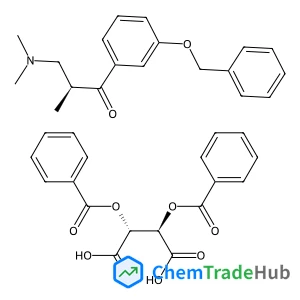
(S)-1-(3-(Benzyloxy)phenyl)-3-(dimethylamino)-2-methylpropan-1-one (2r,3r)-2,3-bis(benzoyloxy)succinate
CAS Number:
1004315-81-4
Molecular Formula:
C37H37NO10
Nguyen Minh Kha, Ching-Hsiang Chen, Wei-Nien Su, John Rick
SiO2 coated silver nanocubes Ag@SiO2 with enhanced surface-enhanced Raman scattering (SERS) and metal enhanced photoluminescence (MEPL) sensitivity were synthesized and characterized. The silver nanocubes (NCs) were synthesized by the polyol method and modified, first with different coupling agents, such as 3-mercaptopropyltrimethoxysilane (MPTMS) and 3-aminopropyltrimethoxysilane (APS), and secondly with tetraethylorthosilicate (TEOS) to improve their SERS and photoluminescence (PL) performances. The SERS and PL intensity of rhodamine 6G (R6G) can be manipulated by tuning the Ag nanocube's SiO2 shell thickness. Modified Ag NCs (with a 2 nm silica layer) were prepared using 1 mM APS and 1 mM TEOS and found to have a SERS intensity 3 fold higher than bare Ag NCs. Additionally, it was found that APS modified Ag@SiO2 NCs possessed both enhanced SERS and PL intensities.
Narendra M. Adhikari, Uvinduni I. Premadasa, Katherine L. A. Cimatu
DOI: 10.1039/C7CP03113K
Alberto Figueroba, Albert Bruix, Gábor Kovács
DOI: 10.1039/C7CP02820B
F. Philippi, J. Zapp
DOI: 10.1039/C7CP04552B
Ibério de P. R. Moreira, Francesc Illas
DOI: 10.1039/C7CP04145D
Ting Hu, Jian Zhou, Jinming Dong
DOI: 10.1039/C7CP03558F
I. Palacio, A. L. Pinardi, J. I. Martínez, A. Preobrajenski, A. Cossaro, A. Jancarik, I. Stará, I. Starý, J. Méndez, J. A. Martín-Gago, M. F. López
DOI: 10.1039/C7CP03955G
Yuanyuan Qu, Mingwen Zhao
DOI: 10.1039/C7CP03422A
Takeyoshi Goto, Krzysztof B. Beć, Yukihiro Ozaki
DOI: 10.1039/C7CP01766A
Debdutta Chakraborty, Ranjita Das, Pratim Kumar Chattaraj
DOI: 10.1039/C7CP02433A
6-(3-Fluorophenyl)picolinic acid is generally considered safe for laboratory use...
(3R)-3-Pyrrolidinol is used in the pharmaceutical industry as a precursor for dr...
When handling (4R,5R)-4,5-Diethoxycarbonyl-2,2-dimethyldioxolane (CAS: 59779-75-...
1-(6-Chloroimidazo[1,2-b]pyridazin-3-yl)ethanone is often synthesized via a mult...
The market for N-Ethyl-3,4-dimethylbenzylamine (CAS: 39180-83-1) remains steady,...
Tert-butyl 3-(pyrrolidin-1-yl)azetidine-1-carboxylate is a chemical compound wit...
1-Bromo-3-chloro-2,4-dimethoxybenzene (CAS: 1228956-93-1) falls under the classi...
The safety of 8-Bromo-2-methyl-3,4-dihydroisoquinolin-1(2H)-one (CAS: 1368622-07...
Benzyl [(3S)-2,6-dioxo-3-piperidinyl]carbamate is generally safe when handled wi...
1-{[4-(4,4,5,5-Tetramethyl-1,3,2-dioxaborolan-2-yl)phenyl]sulfonyl}pyrrolidine s...

Physical Chemistry Chemical Physics (PCCP) is an international journal co-owned by 19 physical chemistry and physics societies from around the world. This journal publishes original, cutting-edge research in physical chemistry, chemical physics and biophysical chemistry. To be suitable for publication in PCCP, articles must include significant innovation and/or insight into physical chemistry; this is the most important criterion that reviewers and Editors will judge against when evaluating submissions. The journal has a broad scope and welcomes contributions spanning experiment, theory, computation and data science. Topical coverage includes spectroscopy, dynamics, kinetics, statistical mechanics, thermodynamics, electrochemistry, catalysis, surface science, quantum mechanics, quantum computing and machine learning. Interdisciplinary research areas such as polymers and soft matter, materials, nanoscience, energy, surfaces/interfaces, and biophysical chemistry are welcomed if they demonstrate significant innovation and/or insight into physical chemistry. Joined experimental/theoretical studies are particularly appreciated when complementary and based on up-to-date approaches.
![5-Bromo-3-isopropyl-1H-pyrrolo[2,3-b]pyridine structure](https://static.chemtradehub.com/structs/125/1256819-54-1-8620.webp "5-Bromo-3-isopropyl-1H-pyrrolo[2,3-b]pyridine structure")