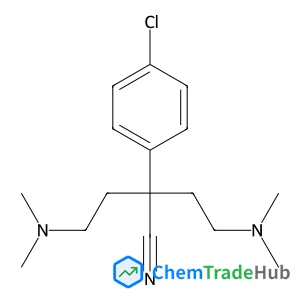
2-(4-Chlorophenyl)-4-(dimethylamino)-2-(2-(dimethylamino)ethyl)butanenitrile
CAS Number:
1246816-57-8
Molecular Formula:
C16H24ClN3
M. Sparenberg, A. Zykov, P. Beyer, L. Pithan, C. Weber, Y. Garmshausen, F. Carlà, S. Hecht, S. Blumstengel, F. Henneberger, S. Kowarik
We report on the impact of partial fluorination of para-sexiphenyl (6P) on the growth mode when deposited on the non-polar ZnO(100) surface. The evolution of the thin film structure and morphology is monitored by in situ atomic force microscopy and in situ real-time X-ray scattering. Both 6P and its symmetrical, terminally fluorinated derivative (6P-F4) grow in a highly crystalline mode, however, with a distinctly different morphology. While 6P films are characterised by the formation of two different phases with three-dimensional nanocrystallites and consequently a rather rough surface morphology, layer-by-layer growth and phase purity in case of 6P-F4 prevails leading to smooth terraced thin films. We relate the different growth behaviour to specifics of the thin film structure.
Aurélien Bornet, Sami Jannin
DOI: 10.1039/C5CP07884A
Juliano Katrib, Paula A. Palade, Neil R. Champness, Samuel W. Kingman
DOI: 10.1039/C5CP05426E
DOI: 10.1039/C5CP07724A
Jung Ho Lee, Jinfa Ying, Ad Bax
DOI: 10.1039/C5CP04542H
Jing-Jing Huang, Yong J. Yuan
DOI: 10.1039/C6CP00167J
Elamparuthi Ramasamy, Yohei Ishida, Vaidhyanathan Ramamurthy
DOI: 10.1039/C5CP06984J
Christophe Garagnon, Valerie Serradeil
DOI: 10.1039/C6CP00972G
Simon Kujawski, Arndt Remhof, Yigang Yan, Nicholas P. Stadie, Ali Al-Zein, Metin Tolan, Simo Huotari, Michael Krisch, Christian Sternemann
DOI: 10.1039/C5CP06571B
Anna Pougin, Martin Dilla
DOI: 10.1039/C5CP07148H
Susmita Maiti, Somashree Kundu, Debasmita Ghosh, Somrita Mondal, Chandra Nath Roy, Abhijit Saha
DOI: 10.1039/C5CP05799J
This compound is mainly used as an intermediate in the synthesis of antipsychoti...
Waste containing 1-(D-Ribofuranosyl)-1,4-dihydro-3-pyridinecarboxamide (CAS: 191...
2-Methyl-2-propanyl 3-bromo-3-(hydroxymethyl)-1-azetidinecarboxylate (CAS: 20079...
N-(4-Chloro-2-pyridinyl)acetamide (CAS: 245056-66-0) is a chemical compound with...
5-Chloro-2-hydroxybenzoic acid, also known as 5-chlorosalicylic acid, is an arom...
When handling 1,1-Dichloro-1-fluoroethane (CAS: 1717-00-6), it is important to u...
Fmoc-(2S,3R)-3-phenylpyrrolidine-2-carboxylic acid is a white crystalline solid ...
4-Amino-5-bromo-2-pyridinecarboxylic acid is primarily used as a precursor in th...
Handling this compound should be done with personal protective equipment (PPE) i...
When handling 8-bromo-2,2-dimethyl-3,4-dihydro-2H-1,4-benzoxazin-3-one, use prop...

Physical Chemistry Chemical Physics (PCCP) is an international journal co-owned by 19 physical chemistry and physics societies from around the world. This journal publishes original, cutting-edge research in physical chemistry, chemical physics and biophysical chemistry. To be suitable for publication in PCCP, articles must include significant innovation and/or insight into physical chemistry; this is the most important criterion that reviewers and Editors will judge against when evaluating submissions. The journal has a broad scope and welcomes contributions spanning experiment, theory, computation and data science. Topical coverage includes spectroscopy, dynamics, kinetics, statistical mechanics, thermodynamics, electrochemistry, catalysis, surface science, quantum mechanics, quantum computing and machine learning. Interdisciplinary research areas such as polymers and soft matter, materials, nanoscience, energy, surfaces/interfaces, and biophysical chemistry are welcomed if they demonstrate significant innovation and/or insight into physical chemistry. Joined experimental/theoretical studies are particularly appreciated when complementary and based on up-to-date approaches.
![tert-Butyl N-[(2-chloropyridin-4-yl)methyl]carbamate structure](https://static.chemtradehub.com/structs/916/916210-27-0-9f95.webp "tert-Butyl N-[(2-chloropyridin-4-yl)methyl]carbamate structure")