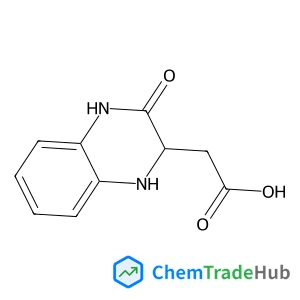
(3-Oxo-1,2,3,4-tetrahydro-2-quinoxalinyl)acetic acid
CAS Number:
136584-14-0
Molecular Formula:
C10H10N2O3
Elamparuthi Ramasamy, Yohei Ishida, Vaidhyanathan Ramamurthy
To achieve the goal of energy transfer and subsequent electron transfer across three molecules, a phenomenon often utilized in artificial light harvesting systems, we have assembled a light absorber (that also serves as an energy donor), an energy acceptor (that also serves as an electron donor) and an electron acceptor on the surface of an anionic clay nanosheet. Since neutral organic molecules have no tendency to adsorb onto the anionic surface of clay, a positively charged water-soluble organic capsule was used to hold neutral light absorbers on the above surface. A three-component assembly was prepared by the co-adsorption of a cationic bipyridinium derivative, cationic zinc porphyrin and cationic octaamine encapsulated 2-acetylanthracene on an exfoliated anionic clay surface in water. Energy and electron transfer phenomena were monitored by steady state fluorescence and picosecond time resolved fluorescence decay. The excitation of 2-acetylanthracene in the three-component system resulted in energy transfer from 2-acetylanthracene to zinc porphyrin with 71% efficiency. Very little loss due to electron transfer from 2-acetylanthracene in the cavitand to the bipyridinium derivative was noticed. Energy transfer was followed by electron transfer from the zinc porphyrin to the cationic bipyridinium derivative with 81% efficiency. Analyses of fluorescence decay profiles confirmed the occurrence of energy transfer and subsequent electron transfer. Merging the concepts of supramolecular chemistry and surface chemistry we realized sequential energy and electron transfer between three hydrophobic molecules in water. Exfoliated transparent saponite clay served as a matrix to align the three photoactive molecules at a close distance in aqueous solutions.
Siming Wang, Ronny William, Kim Kui Georgina Estelle Seah, Xue-Wei Liu
DOI: 10.1039/C3GC41032C
Masoumeh Taherimehr, Syed M. Al-Amsyar, Christopher J. Whiteoak, Paolo P. Pescarmona
DOI: 10.1039/C3GC41303A
Ariel I. Horowitz, Yushi Wang, Matthew J. Panzer
DOI: 10.1039/C3GC41661E
Jan Dijkmans, Dries Gabriëls, Michiel Dusselier, Filip de Clippel, Pieter Vanelderen, Kristof Houthoofd, Annelies Malfliet, Yiannis Pontikes, Bert F. Sels
DOI: 10.1039/C3GC41239C
Sebastian Wertz, Armido Studer
DOI: 10.1039/C3GC41459K
Subrata Chattopadhyay, Helmut Keul, Martin Moeller
DOI: 10.1039/C3GC41406J
Yu Wei, Jinghua Tang, Xuefeng Cong, Xiaoming Zeng
DOI: 10.1039/C3GC41403E
Andreas J. Kunov-Kruse, Anders Riisager, Shunmugavel Saravanamurugan, Rolf W. Berg, Steffen B. Kristensen, Rasmus Fehrmann
DOI: 10.1039/C3GC41174E
Yupu Qiao, Allan D. Headley
DOI: 10.1039/C3GC41024B
This compound is mainly used as an intermediate in the synthesis of antipsychoti...
Waste containing 1-(D-Ribofuranosyl)-1,4-dihydro-3-pyridinecarboxamide (CAS: 191...
2-Methyl-2-propanyl 3-bromo-3-(hydroxymethyl)-1-azetidinecarboxylate (CAS: 20079...
N-(4-Chloro-2-pyridinyl)acetamide (CAS: 245056-66-0) is a chemical compound with...
5-Chloro-2-hydroxybenzoic acid, also known as 5-chlorosalicylic acid, is an arom...
When handling 1,1-Dichloro-1-fluoroethane (CAS: 1717-00-6), it is important to u...
Fmoc-(2S,3R)-3-phenylpyrrolidine-2-carboxylic acid is a white crystalline solid ...
4-Amino-5-bromo-2-pyridinecarboxylic acid is primarily used as a precursor in th...
Handling this compound should be done with personal protective equipment (PPE) i...
When handling 8-bromo-2,2-dimethyl-3,4-dihydro-2H-1,4-benzoxazin-3-one, use prop...

Physical Chemistry Chemical Physics (PCCP) is an international journal co-owned by 19 physical chemistry and physics societies from around the world. This journal publishes original, cutting-edge research in physical chemistry, chemical physics and biophysical chemistry. To be suitable for publication in PCCP, articles must include significant innovation and/or insight into physical chemistry; this is the most important criterion that reviewers and Editors will judge against when evaluating submissions. The journal has a broad scope and welcomes contributions spanning experiment, theory, computation and data science. Topical coverage includes spectroscopy, dynamics, kinetics, statistical mechanics, thermodynamics, electrochemistry, catalysis, surface science, quantum mechanics, quantum computing and machine learning. Interdisciplinary research areas such as polymers and soft matter, materials, nanoscience, energy, surfaces/interfaces, and biophysical chemistry are welcomed if they demonstrate significant innovation and/or insight into physical chemistry. Joined experimental/theoretical studies are particularly appreciated when complementary and based on up-to-date approaches.
![6-Benzyl-4,5,6,7-tetrahydro-1H-pyrazolo[3,4-c]pyridin-3(2H)-one structure](https://static.chemtradehub.com/structs/909/909187-64-0-f54f.webp "6-Benzyl-4,5,6,7-tetrahydro-1H-pyrazolo[3,4-c]pyridin-3(2H)-one structure")