












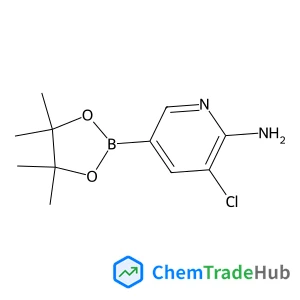
3-Chloro-5-(4,4,5,5-tetramethyl-1,3,2-dioxaborolan-2-yl)-2-pyridinamine
CAS Number:
1032758-99-8
Molecular Formula:
C11H16BClN2O2
Juliano Katrib, Paula A. Palade, Neil R. Champness, Samuel W. Kingman
Preparation of metal organic frameworks (MOFs) via microwave heating is becoming increasingly popular due to reduced reaction times and enhanced control of MOF particle size. However, there is little understanding about the detailed interaction of the electric field portion of the wave with reactants during the synthesis of MOFs. In order to overcome this lack of fundamental understanding, information about the dielectric properties of the reactants is required. In this work the dielectric constants (ε′) and loss factors (ε′′) of benzene-1,4-dicarboxylic acid (H2BDC; also known as terephthalic acid) and a number of M(III) (M = metal) salts dissolved in deionized water were measured as a function of frequency, temperature and concentration and with varying anions and cations. Dielectric data confirm the aqueous M(III) salts to be strong microwave absorbers, particularly at 915 MHz. M(III) salts with mono-anionic ligands (for example chlorides and nitrates) exhibit higher losses than di-anionic salts (sulfates) demonstrating that the former are heated more effectively in an applied microwave field. Of the M(III) salts containing either singly- or doubly-charged anions, those containing Fe(III) have the highest loss indicating that they will heat more efficiently than other M(III) salts such as Cr(III) and Al(III). Interestingly, H2BDC exhibits little interaction with the electric field at microwave frequencies.
Fang Zhang, Chao Liang, Mingzheng Chen, Haibing Guo, Huangyong Jiang, Hexing Li
DOI: 10.1039/C3GC41020J
Martta Asikainen, Olli Jauhiainen, Olli Aaltonen, Ali Harlin
DOI: 10.1039/C3GC41224E
Wentao Wang, Aiqin Wang, Yitao Cui, Xiaofeng Yang, Yanqiang Huang, Xiaoyan Liu, Wengang Liu, Jin-Young Son, Hiroshi Oji, Tao Zhang
DOI: 10.1039/C3GC41117F
Atul Kumar, Deepti Saxena, Maneesh Kumar Gupta
DOI: 10.1039/C3GC41101J
Siva S. Panda, Alexander A. Oliferenko
DOI: 10.1039/C3GC41255E
Patrícia Neves, Margarida M. Antunes, Patrícia A. Russo, Joana P. Abrantes, Sérgio Lima, Auguste Fernandes, Martyn Pillinger, Sílvia M. Rocha, Maria F. Ribeiro, Anabela A. Valente
DOI: 10.1039/C3GC41908H
Michelangelo Gruttadauria, Francesco Giacalone, Renato Noto
DOI: 10.1039/C3GC41132J
Subrata Chattopadhyay, Helmut Keul, Martin Moeller
DOI: 10.1039/C3GC41406J
This compound is mainly used as an intermediate in the synthesis of antipsychoti...
Waste containing 1-(D-Ribofuranosyl)-1,4-dihydro-3-pyridinecarboxamide (CAS: 191...
2-Methyl-2-propanyl 3-bromo-3-(hydroxymethyl)-1-azetidinecarboxylate (CAS: 20079...
N-(4-Chloro-2-pyridinyl)acetamide (CAS: 245056-66-0) is a chemical compound with...
5-Chloro-2-hydroxybenzoic acid, also known as 5-chlorosalicylic acid, is an arom...
When handling 1,1-Dichloro-1-fluoroethane (CAS: 1717-00-6), it is important to u...
Fmoc-(2S,3R)-3-phenylpyrrolidine-2-carboxylic acid is a white crystalline solid ...
4-Amino-5-bromo-2-pyridinecarboxylic acid is primarily used as a precursor in th...
Handling this compound should be done with personal protective equipment (PPE) i...
When handling 8-bromo-2,2-dimethyl-3,4-dihydro-2H-1,4-benzoxazin-3-one, use prop...

Physical Chemistry Chemical Physics (PCCP) is an international journal co-owned by 19 physical chemistry and physics societies from around the world. This journal publishes original, cutting-edge research in physical chemistry, chemical physics and biophysical chemistry. To be suitable for publication in PCCP, articles must include significant innovation and/or insight into physical chemistry; this is the most important criterion that reviewers and Editors will judge against when evaluating submissions. The journal has a broad scope and welcomes contributions spanning experiment, theory, computation and data science. Topical coverage includes spectroscopy, dynamics, kinetics, statistical mechanics, thermodynamics, electrochemistry, catalysis, surface science, quantum mechanics, quantum computing and machine learning. Interdisciplinary research areas such as polymers and soft matter, materials, nanoscience, energy, surfaces/interfaces, and biophysical chemistry are welcomed if they demonstrate significant innovation and/or insight into physical chemistry. Joined experimental/theoretical studies are particularly appreciated when complementary and based on up-to-date approaches.
![Methyl 4-({[(2-methyl-2-propanyl)oxy]carbonyl}amino)bicyclo[2.2.2]octane-1-carboxylate structure](https://static.chemtradehub.com/structs/943/943845-74-7-b7e5.webp "Methyl 4-({[(2-methyl-2-propanyl)oxy]carbonyl}amino)bicyclo[2.2.2]octane-1-carboxylate structure")



