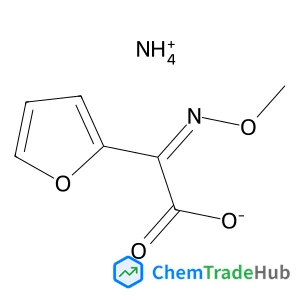
Ammonium (Z)-2-(furan-2-yl)-2-(methoxyimino)acetate
CAS Number:
97148-39-5
Molecular Formula:
C7H10N2O4
Vojtěch Mlýnský, Nils G. Walter
The hepatitis delta virus (HDV) ribozyme is a catalytic RNA motif embedded in the human pathogenic HDV RNA. It catalyzes self-cleavage of its sugar-phosphate backbone with direct participation of the active site cytosine C75. Biochemical and structural data support a general acid role of C75. Here, we used hybrid quantum mechanical/molecular mechanical (QM/MM) calculations to probe the reaction mechanism and changes in Gibbs energy along the ribozyme's reaction pathway with an N3-protonated C75H+ in the active site, which acts as the general acid, and a partially hydrated Mg2+ ion with one deprotonated, inner-shell coordinated water molecule that acts as the general base. We followed eight reaction paths with a distinct position and coordination of the catalytically important active site Mg2+ ion. For six of them, we observed feasible activation barriers ranging from 14.2 to 21.9 kcal mol−1, indicating that the specific position of the Mg2+ ion in the active site is predicted to strongly affect the kinetics of self-cleavage. The deprotonation of the U-1(2′-OH) nucleophile and the nucleophilic attack of the resulting U-1(2′-O−) on the scissile phosphodiester are found to be separate steps, as deprotonation precedes the nucleophilic attack. This sequential mechanism of the HDV ribozyme differs from the concerted nucleophilic activation and attack suggested for the hairpin ribozyme. We estimate the pKa of the U-1(2′-OH) group to range from 8.8 to 11.2, suggesting that it is lowered by several units from that of a free ribose, comparable to and most likely smaller than the pKa of the solvated active site Mg2+ ion. Our results thus support the notion that the structure of the HDV ribozyme, and particularly the positioning of the active site Mg2+ ion, facilitate deprotonation and activation of the 2′-OH nucleophile.
Andrei Parvulescu, Dirk De Vos, Pierre Jacobs
DOI: 10.1039/B509747A
Christoforos G. Kokotos, Varinder K. Aggarwal
DOI: 10.1039/B602226J
Elizabeta Amir, Shlomo Rozen
DOI: 10.1039/B602594C
Mark L. Hlavinka, Jeffrey F. Greco, John R. Hagadorn
DOI: 10.1039/B509190J
Marc Sallé, Jean-Yves Balandier, Franck Le Derf, Eric Levillain, Magali Allain, Pascal Viel, Serge Palacin
DOI: 10.1039/B518275A
Benjamin E. Ketz, Xavier G. Ottenwaelder, Robert M. Waymouth
DOI: 10.1039/B511202H
Beatriz García-Acosta, María Comes, Julia L. Bricks, Margarita A. Kudinova, Vladimir V. Kurdyukov, Alexei I. Tolmachev, M. Dolores Marcos, Ramón Martínez-Máñez, Ana Moreno, Félix Sancenón, Juan Soto, Luis A. Villaescusa, Knut Rurack, José M. Barat, Isabel Escriche, Pedro Amorós
DOI: 10.1039/B602497A
Jonathan Sperry
DOI: 10.1039/B604294E
Vladimir Sindelar, Serena Silvi, Angel E. Kaifer
DOI: 10.1039/B601959E
1H-Indazole-6-carbonitrile finds applications in pharmaceuticals, where it serve...
Waste containing Dioctyl (2E)-2-butenedioate (CAS: 2997-85-5) should be collecte...
Sodium [(1,2-benzoxazol-3-ylmethyl)sulfonyl]azanide is primarily used in pharmac...
Dimethyl 4-(4,4,5,5-tetramethyl-1,3,2-dioxaborolan-2-yl)-2,6-pyridinedicarboxyla...
Waste containing 2-Fluoro-6-hydrazinopyridine (CAS: 80714-39-2) should be manage...
6-Formyl-2-pyridinecarboxylic acid is an organic compound with the molecular for...
Research trends for this compound indicate a focus on its potential applications...
9H-Tribenzo[b,d,f]azepine is typically synthesized via a multi-step process invo...
1-Cyclopropyl-7-ethoxy-6-fluoro-8-methoxy-4-oxo-1,4-dihydro-3-quinolinecarboxyli...
Waste containing Methyl 3-oxo-1,2,3,4-tetrahydro-6-quinoxalinecarboxylate (CAS: ...

Physical Chemistry Chemical Physics (PCCP) is an international journal co-owned by 19 physical chemistry and physics societies from around the world. This journal publishes original, cutting-edge research in physical chemistry, chemical physics and biophysical chemistry. To be suitable for publication in PCCP, articles must include significant innovation and/or insight into physical chemistry; this is the most important criterion that reviewers and Editors will judge against when evaluating submissions. The journal has a broad scope and welcomes contributions spanning experiment, theory, computation and data science. Topical coverage includes spectroscopy, dynamics, kinetics, statistical mechanics, thermodynamics, electrochemistry, catalysis, surface science, quantum mechanics, quantum computing and machine learning. Interdisciplinary research areas such as polymers and soft matter, materials, nanoscience, energy, surfaces/interfaces, and biophysical chemistry are welcomed if they demonstrate significant innovation and/or insight into physical chemistry. Joined experimental/theoretical studies are particularly appreciated when complementary and based on up-to-date approaches.