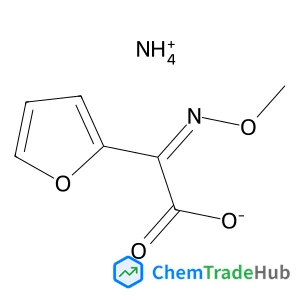
Ammonium (Z)-2-(furan-2-yl)-2-(methoxyimino)acetate
CAS Number:
97148-39-5
Molecular Formula:
C7H10N2O4
Beatriz García-Acosta, María Comes, Julia L. Bricks, Margarita A. Kudinova, Vladimir V. Kurdyukov, Alexei I. Tolmachev, M. Dolores Marcos, Ramón Martínez-Máñez, Ana Moreno, Félix Sancenón, Juan Soto, Luis A. Villaescusa, Knut Rurack, José M. Barat, Isabel Escriche, Pedro Amorós
Pyrylium-containing mesoporous materials have been used for the chromo-fluorogenic sensing of biogenic amines in an aqueous environment.
DOI: 10.1039/JA9900500239
Youzeng Li, Pengfei Yan, Jun Chen, Yumei Ren, Yannan Zhou, Tianpei Ge, Jun Chen
DOI: 10.1039/C9CC06550D
G. Dan Pantoş, Jeremy K. M. Sanders, Michele Orlandi, Claudio Chiorboli, Sandro Fracasso
DOI: 10.1039/C0SC00520G
Run Hao, Yameng Liu, Rugang Zhong
DOI: 10.1039/C3AY41494A
Giancarla Alberti, Valeria M. Nurchi, Lisa R. Magnaghi, Raffaela Biesuz
DOI: 10.1039/C9AY01538H
Serge Kokot
DOI: 10.1039/C4AY02115K
Xin Wu, Bo Li, Chu-Chen Chueh
DOI: 10.1039/D1CS00841B
1H-Indazole-6-carbonitrile finds applications in pharmaceuticals, where it serve...
Waste containing Dioctyl (2E)-2-butenedioate (CAS: 2997-85-5) should be collecte...
Sodium [(1,2-benzoxazol-3-ylmethyl)sulfonyl]azanide is primarily used in pharmac...
Dimethyl 4-(4,4,5,5-tetramethyl-1,3,2-dioxaborolan-2-yl)-2,6-pyridinedicarboxyla...
Waste containing 2-Fluoro-6-hydrazinopyridine (CAS: 80714-39-2) should be manage...
6-Formyl-2-pyridinecarboxylic acid is an organic compound with the molecular for...
Research trends for this compound indicate a focus on its potential applications...
9H-Tribenzo[b,d,f]azepine is typically synthesized via a multi-step process invo...
1-Cyclopropyl-7-ethoxy-6-fluoro-8-methoxy-4-oxo-1,4-dihydro-3-quinolinecarboxyli...
Waste containing Methyl 3-oxo-1,2,3,4-tetrahydro-6-quinoxalinecarboxylate (CAS: ...

ChemComm publishes urgent research which is of outstanding significance and interest to experts in the field, while also appealing to the journal’s broad chemistry readership. Our communication format is ideally suited to short, urgent studies that are of such importance that they require accelerated publication. Our scope covers all topics in chemistry, and research at the interface of chemistry and other disciplines (such as materials science, nanoscience, physics, engineering and biology) where there is a significant novelty in the chemistry aspects. Major topic areas covered include: Analytical Chemistry Catalysis Chemical Biology and medicinal chemistry Computational Chemistry and Machine Learning Energy and sustainable chemistry Environmental Chemistry Green Chemistry Inorganic Chemistry Materials Chemistry Nanoscience Organic Chemistry Physical Chemistry Polymer Chemistry Supramolecular Chemistry
![Sodium 3-[(E)-(4-anilinophenyl)diazenyl]benzenesulfonate structure](https://static.chemtradehub.com/structs/587/587-98-4-035f.webp "Sodium 3-[(E)-(4-anilinophenyl)diazenyl]benzenesulfonate structure")