












Tuning bio-inspired skin–core structure of nascent fiber via interplay of polymer phase transitions
Literature Information
Publication Date
2014-05-02
DOI
10.1039/C4CP00792A
Impact Factor
3.676
Authors
Qi Liu, Huanhuan Gao, Liyun Zha, Zuming Hu, Yu Ma, Muhuo Yu, Lei Chen, Wenbing Hu
View Original
Abstract
The properties of polymer fibers are determined by their inner structures. We performed dynamic Monte Carlo simulations of early-stage solidification in the fluid filaments of stretched polymer solutions after extrusion into a coagulation bath upon fiber spinning. We observed that the radial temperature gradient dominates polymer crystallization to form an oriented crystalline skin (from single to multiple layers), while the radial non-solvent influx dominates phase separation to form a concentrated but less oriented core. The skin–core structure offers fibers a balanced performance between strength and toughness similar to plant stems, which can be tuned by the interplay of phase transitions. Our molecular-level observations facilitate a systematic understanding of the microscopic mechanism of fiber-spinning, which will pave a way towards making excellent polymer fibers.
Recommended Journals
Related Literature
Networked calix[4]arenepolymers with unusual mechanical properties
Joseph N. Grima, Kenneth E. Evans
2005-07-14
Communication
DOI: 10.1039/B505839B
Analysis of key steps in the catalytic cross-coupling of alkyl electrophiles under Negishi-like conditions
Gavin D. Jones, Chris McFarland, Thomas J. Anderson, David A. Vicic
2005-07-22
Communication
DOI: 10.1039/B504996B
Biofunctionalization of fluorescent-magnetic-bifunctional nanospheres and their applications
Guo-Ping Wang, Er-Qun Song, Hai-Yan Xie, Zhi-Ling Zhang, Zhi-Quan Tian, Chao Zuo, Dai-Wen Pang, Dao-Cheng Wu, Yun-Bo Shi
2005-08-08
Communication
DOI: 10.1039/B508075D
Chiral azide-bridged two-dimensional Cu(ii) compounds showing a field-induced spin–flop transition
Young Sin You, Jung Hee Yoon, Hyoung Chan Kim, Chang Seop Hong
2005-07-15
Communication
DOI: 10.1039/B507051A
Photosensitizing properties of 2,4-dichlorobenzoic acid and chlorinated biphenyl carboxylic acids, potentially key components of chromophoric dissolved organic matter
Anne L. Boreen, Kristopher McNeill
2005-07-14
Communication
DOI: 10.1039/B506971H
PNA C–C+i-motif: superior stability of PNA TC8 tetraplexes compared to DNA TC8 tetraplexes at low pH
Nagendra K. Sharma, Krishna N. Ganesh
2005-07-13
Communication
DOI: 10.1039/B506870C
Solvolytic routes to new nonabismuth hydroxy- and alkoxy-oxo complexes: synthesis, characterization and solid-state structures of novel nonabismuth polyoxo cations Bi9(μ3-O)8(μ3-OR)65+ (R = H, Et)
John H. Thurston, Dale C. Swenson, Louis Messerle
2005-07-27
Communication
DOI: 10.1039/B504864H
Comb-shaped poly(ethylene glycol)-modified subtilisin Carlsberg is soluble and highly active in ionic liquids
Kazunori Nakashima, Tatsuo Maruyama, Noriho Kamiya, Masahiro Goto
2005-08-02
Communication
DOI: 10.1039/B505479F
Click-chemistry as an efficient synthetic tool for the preparation of novel conjugated polymers
Dirk Jan V. C. van Steenis, Olivier R. P. David, Gino P. F. van Strijdonck, Jan H. van Maarseveen, Joost N. H. Reek
2005-07-19
Communication
DOI: 10.1039/B507776A
Microporous organic crystals: an unusual case for l-leucyl–l-serine
Carl Henrik Görbitz, Mette Nilsen, Kai Szeto, Linda Wibecke Tangen
2005-07-28
Communication
DOI: 10.1039/B504976H
You might also like
Compound Q&A
How should waste containing N-Methoxy-N-methyl-1,3-thiazole-5-carboxamide (CAS: 898825-89-3) be handled?
Waste containing N-Methoxy-N-methyl-1,3-thiazole-5-carboxamide (CAS: 898825-89-3...
898825-89-3N-Methoxy-N-methyl-1...
Compound Q&A
How should N-(4-Biphenylyl)dibenzo[b,d]furan-4-amine (CAS: 1318338-47-4) be stored?
N-(4-Biphenylyl)dibenzo[b,d]furan-4-amine should be stored in a tightly sealed c...
1318338-47-4N-(4-Biphenylyl)dibe...
Compound Q&A
What is the market or research trend for 3-Acetamido-5-amino-2,4,6-triiodobenzoic acid (CAS: 1713-07-1)?
The market for 3-Acetamido-5-amino-2,4,6-triiodobenzoic acid (CAS: 1713-07-1) is...
1713-07-13-Acetamido-5-amino-...
Compound Q&A
How should Benzyl 2-O-acetyl-3,4,6-tri-O-benzyl-beta-D-galactopyranoside (CAS: 61820-03-9) be stored?
Benzyl 2-O-acetyl-3,4,6-tri-O-benzyl-beta-D-galactopyranoside (CAS: 61820-03-9) ...
61820-03-9Benzyl 2-O-acetyl-3,...
Compound Q&A
What regulatory guidelines apply to 2-Ethylpiperazine dihydrochloride (CAS: 438050-52-3)?
2-Ethylpiperazine dihydrochloride (CAS: 438050-52-3) is regulated under the Glob...
438050-52-32-Ethylpiperazine di...
Compound Q&A
What regulatory guidelines apply to 1,1'-[1,3-Phenylenebis(methylene)]bis(3-methyl-1H-pyrrole-2,5-dione) (CAS: 119462-56-5)?
1,1'-[1,3-Phenylenebis(methylene)]bis(3-methyl-1H-pyrrole-2,5-dione) (CAS: 11946...
119462-56-51,1'-[1,3-Phenyleneb...
Compound Q&A
Are there alternatives to 5-Fluoro-2-(1-pyrrolidinyl)pyridine (CAS: 1287217-79-1) in synthesis?
Several alternatives can be used in the synthesis of 5-Fluoro-2-(1-pyrrolidinyl)...
1287217-79-15-Fluoro-2-(1-pyrrol...
Compound Q&A
What precautions should be taken when handling 1-((2R,3R,4R,5R)-5-((bis(4-methoxyphenyl)(phenyl)methoxy)methyl)-4-hydroxy-3-methoxytetrahydrofuran-2-yl)-5-methylpyrimidine-2,4(1H,3H)-dione (CAS: 153631-19-7)?
Proper personal protective equipment (PPE) must be worn when handling this compo...
153631-19-71-((2R,3R,4R,5R)-5-(...
Compound Q&A
What precautions should be taken when handling 6-Bromoimidazo[1,2-a]pyridin-8-amine (CAS: 676371-00-9)?
When handling 6-Bromoimidazo[1,2-a]pyridin-8-amine, it is important to wear appr...
676371-00-96-Bromoimidazo[1,2-a...
Compound Q&A
Are there alternatives to (2S,4R)-4-(4-Nitrobenzyl)pyrrolidine-2-carboxylic acid hydrochloride (CAS: 1049740-22-8) in synthesis?
Alternatives to (2S,4R)-4-(4-Nitrobenzyl)pyrrolidine-2-carboxylic acid hydrochlo...
1049740-22-8(2S,4R)-4-(4-Nitrobe...
Source Journal
Physical Chemistry Chemical Physics

CiteScore:
5.5
Self-citation Rate:
10.3%
Articles per Year:
3036
Physical Chemistry Chemical Physics (PCCP) is an international journal co-owned by 19 physical chemistry and physics societies from around the world. This journal publishes original, cutting-edge research in physical chemistry, chemical physics and biophysical chemistry. To be suitable for publication in PCCP, articles must include significant innovation and/or insight into physical chemistry; this is the most important criterion that reviewers and Editors will judge against when evaluating submissions. The journal has a broad scope and welcomes contributions spanning experiment, theory, computation and data science. Topical coverage includes spectroscopy, dynamics, kinetics, statistical mechanics, thermodynamics, electrochemistry, catalysis, surface science, quantum mechanics, quantum computing and machine learning. Interdisciplinary research areas such as polymers and soft matter, materials, nanoscience, energy, surfaces/interfaces, and biophysical chemistry are welcomed if they demonstrate significant innovation and/or insight into physical chemistry. Joined experimental/theoretical studies are particularly appreciated when complementary and based on up-to-date approaches.
Recommended Compounds

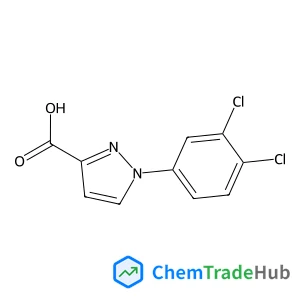
1-(3,4-Dichlorophenyl)-1H-pyrazole-3-carboxylic acid
CAS Number:
1152949-12-6
Molecular Formula:
C10H6Cl2N2O2
![[(5-Methyl-1,3,4-thiadiazol-2-yl)sulfanyl]acetic acid structure](https://static.chemtradehub.com/structs/509/50918-26-8-4ce8.webp "[(5-Methyl-1,3,4-thiadiazol-2-yl)sulfanyl]acetic acid structure")
[(5-Methyl-1,3,4-thiadiazol-2-yl)sulfanyl]acetic acid
CAS Number:
50918-26-8
Molecular Formula:
C5H6N2O2S2

5,5',5''-(((2,4,6-Trimethylbenzene-1,3,5-triyl)tris(methylene))tris(oxy))triisophthalic acid
CAS Number:
1159974-70-5
Molecular Formula:
C36H30O15
Recommended Suppliers





Disclaimer
This page provides academic journal information for reference and research purposes only. We are not affiliated with any journal publishers and do not handle publication submissions. For publication-related inquiries, please contact the respective journal publishers directly.
If you notice any inaccuracies in the information displayed, please contact us at support@chemtradehub.com. We will promptly review and address your concerns.