












PNA C–C+i-motif: superior stability of PNA TC8 tetraplexes compared to DNA TC8 tetraplexes at low pH
Literature Information
Publication Date
2005-07-13
DOI
10.1039/B506870C
Impact Factor
6.222
Authors
Nagendra K. Sharma, Krishna N. Ganesh
View Original
Abstract
Study of self-assembly of PNA TC8 monitored by UV thermal transition at 295 nm indicates formation of a C–C+ tetraplex (i-motif) in acidic pH, with higher stability than the analogous dTC8
Related Literature
N-Fluorobenzenesulfonimide as a highly effective Ag(i)-catalyst attenuator for tryptamine-derived ynesulfonamide cycloisomerization
2019-01-30
Paper
DOI: 10.1039/C9OB00059C
Palladium-catalyzed cross-coupling of (hetero)aryl or alkenyl sulfonates with aryl titanium as the multi-functional reagent
2020-03-03
Research Article
DOI: 10.1039/C9QO01537J
Chemiluminescence molecular probe with a linear chain reaction amplification mechanism
Samer Gnaim, Doron Shabat
2019-01-21
Communication
DOI: 10.1039/C8OB03042A
Iron-catalyzed asymmetric intramolecular cyclopropanation reactions using chiral tetramethyl-1,1′-spirobiindane-based bisoxazoline (TMSI-BOX) ligands
Haorui Gu, Shaoying Huang, Xufeng Lin
2019-01-09
Paper
DOI: 10.1039/C8OB03065K
Ag2O-catalysed nucleophilic isocyanation: selective formation of less-stable benzylic isonitriles
Taiga Yurino, Yuji Tange, Ryutaro Tani, Takeshi Ohkuma
2020-04-27
Research Article
DOI: 10.1039/D0QO00336K
Synthesis of a non-natural glucose-2-phosphate ester able to dupe the acc system of Agrobacterium fabrum
Si-Zhe Li, Armelle Vigouroux, Mohammed Ahmar, Abbas El Sahili, Laurent Soulère, Laïla Sago, David Cornu, Solange Moréra, Yves Queneau
2019-01-04
Paper
DOI: 10.1039/C8OB03086C
Oxidative N-heterocyclic carbene-catalyzed [3 + 3] annulation reaction of enals with benzofuran-3-ones: efficient access to benzofuran-fused δ-lactones
Zhan-Yong Wang, Ting Yang, Kai-Kai Wang, Rongxiang Chen, Menghan Liu
2020-03-17
Research Article
DOI: 10.1039/D0QO00161A
Rapid construction of the ABD tricyclic skeleton in meliacarpinin B from carvone enabled by an INOC strategy
Changming Dong, Tianjiao Qiao, Yi Xie, Xiao Zhang, Junli Ao, Guangxin Liang
2020-06-17
Research Article
DOI: 10.1039/D0QO00576B
You might also like
Compound Q&A
What industries use (1R,3S)-1,3-Cyclopentanediol (CAS: 16326-97-9)?
(1R,3S)-1,3-Cyclopentanediol finds applications in various industries. In the ph...
16326-97-9(1R,3S)-1,3-Cyclopen...
Compound Q&A
What precautions should be taken when handling N'-[4-(Dimethylamino)phenyl]-N,N-dimethyl-1,4-benzenediamine (CAS: 637-31-0)?
When handling N'-[4-(Dimethylamino)phenyl]-N,N-dimethyl-1,4-benzenediamine, it i...
637-31-0N'-[4-(Dimethylamino...
Compound Q&A
Are there alternatives to 5-(2,4-Difluorophenyl)-2-methoxypyrimidine (CAS: 1352318-16-1) in synthesis?
There are several alternatives to 5-(2,4-Difluorophenyl)-2-methoxypyrimidine in ...
1352318-16-15-(2,4-Difluoropheny...
Compound Q&A
What regulatory guidelines apply to 1-(3-Methoxyphenoxy)propan-2-ol (CAS: 382141-68-6)?
1-(3-Methoxyphenoxy)propan-2-ol (CAS: 382141-68-6) must comply with the Globally...
382141-68-61-(3-Methoxyphenoxy)...
Compound Q&A
Is Tetrodotoxin Citrate (CAS: 18660-81-6) safe?
Tetrodotoxin Citrate is extremely dangerous and should be handled with extreme c...
18660-81-6Tetrodotoxin Citrate
Compound Q&A
What are the main uses of 2-Methyl-2-propanyl [(1R,3S)-3-hydroxycyclopentyl]carbamate (CAS: 225641-84-9)?
2-Methyl-2-propanyl [(1R,3S)-3-hydroxycyclopentyl]carbamate (CAS: 225641-84-9) i...
225641-84-92-Methyl-2-propanyl ...
Compound Q&A
How should waste containing 4-(2-Hydroxyhexafluoroisopropyl)Benzoic Acid (CAS: 16261-80-6) be handled?
Waste containing 4-(2-Hydroxyhexafluoroisopropyl)Benzoic Acid (CAS: 16261-80-6) ...
16261-80-64-(2-Hydroxyhexafluo...
Compound Q&A
How is 2-Methyl-2-proanyl {(2S)-1-[(benzyloxy)amino]-3-hydroxy-3-methyl-1-oxo-2-butanyl}carbamate (CAS: 102507-19-7) typically synthesized?
2-Methyl-2-proanyl {(2S)-1-[(benzyloxy)amino]-3-hydroxy-3-methyl-1-oxo-2-butanyl...
102507-19-72-Methyl-2-propanyl ...
Compound Q&A
What is Benzeneethanamine, α-ethyl-, hydrochloride (1:1) (CAS: 20735-15-3)?
Benzeneethanamine, α-ethyl-, hydrochloride (1:1) is an organic compound with the...
20735-15-3Benzeneethanamine, α...
Compound Q&A
Are there alternatives to 3-{(E)-[4-(Dimethylamino)phenyl]diazenyl}benzoic acid (CAS: 20691-84-3) in synthesis?
In the synthesis of compounds similar to 3-{(E)-[4-(Dimethylamino)phenyl]diazeny...
20691-84-33-{(E)-[4-(Dimethyla...
Source Journal
Chemical Communications

CiteScore:
8.6
Self-citation Rate:
4.7%
Articles per Year:
2458
ChemComm publishes urgent research which is of outstanding significance and interest to experts in the field, while also appealing to the journal’s broad chemistry readership. Our communication format is ideally suited to short, urgent studies that are of such importance that they require accelerated publication. Our scope covers all topics in chemistry, and research at the interface of chemistry and other disciplines (such as materials science, nanoscience, physics, engineering and biology) where there is a significant novelty in the chemistry aspects. Major topic areas covered include: Analytical Chemistry Catalysis Chemical Biology and medicinal chemistry Computational Chemistry and Machine Learning Energy and sustainable chemistry Environmental Chemistry Green Chemistry Inorganic Chemistry Materials Chemistry Nanoscience Organic Chemistry Physical Chemistry Polymer Chemistry Supramolecular Chemistry
Recommended Compounds
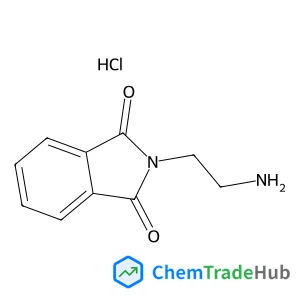
2-(2-Aminoethyl)-1H-isoindole-1,3(2H)-dione hydrochloride (1:1)
CAS Number:
30250-67-0
Molecular Formula:
C10H11ClN2O2
Recommended Suppliers





Disclaimer
This page provides academic journal information for reference and research purposes only. We are not affiliated with any journal publishers and do not handle publication submissions. For publication-related inquiries, please contact the respective journal publishers directly.
If you notice any inaccuracies in the information displayed, please contact us at support@chemtradehub.com. We will promptly review and address your concerns.