











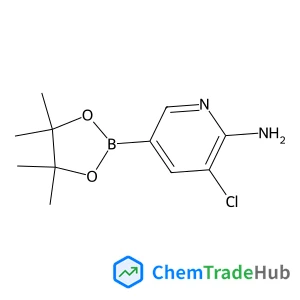
3-Chloro-5-(4,4,5,5-tetramethyl-1,3,2-dioxaborolan-2-yl)-2-pyridinamine
CAS Number:
1032758-99-8
Molecular Formula:
C11H16BClN2O2
Reza Omidyan, Hajar Rezaei
The potential energy profiles of neutral and protonated anisole and p-fluoroanisole at different electronic states have been investigated extensively by the RI-MP2 and RI-CC2 methods. The calculations reveal that the relaxation dynamics in protonated anisole and p-fluoroanisole are essentially different from those of the neutral analogues. In neutral anisole/p-fluoroanisole, the 1πσ* state plays a vital relaxation role along the O–CH3 coordinate, yielding the CH3 radical. For both of these molecules, the calculations indicate conical intersections (CIs) between the ground and excited state potential energy (PE) curves, hindered by a small barrier, and providing non-adiabatic gates for radiation-less deactivation to the ground state. Nevertheless, for the protonated cases, besides the prefulvenic deformation of the benzene ring, it has been predicted that the lowest 1(σ,n)π* state along the C–O–C bond angle plays an important role in photochemistry and the relaxation dynamics. The S1, S0 PE profiles of protonated anisole along with the former reaction coordinate (out-of-plane deformation) show a barrierless relaxation pathway, which can be responsible for the ultrafast deactivation of excited systems to the ground state via the low-lying S1/S0 conical intersection. Moreover, the later reaction coordinate in protonated species (C–O–C angle from 120°–180°) is consequently accompanied with the bond cleavage of C–OCH3 at the 1(σ,n)π* state, hindered by a barrier of ∼0.51 eV, and can be responsible for the relaxation of excited systems with significant excess energy (hν ≥ 5 eV). Furthermore, according to the RI-CC2 calculated results, different effects on the S1–S0 electronic transition energy of anisole and p-fluoroanisole upon protonation have been predicted. The first electronic transitions of anisole and p-fluoroanisole shift by ∼0.3 and 1.3 eV to the red respectively due to protonation.
Rafael Grande-Aztatzi, Jose M. Mercero, Jesus M. Ugalde
DOI: 10.1039/C8CP91727B
Gérôme Melaet, Vitalie Stavila, Lennie Klebanoff
DOI: 10.1039/C7CP07015B
Zhilin Yang, Yang Zhou, Hui Huang, Dingguo Xu, Chaoyang Zhang
DOI: 10.1039/C8CP00345A
DOI: 10.1039/C7CP08032H
M. A. Peck, G. R. Hearne, C. Obuah, J. Darkwa
DOI: 10.1039/C8CP01135D
M. Pelucchi, C. Cavallotti, T. Faravelli, S. J. Klippenstein
DOI: 10.1039/C7CP07779C
F. B. Haffner, N. Canilho, B. Medronho, C. Gardiennet, A. Gansmüller, A. Pasc
DOI: 10.1039/C8CP00073E
Peng Zhang, Nathan W. Yee, Sorin V. Filip, Casey E. Hetrick, Bin Yang, William H. Green
DOI: 10.1039/C7CP07058F
Sandeep P. Patil, Sri Harsha Chilakamarri, Bernd Markert
DOI: 10.1039/C8CP01061G
Yesim Mogulkoc, Aybey Mogulkoc, Bora Alkan
DOI: 10.1039/C8CP00994E
This compound is mainly used as an intermediate in the synthesis of antipsychoti...
Waste containing 1-(D-Ribofuranosyl)-1,4-dihydro-3-pyridinecarboxamide (CAS: 191...
2-Methyl-2-propanyl 3-bromo-3-(hydroxymethyl)-1-azetidinecarboxylate (CAS: 20079...
N-(4-Chloro-2-pyridinyl)acetamide (CAS: 245056-66-0) is a chemical compound with...
5-Chloro-2-hydroxybenzoic acid, also known as 5-chlorosalicylic acid, is an arom...
When handling 1,1-Dichloro-1-fluoroethane (CAS: 1717-00-6), it is important to u...
Fmoc-(2S,3R)-3-phenylpyrrolidine-2-carboxylic acid is a white crystalline solid ...
4-Amino-5-bromo-2-pyridinecarboxylic acid is primarily used as a precursor in th...
Handling this compound should be done with personal protective equipment (PPE) i...
When handling 8-bromo-2,2-dimethyl-3,4-dihydro-2H-1,4-benzoxazin-3-one, use prop...

Physical Chemistry Chemical Physics (PCCP) is an international journal co-owned by 19 physical chemistry and physics societies from around the world. This journal publishes original, cutting-edge research in physical chemistry, chemical physics and biophysical chemistry. To be suitable for publication in PCCP, articles must include significant innovation and/or insight into physical chemistry; this is the most important criterion that reviewers and Editors will judge against when evaluating submissions. The journal has a broad scope and welcomes contributions spanning experiment, theory, computation and data science. Topical coverage includes spectroscopy, dynamics, kinetics, statistical mechanics, thermodynamics, electrochemistry, catalysis, surface science, quantum mechanics, quantum computing and machine learning. Interdisciplinary research areas such as polymers and soft matter, materials, nanoscience, energy, surfaces/interfaces, and biophysical chemistry are welcomed if they demonstrate significant innovation and/or insight into physical chemistry. Joined experimental/theoretical studies are particularly appreciated when complementary and based on up-to-date approaches.
![4-Chloro-3-(trifluoromethyl)-1H-pyrrolo[2,3-b]pyridine structure](https://static.chemtradehub.com/structs/869/869335-75-1-a9d0.webp "4-Chloro-3-(trifluoromethyl)-1H-pyrrolo[2,3-b]pyridine structure")





