












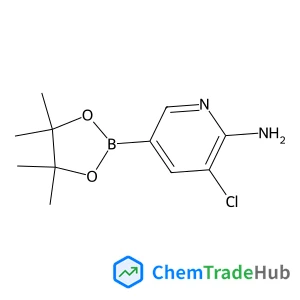
3-Chloro-5-(4,4,5,5-tetramethyl-1,3,2-dioxaborolan-2-yl)-2-pyridinamine
CAS Number:
1032758-99-8
Molecular Formula:
C11H16BClN2O2
Gérôme Melaet, Vitalie Stavila, Lennie Klebanoff
Recent theoretical predictions indicate that functional groups and additives could have a favorable impact on the hydrogen adsorption characteristics of sorbents; however, no definite evidence has been obtained to date and little is known about the impact of such modifications on the thermodynamics of hydrogen uptake and overall capacity. In this work, we investigate the effect of two types of additives on the cryoadsorption of hydrogen to mesoporous silica. First, Lewis and Brønsted acid sites were evaluated by grafting aluminum to the surface of mesoporous silica (MCF-17) and characterizing the resulting silicate materials’ surface area and the concentration of Brønsted and Lewis acid sites created. Heat of adsorption measurements found little influence of surface acidity on the enthalpy of hydrogen cryoadsorption. Secondly, platinum nanoparticles of 1.5 nm and 7.1 nm in diameter were loaded into MCF-17, and characterized by TEM. Hydrogen absorption measurements revealed that the addition of small amounts of metallic platinum nanoparticles increases by up to two-fold the amount of hydrogen adsorbed at liquid nitrogen temperature. Moreover, we found a direct correlation between the size of platinum particles and the amount of hydrogen stored, in favor of smaller particles.
Kun Liu, Xinye Shang, Yuyu Cheng, Xiaoyong Chang, Pengfei Li, Wenjun Li
DOI: 10.1039/C8OB02352B
Guotao Liu, Weijie Chen, Zhiqiang Xu, Fengying Ye, Yingle Pan, Xiaoqiang Chen, Sheng Hua Liu, Lintao Zeng, Jun Yin
DOI: 10.1039/C8OB01258J
Alejandro Gimenez Molina, Ivan Barvik, Sabine Müller, Jean-Jacques Vasseur, Michael Smietana
DOI: 10.1039/C8OB02182A
J. Schörgenhumer, M. Waser
DOI: 10.1039/C8OB02375A
Ali Gouranourimi, Antony Chipman, Rasool Babaahmadi, Angus Olding, Brian F. Yates, Alireza Ariafard
DOI: 10.1039/C8OB02590H
Andrew W. Phillips, Matthew J. Anketell, Tudor Balan, Nelson Y. S. Lam, Simon Williams, Ian Paterson
DOI: 10.1039/C8OB01621F
Danil P. Zarezin, Olga I. Shmatova, Valentine G. Nenajdenko
DOI: 10.1039/C8OB01507D
Wei Yang, Jingyi Wang, He Wang, Lei Li, Yuekai Guan, Xianxiu Xu, Dayu Yu
DOI: 10.1039/C8OB01938J
This compound is mainly used as an intermediate in the synthesis of antipsychoti...
Waste containing 1-(D-Ribofuranosyl)-1,4-dihydro-3-pyridinecarboxamide (CAS: 191...
2-Methyl-2-propanyl 3-bromo-3-(hydroxymethyl)-1-azetidinecarboxylate (CAS: 20079...
N-(4-Chloro-2-pyridinyl)acetamide (CAS: 245056-66-0) is a chemical compound with...
5-Chloro-2-hydroxybenzoic acid, also known as 5-chlorosalicylic acid, is an arom...
When handling 1,1-Dichloro-1-fluoroethane (CAS: 1717-00-6), it is important to u...
Fmoc-(2S,3R)-3-phenylpyrrolidine-2-carboxylic acid is a white crystalline solid ...
4-Amino-5-bromo-2-pyridinecarboxylic acid is primarily used as a precursor in th...
Handling this compound should be done with personal protective equipment (PPE) i...
When handling 8-bromo-2,2-dimethyl-3,4-dihydro-2H-1,4-benzoxazin-3-one, use prop...

Physical Chemistry Chemical Physics (PCCP) is an international journal co-owned by 19 physical chemistry and physics societies from around the world. This journal publishes original, cutting-edge research in physical chemistry, chemical physics and biophysical chemistry. To be suitable for publication in PCCP, articles must include significant innovation and/or insight into physical chemistry; this is the most important criterion that reviewers and Editors will judge against when evaluating submissions. The journal has a broad scope and welcomes contributions spanning experiment, theory, computation and data science. Topical coverage includes spectroscopy, dynamics, kinetics, statistical mechanics, thermodynamics, electrochemistry, catalysis, surface science, quantum mechanics, quantum computing and machine learning. Interdisciplinary research areas such as polymers and soft matter, materials, nanoscience, energy, surfaces/interfaces, and biophysical chemistry are welcomed if they demonstrate significant innovation and/or insight into physical chemistry. Joined experimental/theoretical studies are particularly appreciated when complementary and based on up-to-date approaches.
![1-[3-(4-Morpholinylsulfonyl)phenyl]methanamine structure](https://static.chemtradehub.com/structs/933/933989-32-3-51af.webp "1-[3-(4-Morpholinylsulfonyl)phenyl]methanamine structure")
![Methyl 4-({[(2-methyl-2-propanyl)oxy]carbonyl}amino)bicyclo[2.2.2]octane-1-carboxylate structure](https://static.chemtradehub.com/structs/943/943845-74-7-b7e5.webp "Methyl 4-({[(2-methyl-2-propanyl)oxy]carbonyl}amino)bicyclo[2.2.2]octane-1-carboxylate structure")




