












A supersandwich electrochemiluminescence immunosensor based on mimic-intramolecular interaction for sensitive detection of proteins
Literature Information
Publication Date
2014-07-21
DOI
10.1039/C4AN01002G
Impact Factor
4.616
Authors
Ying He, Yaqin Chai, Ruo Yuan, Haijun Wang, Lijuan Bai, Ni Liao
View Original
Abstract
An electrochemiluminescence (ECL) immunoassay protocol was developed based on mimic-intramolecular interaction for sensitive detection of prostate specific antigen (PSA). It was constructed by integrating the ECL luminophore (tris(4,4′-dicarboxylicacid-2,2′-bipyridyl)-ruthenium(II)dichloride (Ru(dcbpy)32+)) and coreactant (histidine) into the supersandwich DNA structure. This strategy was more effective in amplifying the ECL signal by shortening the electronic transmission distance, improving the ECL luminous stability and enhancing the ECL luminous efficiency. The ECL matrices denoted as MWCNTs@PDA–AuNPs were fabricated through spontaneous oxidative polymerization of dopamine (DA) on multiwalled carbon nanotubes (MWCNTs) and reducing HAuCl4 to produce gold nanoparticles (AuNPs) by DA simultaneously. Then, the prepared matrices were applied to bind capture antibodies. Moreover, supersandwich Ab2 bioconjugate was designed using a PAMAM dendrimer to immobilize the detection antibody and supersandwich DNA structure. The PAMAM dendrimer, with a plurality of secondary and tertiary amine groups, not only facilitated high-density immobilization of the detection antibody and supersandwich DNA structure, but also greatly amplified the ECL signal of Ru(dcbpy)32+. The supersandwich DNA structure contained multiple Ru(dcbpy)32+ and histidine, further amplifying the ECL signal. The proposed supersandwich immunosensor showed high sensitivity with a detection limit of 4.2 fg mL−1 and a wide linear range of 0.01 pg mL−1–40.00 ng mL−1. With the excellent stability, satisfying precision and reproducibility, the proposed immunosensor indicates promising practicability for clinical diagnosis.
Related Literature
Phenothiazine-based small-molecule organic solar cells with power conversion efficiency over 7% and open circuit voltage of about 1.0 V using solvent vapor annealing
Yogajivan Rout, Rajneesh Misra, Rahul Singhal, Subhayan Biswas, Ganesh D. Sharma
2018-01-30
Paper
DOI: 10.1039/C7CP08308D
DNA triplex structure, thermodynamics, and destabilisation: insight from molecular simulations
Belinda J. Boehm, Charles Whidborne, Alexander L. Button, Tara L. Pukala, David M. Huang
2018-05-04
Paper
DOI: 10.1039/C8CP02385A
Spatiotemporal dynamics of minimal bromate oscillators in an open one-side-fed reactor
Krisztina Kurin-Csörgei, István Szalai
2018-04-30
Paper
DOI: 10.1039/C8CP01953C
A combined experimental and computational investigation on pyrene based D–π–A dyes
Themmila Khamrang, Marappan Velusamy, Mohan Ramesh, Murugavel Kathiresan, Arunkumar Kathiravan
2018-01-31
Paper
DOI: 10.1039/C7CP08038G
Influence of the anion on the properties of ionic liquid mixtures: a molecular dynamics study
Renata Costa, Carlos M. Pereira, M. Natália D. S. Cordeiro
2018-05-17
Paper
DOI: 10.1039/C8CP01541D
Imperfect mixing as a dominant factor leading to stochastic behavior: a new system exhibiting crazy clock behavior
László Valkai, Attila K. Horváth
2018-05-11
Paper
DOI: 10.1039/C8CP01156G
Calculation of linear and nonlinear optical properties of azobenzene derivatives with Kohn–Sham and coupled-cluster methods
Arun K. Pal, Thomas J. Duignan, Jochen Autschbach
2018-02-06
Paper
DOI: 10.1039/C7CP08655E
Atomistic modeling of La3+ doping segregation effect on nanocrystalline yttria-stabilized zirconia
Shenli Zhang, Haoyan Sha, Ricardo H. R. Castro, Roland Faller
2018-04-17
Paper
DOI: 10.1039/C8CP02010H
Basic photophysical analysis of a thermally activated delayed fluorescence copper(i) complex in the solid state: theoretical estimations from a polarizable continuum model (PCM)-tuned range-separated density functional approach
Lingling Lv, Kun Yuan, Yongcheng Wang
2018-02-02
Paper
DOI: 10.1039/C7CP08264A
Conformational preferences and isomerization upon excitation/ionization of 2-methoxypyridine and 2-N-methylaminopyridine
Min Cheng, Yikui Du, Qihe Zhu
2018-01-24
Paper
DOI: 10.1039/C7CP07854D
You might also like
Compound Q&A
What precautions should be taken when handling 2-Chloro-1,2-bis(4-methylphenyl)ethanone (CAS: 71193-32-3)?
When handling 2-Chloro-1,2-bis(4-methylphenyl)ethanone (CAS: 71193-32-3), it is ...
71193-32-32-Chloro-1,2-bis(4-m...
Compound Q&A
What industries use 4-Ethoxy-3-(5-methyl-4-oxo-7-propyl-1,4-dihydroimidazo[5,1-f][1,2,4]triazin-2-yl)benzenesulfonyl chloride (CAS: 224789-26-8)?
4-Ethoxy-3-(5-methyl-4-oxo-7-propyl-1,4-dihydroimidazo[5,1-f][1,2,4]triazin-2-yl...
224789-26-84-Ethoxy-3-(5-methyl...
Compound Q&A
How should Methyl 3-Oxo-4-Androsten-17-Carboxylate (CAS: 2681-55-2) be stored?
Methyl 3-Oxo-4-Androsten-17-Carboxylate (CAS: 2681-55-2) should be stored in a c...
2681-55-2Methyl 3-Oxo-4-Andro...
Compound Q&A
What are the main uses of (R)-3-Amino-4-(3-hexylphenylamino)-4-oxobutylphosphonic acid (CAS: 909725-61-7)?
(R)-3-Amino-4-(3-hexylphenylamino)-4-oxobutylphosphonic acid is primarily used i...
909725-61-7(R)-3-Amino-4-(3-hex...
Compound Q&A
What regulatory guidelines apply to 2-Methyl-2-propanyl 3-amino-3-carbamoyl-1-azetidinecarboxylate (CAS: 1254120-14-3)?
2-Methyl-2-propanyl 3-amino-3-carbamoyl-1-azetidinecarboxylate (CAS: 1254120-14-...
1254120-14-32-Methyl-2-propanyl ...
Compound Q&A
Are there alternatives to (E)-4-(tert-Butoxy)-4-oxobut-2-enoic acid (CAS: 135355-96-3) in synthesis?
There are alternative reagents that can be used in synthesis instead of (E)-4-(t...
135355-96-3(E)-4-(tert-Butoxy)-...
Compound Q&A
What are the physical and chemical properties of [2-(3-Chlorophenyl)-1,3-thiazol-4-yl]methanol (CAS: 121202-20-8)?
[2-(3-Chlorophenyl)-1,3-thiazol-4-yl]methanol (CAS: 121202-20-8) is a crystallin...
121202-20-8[2-(3-Chlorophenyl)-...
Compound Q&A
What is the market or research trend for Methyl (2S)-[(4S)-2,2-dimethyl-1,3-dioxolan-4-yl]{[(4-methylphenyl)sulfonyl]oxy}acetate (CAS: 166249-17-8)?
The market and research trends for Methyl (2S)-[(4S)-2,2-dimethyl-1,3-dioxolan-4...
166249-17-8Methyl (2S)-[(4S)-2,...
Compound Q&A
What is the market or research trend for 1-Bromo-2-isocyanatoethane (CAS: 42865-19-0)?
The market for 1-Bromo-2-isocyanatoethane (CAS: 42865-19-0) is driven by its use...
42865-19-01-Bromo-2-isocyanato...
Compound Q&A
What are the main uses of 4-Nitro-D-phenylalanine hydrochloride (CAS: 147065-06-3)?
4-Nitro-D-phenylalanine hydrochloride (CAS: 147065-06-3) is primarily used in re...
147065-06-34-Nitro-D-phenylalan...
Source Journal
Analyst

CiteScore:
7.8
Self-citation Rate:
5.6%
Articles per Year:
653
Analyst publishes analytical and bioanalytical research that reports premier fundamental discoveries and inventions, and the applications of those discoveries, unconfined by traditional discipline barriers.
Recommended Compounds


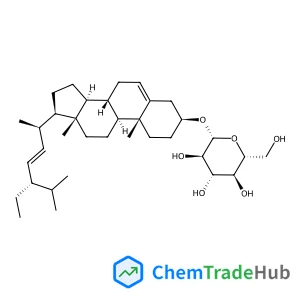
(3beta,22E)-Stigmasta-5,22-dien-3-yl beta-D-glucopyranoside
CAS Number:
19716-26-8
Molecular Formula:
C35H58O6
![(1R)-3-Bromo-1,7,7-trimethylbicyclo[2.2.1]heptan-2-one structure](https://static.chemtradehub.com/structs/102/10293-06-8-dd8a.webp "(1R)-3-Bromo-1,7,7-trimethylbicyclo[2.2.1]heptan-2-one structure")
(1R)-3-Bromo-1,7,7-trimethylbicyclo[2.2.1]heptan-2-one
CAS Number:
10293-06-8
Molecular Formula:
C10H15BrO
Recommended Suppliers






Disclaimer
This page provides academic journal information for reference and research purposes only. We are not affiliated with any journal publishers and do not handle publication submissions. For publication-related inquiries, please contact the respective journal publishers directly.
If you notice any inaccuracies in the information displayed, please contact us at support@chemtradehub.com. We will promptly review and address your concerns.