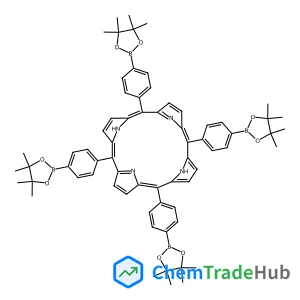
5,10,15,20-tetrakis(4-boronic acid pinacol ester phenyl) porphyrin
CAS Number:
1332748-00-1
Molecular Formula:
C68H74B4N4O8
Shenli Zhang, Haoyan Sha, Ricardo H. R. Castro, Roland Faller
The effect of La3+ doping on the structure and ionic conductivity change in nanocrystalline yttria-stabilized zirconia (YSZ) was studied using a combination of Monte Carlo and molecular dynamics simulations. The simulation revealed the segregation of La3+ at eight tilt grain boundary (GB) structures and predicted an average grain boundary (GB) energy decrease of 0.25 J m−2, which is close to the experimental values reported in the literature. Cation stabilization was found to be the main reason for the GB energy decrease, and energy fluctuations near the grain boundary are smoothed out with La3+ segregation. Both dynamic and energetic analysis on the Σ13(510)/[001] GB structure revealed La3+ doping hinders O2− diffusion in the GB region, where the diffusion coefficient monotonically decreases with increasing La3+ doping concentration. The effect was attributed to the increase in the site-dependent migration barriers for O2− hopping caused by segregated La3+, which also leads to anisotropic diffusion at the GB.
Jakob Hofinger, Felix Mayr, Katarina Gugujonovic, Dominik Wielend, Markus C. Scharber
DOI: 10.1039/D1MA00293G
Bruno Freitas, Willian G. Nunes, Davi Marcelo Soares, Fernando C. Rufino, Cássio Murilo Moreira, Leonardo Morais Da Silva, Hudson Zanin
DOI: 10.1039/D0MA00783H
Xiaosong Xiong, Ruoyu Zhi, Qi Zhou, Wenqi Yan, Yusong Zhu, Yuhui Chen, Lijun Fu, Nengfei Yu, Yuping Wu
DOI: 10.1039/D1MA00121C
Sujit Jain, Sumedh P. Surwade, Srikanth Rao Agnihotra, Vineet Dua, Pamela A. Eliason, Gregory J. Morose, Sanjeev K. Manohar
DOI: 10.1039/B923400D
Christophe Renault, Véronique Balland, Eugenia Martinez-Ferrero, Lionel Nicole, Clément Sanchez, Benoît Limoges
DOI: 10.1039/B919976D
Qiankun Zhong, Wensheng Liu, Yong Yang, Wenkang Pan, Mingzai Wu, Fangcai Zheng, Xiao Lian, Helin Niu
DOI: 10.1039/D1MA00390A
Justyna Łuczak, Christian Jungnickel, Izabela Łącka, Stefan Stolte, Jan Hupka
DOI: 10.1039/B921805J
Jin Seon Kwon, So Mi Yoon, Doo Yeon Kwon, Da Yeon Kim, Guo Zhe Tai, Ling Mei Jin, Boram Song, Bong Lee, Jae Ho Kim, Dong Keun Han, Byoung Hyun Min, Moon Suk Kim
DOI: 10.1039/C3TB20105H
Paul N. Davey, Martyn J. Earle, Jennifer T. Hamill, Suhas P. Katdare, David W. Rooney, Kenneth R. Seddon
DOI: 10.1039/B915131A
When handling 4-Methyl-6-(trifluoromethyl)quinoline (CAS: 40716-16-3), safety go...
4-(3,5-Difluorophenyl)aniline is an aromatic organic compound with the CAS numbe...
5-{[4-(Trifluoromethyl)phenyl]sulfanyl}-1,2,3-thiadiazole-4-carboxylic acid can ...
The market for 4-Benzylaniline hydrochloride (CAS: 6317-57-3) is steadily growin...
[3-(Diethylsulfamoyl)phenyl]boronic acid is generally considered safe when handl...
3-Bromo-2,5-dimethoxyaniline is mainly used in the pharmaceutical and chemical i...
N-Methyl-1-(5-methyl-1H-indol-3-yl)methanamine (CAS: 915922-67-7) is subject to ...
This compound is primarily used in the pharmaceutical industry for the synthesis...
2-Methyl-2-propanyl [(1S,3R)-3-aminocyclohexyl]carbamate (CAS: 1298101-47-9) sho...
Ethyl 2-bromo-4,4,4-trifluorobutanoate (CAS: 367-33-9) is utilized in the pharma...

Physical Chemistry Chemical Physics (PCCP) is an international journal co-owned by 19 physical chemistry and physics societies from around the world. This journal publishes original, cutting-edge research in physical chemistry, chemical physics and biophysical chemistry. To be suitable for publication in PCCP, articles must include significant innovation and/or insight into physical chemistry; this is the most important criterion that reviewers and Editors will judge against when evaluating submissions. The journal has a broad scope and welcomes contributions spanning experiment, theory, computation and data science. Topical coverage includes spectroscopy, dynamics, kinetics, statistical mechanics, thermodynamics, electrochemistry, catalysis, surface science, quantum mechanics, quantum computing and machine learning. Interdisciplinary research areas such as polymers and soft matter, materials, nanoscience, energy, surfaces/interfaces, and biophysical chemistry are welcomed if they demonstrate significant innovation and/or insight into physical chemistry. Joined experimental/theoretical studies are particularly appreciated when complementary and based on up-to-date approaches.