












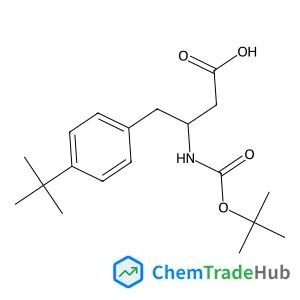
(S)-3-((tert-Butoxycarbonyl)amino)-4-(4-(tert-butyl)phenyl)butanoic acid
CAS Number:
403661-85-8
Molecular Formula:
C19H29NO4
Arun K. Pal, Thomas J. Duignan, Jochen Autschbach
Linear polarizabilities (α) and second hyperpolarizabilities (γ) of unsubstituted azobenzenes and ‘push–pull’ azobenzene derivatives are investigated using Kohn–Sham theory (KST) and coupled-cluster (CC) approaches. Various standard exchange–correlation functionals as well as a non-empirically ‘tuned’ long-range corrected (LC) functional with range-separated exchange are used in the KST calculations. When compared to correlated ab initio calculations and measurements, the tuned functional gives accurate low-energy excitation energies, especially for charge transfer (CT) transitions, and performs well for α. Basis set and solvent effects are also studied. In contrast to expectations, but in agreement with a prior study of π-conjugated systems that do not have low-energy CT excitations, the improvements of the CT excitation energies for the push–pull π-chromophores due to tuning do not go along with clear improvements of γ toward the CC reference data, likely due to the importance of the dynamic electron correlation for this property.
Jakob Hofinger, Felix Mayr, Katarina Gugujonovic, Dominik Wielend, Markus C. Scharber
DOI: 10.1039/D1MA00293G
Bo Yang, Joshua I. Wheeler, Brett Sorensen, Robert Steagall, Taylor Nielson, Jianhua Yao, Jose Mendez-Arroyo, Daniel H. Ess
DOI: 10.1039/D1MA00330E
Sujit Jain, Sumedh P. Surwade, Srikanth Rao Agnihotra, Vineet Dua, Pamela A. Eliason, Gregory J. Morose, Sanjeev K. Manohar
DOI: 10.1039/B923400D
Savarimuthu Philip Anthony, Sunil Varughese, Sylvia M. Draper
DOI: 10.1039/B914027A
Xieweiyi Ye, Yakun Xue, Kaijia Li, Wen Tang, Xiao Han, Xibo Zhang, Zhijia Song, Zhiping Zheng, Qin Kuang
DOI: 10.1039/D1MA00475A
Ana C. Fernandes, Moisés L. Pinto, Fernando Antunes, João Pires
DOI: 10.1039/C3TB20535E
Bruno Freitas, Willian G. Nunes, Davi Marcelo Soares, Fernando C. Rufino, Cássio Murilo Moreira, Leonardo Morais Da Silva, Hudson Zanin
DOI: 10.1039/D0MA00783H
Wesley Sattler, Gerard Parkin
DOI: 10.1039/B917156H
When handling 4-Methyl-6-(trifluoromethyl)quinoline (CAS: 40716-16-3), safety go...
4-(3,5-Difluorophenyl)aniline is an aromatic organic compound with the CAS numbe...
5-{[4-(Trifluoromethyl)phenyl]sulfanyl}-1,2,3-thiadiazole-4-carboxylic acid can ...
The market for 4-Benzylaniline hydrochloride (CAS: 6317-57-3) is steadily growin...
[3-(Diethylsulfamoyl)phenyl]boronic acid is generally considered safe when handl...
3-Bromo-2,5-dimethoxyaniline is mainly used in the pharmaceutical and chemical i...
N-Methyl-1-(5-methyl-1H-indol-3-yl)methanamine (CAS: 915922-67-7) is subject to ...
This compound is primarily used in the pharmaceutical industry for the synthesis...
2-Methyl-2-propanyl [(1S,3R)-3-aminocyclohexyl]carbamate (CAS: 1298101-47-9) sho...
Ethyl 2-bromo-4,4,4-trifluorobutanoate (CAS: 367-33-9) is utilized in the pharma...

Physical Chemistry Chemical Physics (PCCP) is an international journal co-owned by 19 physical chemistry and physics societies from around the world. This journal publishes original, cutting-edge research in physical chemistry, chemical physics and biophysical chemistry. To be suitable for publication in PCCP, articles must include significant innovation and/or insight into physical chemistry; this is the most important criterion that reviewers and Editors will judge against when evaluating submissions. The journal has a broad scope and welcomes contributions spanning experiment, theory, computation and data science. Topical coverage includes spectroscopy, dynamics, kinetics, statistical mechanics, thermodynamics, electrochemistry, catalysis, surface science, quantum mechanics, quantum computing and machine learning. Interdisciplinary research areas such as polymers and soft matter, materials, nanoscience, energy, surfaces/interfaces, and biophysical chemistry are welcomed if they demonstrate significant innovation and/or insight into physical chemistry. Joined experimental/theoretical studies are particularly appreciated when complementary and based on up-to-date approaches.
![6,7-Dihydro-5H-pyrrolo[1,2-a]imidazole-6-carboxylic acid structure](https://static.chemtradehub.com/structs/136/1369160-12-2-6524.webp "6,7-Dihydro-5H-pyrrolo[1,2-a]imidazole-6-carboxylic acid structure")
![6-Bromo-3-ethyl-3H-imidazo[4,5-b]pyridine structure](https://static.chemtradehub.com/structs/103/1033202-59-3-2a8f.webp "6-Bromo-3-ethyl-3H-imidazo[4,5-b]pyridine structure")




