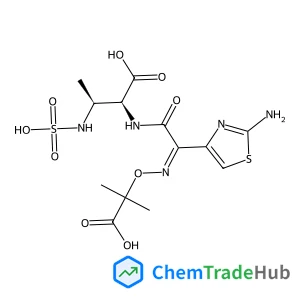
Aztreonam USP Related Compound A (Open-ring Aztreonam)
CAS Number:
87500-74-1
Molecular Formula:
C13H19N5O9S2
Yogesh Patil, Bruno Ameduri
The radical copolymerization of tert-butyl 2-trifluoromethacrylate (MAF-TBE) with vinylidene fluoride (VDF), initiated by bis(4-tert-butyl cyclohexyl) peroxydicarbonate and controlled by O-ethyl-S-(1-methyloxycarbonyl) ethyl xanthate as a chain transfer agent (CTA) is presented. Molar masses ranged between 1500 and 50 000 g mol−1 while polydispersity indices (PDIs) were lower than 1.8. Various experimental conditions such as different radical initiators, solvents, initial [initiator]o/([VDF]o + [MAF-TBE]o) and [CTA]o/([VDF]o + [MAF-TBE]o) molar ratios, and their effect on the copolymerization (in terms of molar percentages of both comonomers in the copolymer, yields, molar masses, and thermal properties) were examined and discussed. These poly(VDF-co-MAF-TBE) copolymers bearing a xanthate end-group were further involved in controlled radical polymerizations of vinyl acetate (VAc) or VDF leading to poly(VDF-co-MAF-TBE)-b-poly(VAc) and poly(VDF-co-MAF-TBE)-b-poly(VDF) block copolymers, respectively. The success of these radical copolymerizations of MAF-TBE contrasts with its homopolymerization that occurred with difficulty and produced low molecular weight-homopolymers in low yields. On the other hand, the controlled character of the polymerization involving O-ethyl-S-(1-methyloxycarbonyl) ethyl xanthate was confirmed by the evolutions of log([M]o/[M]) and MAF-TBE conversion versus time and by size exclusion chromatography that were found to be linear. All the structures of the obtained intermediates and block copolymers were characterized by 1H and 19F NMR spectroscopy and size exclusion chromatography to assess the molar percentages of VDF and MAF-TBE and the molecular weights and PDIs, respectively. The thermal and surface properties of such original copolymers were determined by thermogravimetric analysis and water contact angle measurements, respectively.
DOI: 10.1039/C7CP01985H
DOI: 10.1039/C7CP05102F
Eric R. Kennehan, Christopher Grieco, Alyssa N. Brigeman, Adam Rimshaw, Kayla Bisgaier, Noel C. Giebink
DOI: 10.1039/C7CP04819J
E. Cassette, S. Pedetti, B. Mahler, S. Ithurria, B. Dubertret, G. D. Scholes
DOI: 10.1039/C6CP08689F
Zhongxu Wang
DOI: 10.1039/C7CP04299J
I. León, E. R. Alonso, S. Mata, C. Cabezas, M. A. Rodríguez, J.-U. Grabow, J. L. Alonso
DOI: 10.1039/C7CP03924G
Fangfang Chen
DOI: 10.1039/C7CP90203D
Yingjie Zhang, Yang Li
DOI: 10.1039/C7CP04591C
Chun-Yu Chang, Yu-Ching Huang, Chien-An Chen, Chun-Jen Su
DOI: 10.1039/C7CP04238H
6-(3-Fluorophenyl)picolinic acid is generally considered safe for laboratory use...
(3R)-3-Pyrrolidinol is used in the pharmaceutical industry as a precursor for dr...
When handling (4R,5R)-4,5-Diethoxycarbonyl-2,2-dimethyldioxolane (CAS: 59779-75-...
1-(6-Chloroimidazo[1,2-b]pyridazin-3-yl)ethanone is often synthesized via a mult...
The market for N-Ethyl-3,4-dimethylbenzylamine (CAS: 39180-83-1) remains steady,...
Tert-butyl 3-(pyrrolidin-1-yl)azetidine-1-carboxylate is a chemical compound wit...
1-Bromo-3-chloro-2,4-dimethoxybenzene (CAS: 1228956-93-1) falls under the classi...
The safety of 8-Bromo-2-methyl-3,4-dihydroisoquinolin-1(2H)-one (CAS: 1368622-07...
Benzyl [(3S)-2,6-dioxo-3-piperidinyl]carbamate is generally safe when handled wi...
1-{[4-(4,4,5,5-Tetramethyl-1,3,2-dioxaborolan-2-yl)phenyl]sulfonyl}pyrrolidine s...

Polymer Chemistry welcomes submissions in all areas of polymer science that have a strong focus on macromolecular chemistry. Manuscripts may cover a broad range of fields, yet no direct application focus is required.