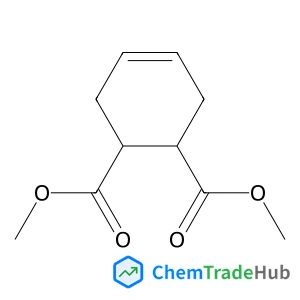
4-Cyclohexene-1,2-dicarboxylic acid, 1,2-dimethyl ester, (1R,2R)-rel-
CAS Number:
17673-68-6
Molecular Formula:
C10H14O4
Dong-Gyun Kim, Hyo Kang, Yong-Seok Choi, Sungsoo Han, Jong-Chan Lee
Star-shaped polymers (SPCs) containing poly(ethylene glycol) (PEG) and renewable cardanol side groups were synthesized by atom transfer radical polymerization (ATRP). Water-soluble SPCs were turned into water-insoluble materials by self-cross-linking reaction of the unsaturated hydrocarbon chains of cardanol moieties upon UV irradiation. The SPC-coated membranes with UV curing exhibited noticeably higher bio- and oil-fouling resistance than the bare polysulfone (PSf) membrane during filtration experiments, whereas the SPC-coated membranes without UV curing showed a large flux-decline caused by fouling compared to that of the bare membrane, because SPCs were washed out during filtration. The enhanced antifouling properties of the SPC-coated membranes with UV curing were ascribed to a large quantity of PEG moieties on the surfaces stabilized by the cross-linked polymeric structure, leading to decreased interactions with proteins and oils.
Rajamani Krishna, Jasper M. van Baten
DOI: 10.1039/C7CP00586E
Yani Zhao, Marek Cieplak
DOI: 10.1039/C7CP03829A
DOI: 10.1039/C7CP04152G
Amanda N. Oehrlein, Antonio Sanchez-Diaz, Philip C. Goff, Gretchen M. Ziegler, Ted M. Pappenfus, Kent R. Mann, David A. Blank, Wayne L. Gladfelter
DOI: 10.1039/C7CP03784H
Lauri Hautala, Kari Jänkälä, Mikko-Heikki Mikkelä, Paavo Turunen, Nønne L. Prisle, Minna Patanen, Maxim Tchaplyguine, Marko Huttula
DOI: 10.1039/C7CP04398H
I. León, E. R. Alonso, S. Mata, C. Cabezas, M. A. Rodríguez, J.-U. Grabow, J. L. Alonso
DOI: 10.1039/C7CP03924G
Seishi Shimizu
DOI: 10.1039/C7CP02132A
Yingjie Zhang, Yang Li
DOI: 10.1039/C7CP04591C
Jacob C. Dean, Ruomeng Zhang, Rawad K. Hallani, Ryan D. Pensack, Samuel N. Sanders, Daniel G. Oblinsky, Sean R. Parkin, Luis M. Campos, John E. Anthony, Gregory D. Scholes
DOI: 10.1039/C7CP03774K
6-(3-Fluorophenyl)picolinic acid is generally considered safe for laboratory use...
(3R)-3-Pyrrolidinol is used in the pharmaceutical industry as a precursor for dr...
When handling (4R,5R)-4,5-Diethoxycarbonyl-2,2-dimethyldioxolane (CAS: 59779-75-...
1-(6-Chloroimidazo[1,2-b]pyridazin-3-yl)ethanone is often synthesized via a mult...
The market for N-Ethyl-3,4-dimethylbenzylamine (CAS: 39180-83-1) remains steady,...
Tert-butyl 3-(pyrrolidin-1-yl)azetidine-1-carboxylate is a chemical compound wit...
1-Bromo-3-chloro-2,4-dimethoxybenzene (CAS: 1228956-93-1) falls under the classi...
The safety of 8-Bromo-2-methyl-3,4-dihydroisoquinolin-1(2H)-one (CAS: 1368622-07...
Benzyl [(3S)-2,6-dioxo-3-piperidinyl]carbamate is generally safe when handled wi...
1-{[4-(4,4,5,5-Tetramethyl-1,3,2-dioxaborolan-2-yl)phenyl]sulfonyl}pyrrolidine s...

Polymer Chemistry welcomes submissions in all areas of polymer science that have a strong focus on macromolecular chemistry. Manuscripts may cover a broad range of fields, yet no direct application focus is required.