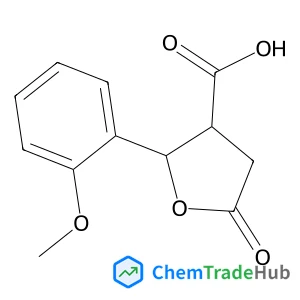
trans-2-(2-Methoxyphenyl)-5-oxotetrahydrofuran-3-carboxylic acid
CAS Number:
99226-02-5
Molecular Formula:
C12H12O5
Rajamani Krishna, Jasper M. van Baten
This article compares the performances of several metal–organic frameworks (MOFs) and zeolitic imidazolate frameworks (ZIFs) for the separation of pentane isomers: n-pentane (nC5), 2-methylbutane (2MB), and 2,2-dimethylpropane (= neo-pentane (neo-P)) in fixed bed adsorbers. The required input data on unary and mixture adsorption equilibria are obtained from Configurational-Bias Monte Carlo (CBMC) simulations for twelve different adsorbents. The best separation performance is realized with Fe2(BDP)3, where BDP2− = 1,4-benzenedipyrazolate, a MOF with triangular shaped 4.9 Å channels that affords the ideal pore topology to differentiate between the three pentane isomers; the linear nC5 aligns commensurately with the pore landscape. Using transient breakthrough simulations in fixed bed adsorbers, the separation performance of Fe2(BDP)3 is found to be significantly superior to that of other materials.
Nadia Hundt, Kumaranand Palaniappan, Prakash Sista, John W. Murphy, Jing Hao, Hien Nguyen, Eugene Stein, Michael C. Biewer, Bruce E. Gnade, Mihaela C. Stefan
DOI: 10.1039/C0PY00176G
Miaojun Ding, Hongyuan Hu
DOI: 10.1039/C0PY00170H
Christian Porsch, Susanne Hansson, Niklas Nordgren, Eva Malmström
DOI: 10.1039/C0PY00417K
Hideki Matsubara, Hiroyasu Kataoka, Hajime Ohtani
DOI: 10.1039/C0PY00026D
Andrew J. D. Magenau, Justin W. Chan, Charles E. Hoyle, Robson F. Storey
DOI: 10.1039/C0PY00094A
Sharon K. Hamilton, Artez L. Sims, Jenna Donavan, Eva Harth
DOI: 10.1039/C0PY00342E
Fang Liu, William L. Jarrett, Marek W. Urban
DOI: 10.1039/C0PY00366B
DOI: 10.1039/C0PY00162G
Nicolas Sanson, Jutta Rieger
DOI: 10.1039/C0PY00010H
6-(3-Fluorophenyl)picolinic acid is generally considered safe for laboratory use...
(3R)-3-Pyrrolidinol is used in the pharmaceutical industry as a precursor for dr...
When handling (4R,5R)-4,5-Diethoxycarbonyl-2,2-dimethyldioxolane (CAS: 59779-75-...
1-(6-Chloroimidazo[1,2-b]pyridazin-3-yl)ethanone is often synthesized via a mult...
The market for N-Ethyl-3,4-dimethylbenzylamine (CAS: 39180-83-1) remains steady,...
Tert-butyl 3-(pyrrolidin-1-yl)azetidine-1-carboxylate is a chemical compound wit...
1-Bromo-3-chloro-2,4-dimethoxybenzene (CAS: 1228956-93-1) falls under the classi...
The safety of 8-Bromo-2-methyl-3,4-dihydroisoquinolin-1(2H)-one (CAS: 1368622-07...
Benzyl [(3S)-2,6-dioxo-3-piperidinyl]carbamate is generally safe when handled wi...
1-{[4-(4,4,5,5-Tetramethyl-1,3,2-dioxaborolan-2-yl)phenyl]sulfonyl}pyrrolidine s...

Physical Chemistry Chemical Physics (PCCP) is an international journal co-owned by 19 physical chemistry and physics societies from around the world. This journal publishes original, cutting-edge research in physical chemistry, chemical physics and biophysical chemistry. To be suitable for publication in PCCP, articles must include significant innovation and/or insight into physical chemistry; this is the most important criterion that reviewers and Editors will judge against when evaluating submissions. The journal has a broad scope and welcomes contributions spanning experiment, theory, computation and data science. Topical coverage includes spectroscopy, dynamics, kinetics, statistical mechanics, thermodynamics, electrochemistry, catalysis, surface science, quantum mechanics, quantum computing and machine learning. Interdisciplinary research areas such as polymers and soft matter, materials, nanoscience, energy, surfaces/interfaces, and biophysical chemistry are welcomed if they demonstrate significant innovation and/or insight into physical chemistry. Joined experimental/theoretical studies are particularly appreciated when complementary and based on up-to-date approaches.