












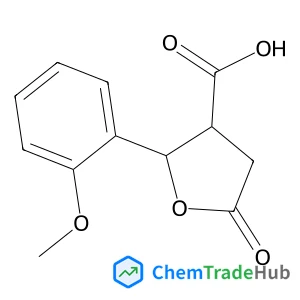
trans-2-(2-Methoxyphenyl)-5-oxotetrahydrofuran-3-carboxylic acid
CAS Number:
99226-02-5
Molecular Formula:
C12H12O5
Artur Schneider, Torsten Brezesinski
The use of monolithic carbons with structural hierarchy and varying amounts of nitrogen and oxygen functionalities as sulfur host materials in high-loading lithium–sulfur cells is reported. The primary focus is on the strength of the polysulfide/carbon interaction with the goal of assessing the effect of (surface) dopant concentration on cathode performance. The adsorption capacity – which is a measure of the interaction strength between the intermediate lithium polysulfide species and the carbon – was found to scale almost linearly with the nitrogen level. Likewise, the discharge capacity of lithium–sulfur cells increased linearly. This positive correlation can be explained by the favorable effect of nitrogen on both the chemical and electronic properties of the carbon host. The incorporation of additional oxygen-containing surface groups into highly nitrogen-functionalized carbon helped to further enhance the polysulfide adsorption efficiency, and therefore the reversible cell capacity. Overall, the areal capacity could be increased by almost 70% to around 3 mA h cm−2. We believe that the design parameters described here provide a blueprint for future carbon-based nanocomposites for high-performance lithium–sulfur cells.
Atanu Kotal, Tapas K. Paira, Sanjib Banerjee, Chinmoy Bhattacharya, Tarun K. Mandal
DOI: 10.1039/C0PY00180E
Maria Kavallaris, Volga Bulmus
DOI: 10.1039/C0PY00256A
Andrew J. Inglis, Christopher Barner-Kowollik
DOI: 10.1039/C0PY00189A
Oleg Yu. Posudievsky, Olga A. Kozarenko
DOI: 10.1039/C0PY00212G
DOI: 10.1039/C0PY00162G
Ken Cham-Fai Leung, Kwun-Ngai Lau
DOI: 10.1039/B9PY00380K
6-(3-Fluorophenyl)picolinic acid is generally considered safe for laboratory use...
(3R)-3-Pyrrolidinol is used in the pharmaceutical industry as a precursor for dr...
When handling (4R,5R)-4,5-Diethoxycarbonyl-2,2-dimethyldioxolane (CAS: 59779-75-...
1-(6-Chloroimidazo[1,2-b]pyridazin-3-yl)ethanone is often synthesized via a mult...
The market for N-Ethyl-3,4-dimethylbenzylamine (CAS: 39180-83-1) remains steady,...
Tert-butyl 3-(pyrrolidin-1-yl)azetidine-1-carboxylate is a chemical compound wit...
1-Bromo-3-chloro-2,4-dimethoxybenzene (CAS: 1228956-93-1) falls under the classi...
The safety of 8-Bromo-2-methyl-3,4-dihydroisoquinolin-1(2H)-one (CAS: 1368622-07...
Benzyl [(3S)-2,6-dioxo-3-piperidinyl]carbamate is generally safe when handled wi...
1-{[4-(4,4,5,5-Tetramethyl-1,3,2-dioxaborolan-2-yl)phenyl]sulfonyl}pyrrolidine s...

Physical Chemistry Chemical Physics (PCCP) is an international journal co-owned by 19 physical chemistry and physics societies from around the world. This journal publishes original, cutting-edge research in physical chemistry, chemical physics and biophysical chemistry. To be suitable for publication in PCCP, articles must include significant innovation and/or insight into physical chemistry; this is the most important criterion that reviewers and Editors will judge against when evaluating submissions. The journal has a broad scope and welcomes contributions spanning experiment, theory, computation and data science. Topical coverage includes spectroscopy, dynamics, kinetics, statistical mechanics, thermodynamics, electrochemistry, catalysis, surface science, quantum mechanics, quantum computing and machine learning. Interdisciplinary research areas such as polymers and soft matter, materials, nanoscience, energy, surfaces/interfaces, and biophysical chemistry are welcomed if they demonstrate significant innovation and/or insight into physical chemistry. Joined experimental/theoretical studies are particularly appreciated when complementary and based on up-to-date approaches.
![(2E)-4-[(1R,2S,8R,19S,21R)-14-Hydroxy-11-isopropenyl-8,23,23-trimethyl-5-(3-methyl-2-buten-1-yl)-16,20-dioxo-3,7,22-trioxaheptacyclo[17.4.1.1~8,12~.0~2,17~.0~2,21~.0~4,15~.0~6,13~]pentacosa-4(15),5,13
,17-tetraen-21-yl]-2-methyl-2-butenoic acid structure](https://static.chemtradehub.com/structs/173/173867-04-4-d2d3.webp "(2E)-4-[(1R,2S,8R,19S,21R)-14-Hydroxy-11-isopropenyl-8,23,23-trimethyl-5-(3-methyl-2-buten-1-yl)-16,20-dioxo-3,7,22-trioxaheptacyclo[17.4.1.1~8,12~.0~2,17~.0~2,21~.0~4,15~.0~6,13~]pentacosa-4(15),5,13
,17-tetraen-21-yl]-2-methyl-2-butenoic acid structure")





