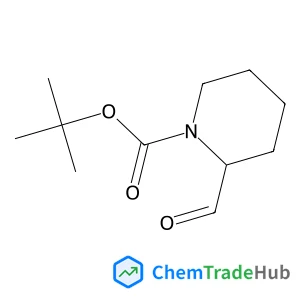
2-Methyl-2-propanyl (2R)-2-formyl-1-piperidinecarboxylate
CAS Number:
134526-69-5
Molecular Formula:
C11H19NO3
M. Virumbrales-del Olmo, A. Delgado-Cabello, A. Andrada-Chacón, J. Sánchez-Benítez, E. Urones-Garrote, V. Blanco-Gutiérrez, M. J. Torralvo, R. Sáez-Puche
Single domain superparamagnetic ferrite nanoparticles with the composition MFe2O4 (M = Fe, Co, Zn) have been prepared by thermal decomposition of metal acetylacetonates in diphenyl ether or dibenzyl ether, using oleic acid in the presence of oleylamine as a stabilizing agent. The Fe, Co and Zn ferrite nanoparticles are monodisperse with diameters of 4.9, 4.4 and 4.7 nm, respectively. The TG and IR results indicate that four or six carboxylate groups per nm2 are bonded at the surface of the particles acting as chelating and/or bridging bidentate ligands depending on the composition. The oleate groups minimize the interparticle interactions in Fe and Zn ferrite samples, while in the Co ferrite sample dipolar interactions produce broad maxima in the ZFC and energy barriers distribution curves. The inversion degree has been estimated from the Raman spectra and the obtained x values have been used to calculate the saturation magnetization and compare them with the experimental MS values. Compared to bulk materials, the magnetization value is higher for the Zn ferrite sample due to its mixed spinel cation distribution. For the Co ferrite sample, and probably for the Fe one, the low value of saturation magnetization seems to be due to the surface disordered layer of canted spins. Compared to non-coated nanoparticles with the same composition and similar size, the oleate groups, covalently bonded to the superficial cations, increase the anisotropy field and decrease the magnetization.
Christoph Naumann, Philip William Kuchel
DOI: 10.1039/C0PY00038H
Robert T. Woodward, Jonathan V. M. Weaver
DOI: 10.1039/C0PY00277A
Anshu Kumar, Anil Kumar
DOI: 10.1039/B9PY00265K
Stefan Theiler, Michael Teske, Helmut Keul, Katrin Sternberg, Martin Möller
DOI: 10.1039/C0PY00097C
Johannes Pall Magnusson, Aram Omer Saeed, Francisco Fernández-Trillo, Cameron Alexander
DOI: 10.1039/C0PY00210K
M. Baklar, S. Barard, D. Sparrowe, R. M. Wilson, T. Kreouzis
DOI: 10.1039/C0PY00056F
Tetsu Mitsumata, Suguru Ohori
DOI: 10.1039/C1PY00033K
Yung-Chung Chen, Wen-Yi Wu, Tzong-Yuan Juang, Shenghong A. Dai, Wen-Chiung Su, Ying-Ling Liu, Rong-Ho Lee, Ru-Jong Jeng
DOI: 10.1039/C0PY00358A
Nicolas Sanson, Jutta Rieger
DOI: 10.1039/C0PY00010H
Hui Ge, Stergios Pispas
DOI: 10.1039/C0PY00361A
6-(3-Fluorophenyl)picolinic acid is generally considered safe for laboratory use...
(3R)-3-Pyrrolidinol is used in the pharmaceutical industry as a precursor for dr...
When handling (4R,5R)-4,5-Diethoxycarbonyl-2,2-dimethyldioxolane (CAS: 59779-75-...
1-(6-Chloroimidazo[1,2-b]pyridazin-3-yl)ethanone is often synthesized via a mult...
The market for N-Ethyl-3,4-dimethylbenzylamine (CAS: 39180-83-1) remains steady,...
Tert-butyl 3-(pyrrolidin-1-yl)azetidine-1-carboxylate is a chemical compound wit...
1-Bromo-3-chloro-2,4-dimethoxybenzene (CAS: 1228956-93-1) falls under the classi...
The safety of 8-Bromo-2-methyl-3,4-dihydroisoquinolin-1(2H)-one (CAS: 1368622-07...
Benzyl [(3S)-2,6-dioxo-3-piperidinyl]carbamate is generally safe when handled wi...
1-{[4-(4,4,5,5-Tetramethyl-1,3,2-dioxaborolan-2-yl)phenyl]sulfonyl}pyrrolidine s...

Physical Chemistry Chemical Physics (PCCP) is an international journal co-owned by 19 physical chemistry and physics societies from around the world. This journal publishes original, cutting-edge research in physical chemistry, chemical physics and biophysical chemistry. To be suitable for publication in PCCP, articles must include significant innovation and/or insight into physical chemistry; this is the most important criterion that reviewers and Editors will judge against when evaluating submissions. The journal has a broad scope and welcomes contributions spanning experiment, theory, computation and data science. Topical coverage includes spectroscopy, dynamics, kinetics, statistical mechanics, thermodynamics, electrochemistry, catalysis, surface science, quantum mechanics, quantum computing and machine learning. Interdisciplinary research areas such as polymers and soft matter, materials, nanoscience, energy, surfaces/interfaces, and biophysical chemistry are welcomed if they demonstrate significant innovation and/or insight into physical chemistry. Joined experimental/theoretical studies are particularly appreciated when complementary and based on up-to-date approaches.

![[4-Chloro-3-(diethylcarbamoyl)phenyl]boronic acid structure](https://static.chemtradehub.com/structs/871/871332-68-2-0e3b.webp "[4-Chloro-3-(diethylcarbamoyl)phenyl]boronic acid structure")