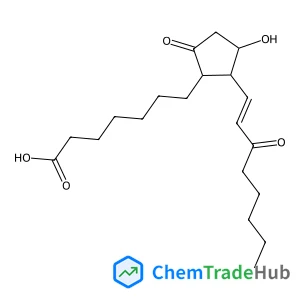
(11alpha,13E)-11-Hydroxy-9,15-dioxoprost-13-en-1-oic acid
CAS Number:
22973-19-9
Molecular Formula:
C20H32O5
Guoyi Zhang, Mingzu Zhang, Jinlin He, Peihong Ni
We report here a strategy that allows the preparation of a novel water-soluble polymeric prodrug, paclitaxel–poly(ethyl ethylene phosphate) conjugated with folic acid molecules (abbreviated as PTX–PEEP–FA). PTX was directly used as an initiator for the ring-opening polymerization (ROP) of 2-ethoxy-2-oxo-1,3,2-dioxaphospholane (EOP) under the catalysis of Sn(Oct)2 to fabricate an amphiphilic PTX–PEEP, followed by covalently conjugating a FA moiety via esterification to obtain the biodegradable and targeted polymeric prodrug PTX–PEEP–FA. The chemical structure of the prodrug was characterized by 1H NMR and MALDI-TOF mass spectroscopy. TEM and DLS measurements showed that these prodrugs could self-assemble in aqueous solution to form micelles with PTX as the core and PEEP–FA as the corona, and the average particle size was less than 130 nm. The hydrophobic PTX core could be further used to load more water-insoluble anti-cancer drugs, such as PTX or doxorubicin (DOX), while the hydrophilic PEEP–FA chain endowed micelles with good stability during systemic circulation and significantly improved controlled-release properties compared to free PTX or DOX. Live cell imaging system was utilized to monitor the cellular uptake process of DOX-loaded PTX–PEEP–FA micelles for HeLa and KB cells, respectively. The results revealed that these drug-loaded micelles with FA on their surface could remarkably improve cell endocytosis. In vitro biological evaluations confirmed that PTX–PEEP–FA, simultaneously acted as both a prodrug and drug delivery carrier, could achieve the aims of increased drug loading efficiency, reduced cytotoxicity, and enhanced targeting efficacy.
Artur Schneider, Torsten Brezesinski
DOI: 10.1039/C6CP08865A
Binita Pathak, Goutam Prasanna Kar, Suryasarathi Bose, Saptarshi Basu
DOI: 10.1039/C7CP03621C
DOI: 10.1039/C7CP04759B
Noriyuki Isobe, James H. Clark, Seishi Shimizu
DOI: 10.1039/C7CP04647B
Felix Uhl, Harald Forbert, Dominik Marx
DOI: 10.1039/C7CP00652G
E. Fadda, M. G. Nixon
DOI: 10.1039/C7CP02485A
Rakesh Gupta, Nishi Kashyap, Beena Rai
DOI: 10.1039/C6CP08775B
Yvonne Gründer, Christopher A. Lucas
DOI: 10.1039/C7CP00244K
Chaoping Liang, Yongping Zheng, Nickolas Ashburn, Young Jun Oh, Fantai Kong, Chenxi Zhang, Yifan Nie, Jian Sun, Kaihua He, Yu Ye, Rong Chen, Kyeongjae Cho
DOI: 10.1039/C7CP04611A
6-(3-Fluorophenyl)picolinic acid is generally considered safe for laboratory use...
(3R)-3-Pyrrolidinol is used in the pharmaceutical industry as a precursor for dr...
When handling (4R,5R)-4,5-Diethoxycarbonyl-2,2-dimethyldioxolane (CAS: 59779-75-...
1-(6-Chloroimidazo[1,2-b]pyridazin-3-yl)ethanone is often synthesized via a mult...
The market for N-Ethyl-3,4-dimethylbenzylamine (CAS: 39180-83-1) remains steady,...
Tert-butyl 3-(pyrrolidin-1-yl)azetidine-1-carboxylate is a chemical compound wit...
1-Bromo-3-chloro-2,4-dimethoxybenzene (CAS: 1228956-93-1) falls under the classi...
The safety of 8-Bromo-2-methyl-3,4-dihydroisoquinolin-1(2H)-one (CAS: 1368622-07...
Benzyl [(3S)-2,6-dioxo-3-piperidinyl]carbamate is generally safe when handled wi...
1-{[4-(4,4,5,5-Tetramethyl-1,3,2-dioxaborolan-2-yl)phenyl]sulfonyl}pyrrolidine s...

Polymer Chemistry welcomes submissions in all areas of polymer science that have a strong focus on macromolecular chemistry. Manuscripts may cover a broad range of fields, yet no direct application focus is required.
![4-[(2,4-Dihydroxyphenyl)diazenyl]-5-hydroxy-2,7-naphthalenedisulfonic acid structure](https://static.chemtradehub.com/structs/362/3627-01-8-79ac.webp "4-[(2,4-Dihydroxyphenyl)diazenyl]-5-hydroxy-2,7-naphthalenedisulfonic acid structure")