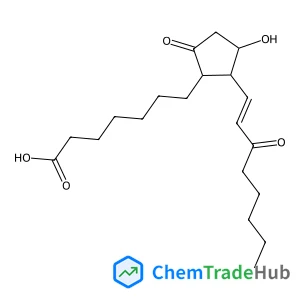
(11alpha,13E)-11-Hydroxy-9,15-dioxoprost-13-en-1-oic acid
CAS Number:
22973-19-9
Molecular Formula:
C20H32O5
Nabarun Roy, Eric Buhler, Jean-Marie Lehn
We describe a novel approach to the generation of a supramolecular polymer and its assembly into microcapsules by the aerial oxidation of a supramolecular building block. It involves the initial build-up of a ditopic supramolecular component by hydrogen bonding association of two complementary subunits, followed by its covalent polymerization through oxidative formation of C–C linkages. The supramolecular component itself was selectively formed from a dynamic covalent library of hydrazone isomers by target specific amplification of a single library constituent. The polymer obtained condenses into supramolecular aggregates of micrometric size and capsular-type morphology, presenting multilayered walls, which have been characterized by STEM, SEM and AFM imaging methods. The present design methodology implements the covalent polycondensation of non-covalent monomers towards the formation of supramolecular polymers, in a sequence opposite to the usual non-covalent polyassociation of covalent complementary monomers. It can be envisaged as a proactive step towards forming adaptive smart materials through manipulation of the sequence of supramolecular/non-covalent and molecular/covalent steps for the generation of supramolecular polymers by suitable selection of receptor and substrate moieties.
Xiya Wang, Hao Su, Yongjun Liu
DOI: 10.1039/C7CP00313G
Lijia Tong, Junjie He, Min Yang, Zheng Chen, Jing Zhang, Yanli Lu, Ziyuan Zhao
DOI: 10.1039/C7CP04117A
J. S. Eardley, N. Warner, L. Z. Deng, E. Wrede
DOI: 10.1039/C7CP00458C
Ranjana Rautela, Neeraj K. Joshi, Sacha Novakovic, Wallace W. H. Wong, Jonathan M. White, Kenneth P. Ghiggino, Matthew F. Paige, Ronald P. Steer
DOI: 10.1039/C7CP04746K
I. León, E. R. Alonso, S. Mata, C. Cabezas, M. A. Rodríguez, J.-U. Grabow, J. L. Alonso
DOI: 10.1039/C7CP03924G
Eric R. Kennehan, Christopher Grieco, Alyssa N. Brigeman, Adam Rimshaw, Kayla Bisgaier, Noel C. Giebink
DOI: 10.1039/C7CP04819J
Akira Takakado, Yusuke Nakasone, Masahide Terazima
DOI: 10.1039/C7CP03686H
6-(3-Fluorophenyl)picolinic acid is generally considered safe for laboratory use...
(3R)-3-Pyrrolidinol is used in the pharmaceutical industry as a precursor for dr...
When handling (4R,5R)-4,5-Diethoxycarbonyl-2,2-dimethyldioxolane (CAS: 59779-75-...
1-(6-Chloroimidazo[1,2-b]pyridazin-3-yl)ethanone is often synthesized via a mult...
The market for N-Ethyl-3,4-dimethylbenzylamine (CAS: 39180-83-1) remains steady,...
Tert-butyl 3-(pyrrolidin-1-yl)azetidine-1-carboxylate is a chemical compound wit...
1-Bromo-3-chloro-2,4-dimethoxybenzene (CAS: 1228956-93-1) falls under the classi...
The safety of 8-Bromo-2-methyl-3,4-dihydroisoquinolin-1(2H)-one (CAS: 1368622-07...
Benzyl [(3S)-2,6-dioxo-3-piperidinyl]carbamate is generally safe when handled wi...
1-{[4-(4,4,5,5-Tetramethyl-1,3,2-dioxaborolan-2-yl)phenyl]sulfonyl}pyrrolidine s...

Polymer Chemistry welcomes submissions in all areas of polymer science that have a strong focus on macromolecular chemistry. Manuscripts may cover a broad range of fields, yet no direct application focus is required.