












Facile synthesis of thermal-responsive P(NIPAM-S)/SiO2 hybrid hollow spheres and their controllable release properties for fragrance
Literature Information
Publication Date
2013-03-13
DOI
10.1039/C3PY00186E
Impact Factor
5.582
Authors
Liqin Liu, Yuyao Xie, Limin Wu
View Original
Abstract
In this paper, thermal-responsive poly(n-isopropyl acrylamide-co-styrene) (P(NIPAM-S))/SiO2 hybrid hollow spheres were successfully synthesized via a one-step method. In this approach, when P(NIPAM-S) colloidal particles were used as templates and encapsulated by SiO2 nanoparticles derived from the sol–gel reaction of tetraethoxysilane under alkaline conditions, P(NIPAM-S)/SiO2 hybrid hollow spheres were directly obtained. Neither calcinations nor an etching process was needed. Very interestingly, the as-obtained hybrid hollow spheres didn't exhibit typical thermal-responsive properties in aqueous solutions but rather in ethanol solutions, and thus could be used as controllable releasing systems in some specific environments.
Related Literature
Functional oligo(vinyl acetate) bearing bipyridine moieties by RAFT polymerization and extraction of metal ions in supercritical carbon dioxide
Shoucun Zhang, Yali Luo, Hongwei Yang, Hai-Jian Yang, Bien Tan
2013-04-02
Paper
DOI: 10.1039/C3PY00212H
Polymerization of n-butyl acrylate with high concentration of a chain transfer agent (CBr4): detailed characterization and impact on branching
A. Agirre, J. I. Santos, A. Etxeberria, V. Sauerland, J. R. Leiza
2013-01-08
Paper
DOI: 10.1039/C2PY21123H
A self-healing supramolecular polymer gel with stimuli-responsiveness constructed by crown ether based molecular recognition
Xuzhou Yan, Donghua Xu, Jianzhuang Chen, Mingming Zhang, Bingjie Hu, Yihua Yu, Feihe Huang
2013-03-12
Paper
DOI: 10.1039/C3PY00283G
Poly(3-alkylthiophene) with tuneable regioregularity: synthesis and self-assembling properties
Pieter Willot, Joost Steverlynck, David Moerman, Philippe Leclère, Roberto Lazzaroni, Guy Koeckelberghs
2013-03-05
Communication
DOI: 10.1039/C3PY00236E
Controlled thiol–ene post-polymerization reactions on polyferrocenylsilane homopolymers and block copolymers
Laurent Chabanne, Stefan Pfirrmann, David J. Lunn, Ian Manners
2013-02-13
Paper
DOI: 10.1039/C3PY21129K
N-Acetoxy-phthalimide (NAPI) as a new H-abstracting agent at high temperature: application to the melt functionalization of polyethylene
Denis Bélékian, Philippe Cassagnau, Jean-Jacques Flat, Sébastien Quinebeche, Laurent Autissier, Denis Bertin, Didier Siri, Didier Gigmes, Yohann Guillaneuf, Philippe Chaumont, Emmanuel Beyou
2013-03-15
Communication
DOI: 10.1039/C3PY00246B
pH degradable dendron-functionalized poly(2-ethyl-2-oxazoline) prepared by a cascade “double-click” reaction
Sebla Onbulak, Amitav Sanyal, Richard Hoogenboom
2013-03-15
Paper
DOI: 10.1039/C3PY00258F
A colorless functional polydopamine thin layer as a basis for polymer capsules
Michinari Kohri, Hiroto Kohma, Yoshihiro Shinoda, Mitsuaki Yamauchi, Shiki Yagai, Takashi Kojima, Tatsuo Taniguchi, Keiki Kishikawa
2013-02-28
Paper
DOI: 10.1039/C3PY00181D
You might also like
Compound Q&A
What is 1-(2,4,6-Trifluorophenyl)ethanol (CAS: 1250113-83-7)?
1-(2,4,6-Trifluorophenyl)ethanol is an organic compound with the CAS number 1250...
1250113-83-71-(2,4,6-Trifluoroph...
Compound Q&A
Is 1-(2,4-Dimethoxybenzyl)-4-(hydroxymethyl)-2-pyrrolidinone (CAS: 919111-34-5) safe?
1-(2,4-Dimethoxybenzyl)-4-(hydroxymethyl)-2-pyrrolidinone (CAS: 919111-34-5) is ...
919111-34-51-(2,4-Dimethoxybenz...
Compound Q&A
What are the physical and chemical properties of (7S,15R)-6β,15-Diacetoxy-7α,20-epoxy-7-hydroxykaura-2,16-dien-1-one (CAS: 51419-51-3)?
(7S,15R)-6β,15-Diacetoxy-7α,20-epoxy-7-hydroxykaura-2,16-dien-1-one is a crystal...
51419-51-3(7S,15R)-6β,15-Diace...
Compound Q&A
What regulatory guidelines apply to rac-ethyl (1r,4r)-4-hydroxycyclohexane-1-carboxylate, trans (CAS: 3618-04-0)?
The compound rac-ethyl (1r,4r)-4-hydroxycyclohexane-1-carboxylate, trans (CAS: 3...
3618-04-0rac-ethyl (1r,4r)-4-...
Compound Q&A
What is the market or research trend for 2-(2,4-Difluorophenoxy)-3-nitropyridine (CAS: 175135-62-3)?
The market for 2-(2,4-Difluorophenoxy)-3-nitropyridine (CAS: 175135-62-3) is cur...
175135-62-32-(2,4-Difluoropheno...
Compound Q&A
What are the main uses of 6-Diazo-5-oxo-L-norleucine (CAS: 157-03-9)?
The main uses of 6-Diazo-5-oxo-L-norleucine (CAS: 157-03-9) include research in ...
157-03-96-Diazo-5-oxo-L-norl...
Compound Q&A
What precautions should be taken when handling 2-Aminoethyl-mono-amide-DOTA-tris(tBu ester) (CAS: 173308-19-5)?
When handling 2-Aminoethyl-mono-amide-DOTA-tris(tBu ester) (CAS: 173308-19-5), i...
173308-19-52-Aminoethyl-mono-am...
Compound Q&A
How is 5-Methylimidazo[1,2-a]pyridine-3-carbaldehyde (CAS: 178488-37-4) typically synthesized?
5-Methylimidazo[1,2-a]pyridine-3-carbaldehyde (CAS: 178488-37-4) can be synthesi...
178488-37-45-Methylimidazo[1,2-...
Compound Q&A
Are there alternatives to 2,4,6-Trihydroxyisophthalaldehyde (CAS: 4396-13-8) in synthesis?
There are alternative reagents that can be used in the synthesis of 2,4,6-Trihyd...
4396-13-82,4,6-Trihydroxyisop...
Compound Q&A
What is (2Z)-3-(5-Fluoro-1H-indol-3-yl)-2-sulfanylacrylic acid (CAS: 179461-52-0)?
(2Z)-3-(5-Fluoro-1H-indol-3-yl)-2-sulfanylacrylic acid is a chemical compound wi...
179461-52-0(2Z)-3-(5-Fluoro-1H-...
Source Journal
Polymer Chemistry

CiteScore:
8.6
Self-citation Rate:
7.3%
Articles per Year:
457
Polymer Chemistry welcomes submissions in all areas of polymer science that have a strong focus on macromolecular chemistry. Manuscripts may cover a broad range of fields, yet no direct application focus is required.
Recommended Compounds
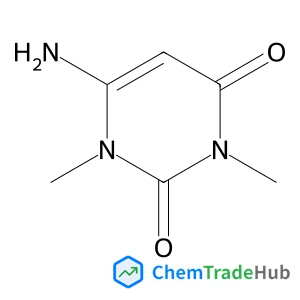
6-amino-1,3-dimethyl-1,2,3,4-tetrahydropyrimidine-2,4-dione
CAS Number:
6642-31-5
Molecular Formula:
C6H9N3O2

Recommended Suppliers






Disclaimer
This page provides academic journal information for reference and research purposes only. We are not affiliated with any journal publishers and do not handle publication submissions. For publication-related inquiries, please contact the respective journal publishers directly.
If you notice any inaccuracies in the information displayed, please contact us at support@chemtradehub.com. We will promptly review and address your concerns.