












![5-Bromo-1H-pyrrolo[2,3-b]pyridine structure](https://static.chemtradehub.com/structs/183/183208-35-7-2d72.webp "5-Bromo-1H-pyrrolo[2,3-b]pyridine structure")
Poly(3-alkylthiophene) with tuneable regioregularity: synthesis and self-assembling properties
Literature Information
Publication Date
2013-03-05
DOI
10.1039/C3PY00236E
Impact Factor
5.582
Authors
Pieter Willot, Joost Steverlynck, David Moerman, Philippe Leclère, Roberto Lazzaroni, Guy Koeckelberghs
View Original
Abstract
This work reports a synthetic strategy to generate poly(3-alkylthiophene)s (P3ATs) with joint-simultaneous control of the molar mass and the regioregularity. A series of chiral P3ATs with different regioregularities is synthesized using a Pd(RuPhos)-catalyzed chain-growth polymerisation. All polymers have molar masses and polydispersities (PDI) that lie within a narrow region. Furthermore, it is shown that the Pd-catalyst forms all kinds of couplings [head-to-tail (HT), tail-to-tail (TT) and head-to-head (HH)] to a similar extent, which allows insertion of predictable amounts of regio-irregularities into the polymer chain. This enables a thorough study of the influence of the regioregularity on the properties of P3AT, which was performed using UV-vis and circular dichroïsm (CD) spectroscopy, differential scanning calorimetry (DSC) and atomic force microscopy (AFM) measurements. Unexpectedly, it is found that under “kinetic” conditions the highest crystallinity, π-stacking, supramolecular organisation and chiral expression are not obtained for fully regioregular P3AT with 100% HT couplings, but that a small amount of regio-irregularity increases these properties and the chiral expression. Under “thermodynamic” conditions (after annealing, very slow solvent evaporation or very slow cooling from the melt), this effect is less pronounced or not found. This behaviour can be explained by a higher degree of motional freedom within the non-perfect polymer chains due to the increased steric repulsion from the HH-couplings, which leads to a more easy stacking under “kinetic” conditions.
Related Literature
An active ferrocenyl triarylphosphine for palladium-catalyzed Suzuki–Miyaura cross-coupling of aryl halides
Fuk Yee Kwong, Kin Shing Chan, Chi Hung Yeung, Albert S. C. Chan
2004-09-21
Communication
DOI: 10.1039/B407661C
Nanoporosity of an interpenetrated NbO-type molecular framework studied by single crystal X-ray diffraction
Prasad V. Ganesan, Cameron J. Kepert
2004-09-01
Communication
DOI: 10.1039/B409543J
The anion sequence in the phase transformation of mesostructures templated by non-ionic block copolymers
Jiawei Tang, Chengzhong Yu, Xufeng Zhou, Xiaoxia Yan, Dongyuan Zhao
2004-08-25
Communication
DOI: 10.1039/B408100E
A samarium cyclooctatetraene complex as catalyst for hydroamination/cyclisation catalysis
Agustino Zulys, Tarun K. Panda, Michael T. Gamer, Peter W. Roesky
2004-09-30
Communication
DOI: 10.1039/B410918J
Biomimetic thermo-responsive star diblock gelators
Yuting Li, Ravin Narain, Yinghua Ma, Andrew L. Lewis, Steven P. Armes
2004-10-18
Communication
DOI: 10.1039/B410150B
Cyclopeptide alkaloids: chemistry and biology
Madeleine M. Joullié, David J. Richard
2004-08-31
Feature Article
DOI: 10.1039/B400334A
Photo-reversible Pb2+-complexation of thermosensitive poly(N-isopropyl acrylamide-co-spiropyran acrylate) in water
Takayuki Suzuki, Tatsuya Kato, Hiraku Shinozaki
2004-08-13
Communication
DOI: 10.1039/B407342H
Chiral amplification by polypeptides and its relevance to prebiotic catalysis
David R. Kelly, Alastair Meek, Stanley M. Roberts
2004-08-25
Communication
DOI: 10.1039/B404379K
New reactions in water: metal-free conversion of alcohols and ketones into α-iodoketones
José Barluenga, María Marco-Arias, Francisco González-Bobes, Alfredo Ballesteros, José M. González
2004-10-04
Communication
DOI: 10.1039/B411227J
Water-in-water mesophases for templating inorganics
Andreas Taubert, Ernst Furrer, Wolfgang Meier
2004-09-02
Communication
DOI: 10.1039/B405610H
You might also like
Compound Q&A
What is 1-(2,4,6-Trifluorophenyl)ethanol (CAS: 1250113-83-7)?
1-(2,4,6-Trifluorophenyl)ethanol is an organic compound with the CAS number 1250...
1250113-83-71-(2,4,6-Trifluoroph...
Compound Q&A
Is 1-(2,4-Dimethoxybenzyl)-4-(hydroxymethyl)-2-pyrrolidinone (CAS: 919111-34-5) safe?
1-(2,4-Dimethoxybenzyl)-4-(hydroxymethyl)-2-pyrrolidinone (CAS: 919111-34-5) is ...
919111-34-51-(2,4-Dimethoxybenz...
Compound Q&A
What are the physical and chemical properties of (7S,15R)-6β,15-Diacetoxy-7α,20-epoxy-7-hydroxykaura-2,16-dien-1-one (CAS: 51419-51-3)?
(7S,15R)-6β,15-Diacetoxy-7α,20-epoxy-7-hydroxykaura-2,16-dien-1-one is a crystal...
51419-51-3(7S,15R)-6β,15-Diace...
Compound Q&A
What regulatory guidelines apply to rac-ethyl (1r,4r)-4-hydroxycyclohexane-1-carboxylate, trans (CAS: 3618-04-0)?
The compound rac-ethyl (1r,4r)-4-hydroxycyclohexane-1-carboxylate, trans (CAS: 3...
3618-04-0rac-ethyl (1r,4r)-4-...
Compound Q&A
What is the market or research trend for 2-(2,4-Difluorophenoxy)-3-nitropyridine (CAS: 175135-62-3)?
The market for 2-(2,4-Difluorophenoxy)-3-nitropyridine (CAS: 175135-62-3) is cur...
175135-62-32-(2,4-Difluoropheno...
Compound Q&A
What are the main uses of 6-Diazo-5-oxo-L-norleucine (CAS: 157-03-9)?
The main uses of 6-Diazo-5-oxo-L-norleucine (CAS: 157-03-9) include research in ...
157-03-96-Diazo-5-oxo-L-norl...
Compound Q&A
What precautions should be taken when handling 2-Aminoethyl-mono-amide-DOTA-tris(tBu ester) (CAS: 173308-19-5)?
When handling 2-Aminoethyl-mono-amide-DOTA-tris(tBu ester) (CAS: 173308-19-5), i...
173308-19-52-Aminoethyl-mono-am...
Compound Q&A
How is 5-Methylimidazo[1,2-a]pyridine-3-carbaldehyde (CAS: 178488-37-4) typically synthesized?
5-Methylimidazo[1,2-a]pyridine-3-carbaldehyde (CAS: 178488-37-4) can be synthesi...
178488-37-45-Methylimidazo[1,2-...
Compound Q&A
Are there alternatives to 2,4,6-Trihydroxyisophthalaldehyde (CAS: 4396-13-8) in synthesis?
There are alternative reagents that can be used in the synthesis of 2,4,6-Trihyd...
4396-13-82,4,6-Trihydroxyisop...
Compound Q&A
What is (2Z)-3-(5-Fluoro-1H-indol-3-yl)-2-sulfanylacrylic acid (CAS: 179461-52-0)?
(2Z)-3-(5-Fluoro-1H-indol-3-yl)-2-sulfanylacrylic acid is a chemical compound wi...
179461-52-0(2Z)-3-(5-Fluoro-1H-...
Source Journal
Polymer Chemistry

CiteScore:
8.6
Self-citation Rate:
7.3%
Articles per Year:
457
Polymer Chemistry welcomes submissions in all areas of polymer science that have a strong focus on macromolecular chemistry. Manuscripts may cover a broad range of fields, yet no direct application focus is required.
Recommended Compounds
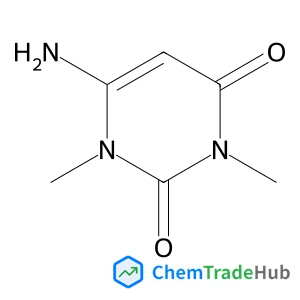
6-amino-1,3-dimethyl-1,2,3,4-tetrahydropyrimidine-2,4-dione
CAS Number:
6642-31-5
Molecular Formula:
C6H9N3O2
Recommended Suppliers


Disclaimer
This page provides academic journal information for reference and research purposes only. We are not affiliated with any journal publishers and do not handle publication submissions. For publication-related inquiries, please contact the respective journal publishers directly.
If you notice any inaccuracies in the information displayed, please contact us at support@chemtradehub.com. We will promptly review and address your concerns.