












Common processes drive the thermochemical pretreatment of lignocellulosic biomass
Literature Information
Publication Date
2013-10-29
DOI
10.1039/C3GC41962B
Impact Factor
10.182
Authors
Marcus Foston, Yoshiharu Nishiyama, B. Leif Hanson, Shane Harton, William T. Heller, Barbara R. Evans, S. Gnanakaran, Arthur J. Ragauskas, Brian H. Davison
View Original
Abstract
Lignocellulosic biomass, a potentially important renewable organic source of energy and chemical feedstock, resists degradation to glucose in industrial hydrolysis processes and thus requires expensive thermochemical pretreatments. Understanding the mechanism of biomass breakdown during these pretreatments will lead to more efficient use of biomass. By combining multiple probes of structure, sensitive to different length scales, with molecular dynamics simulations, we reveal two fundamental processes responsible for the morphological changes in biomass during steam explosion pretreatment: cellulose dehydration and lignin-hemicellulose phase separation. We further show that the basic driving forces are the same in other leading thermochemical pretreatments, such as dilute acid pretreatment and ammonia fiber expansion.
Recommended Journals
Related Literature
Synthesis and charge-transporting properties of electron-deficient CN2–fluorene based D–A copolymers
Yan Zhao, Xunlei Ding, Hui Jia, Bo Jiang, Zhiguo Zhang, Chuanlang Zhan, Shenggui He, Qibing Pei, Yongfang Li, Yunqi Liu, Jiannian Yao
2012-04-30
Paper
DOI: 10.1039/C2PY20184D
Poly(dopamine acrylamide)-co-poly(propargyl acrylamide)-modified titanium surfaces for ‘click’ functionalization
Li Qun Xu, Hua Jiang, Koon-Gee Neoh, En-Tang Kang, Guo Dong Fu
2012-01-30
Paper
DOI: 10.1039/C2PY00552B
Substituent effects on the stabilities of polymeric and small molecule bis-terpyridine complexes
Ian M. Henderson, Ryan C. Hayward
2012-03-13
Paper
DOI: 10.1039/C2PY20042B
Separation and quantification of dead species in styreneRAFT polymerization by gradient polymerelution chromatography
Ruiwei Guo, Zhipeng Shi, Xingxing Wang, Anjie Dong
2012-03-23
Paper
DOI: 10.1039/C2PY20102J
Poly(N-isopropylacrylamide) on two-dimensional graphene oxide surfaces
Junjie Qi, Weipeng Lv, Guoliang Zhang, Fengbao Zhang, Xiaobin Fan
2012-01-18
Communication
DOI: 10.1039/C2PY00577H
A versatile macro-initiator with dual functional anchoring groups for surface-initiated atom transfer radical polymerization on various substrates
Xiaolong Wang, Feng Zhou
2012-04-18
Paper
DOI: 10.1039/C2PY20148H
Recent advances in (reactive) melt processing of cellulose acetate and related biodegradable bio-compositions
Robert Quintana, Olivier Persenaire, Leila Bonnaud, Philippe Dubois
2011-11-28
Minireview
DOI: 10.1039/C1PY00421B
Aromatic-aliphatic random and block copolyesters: synthesis, sequence distribution and thermal properties
Wen-Da Li, Jian-Bing Zeng, Xiao-Jie Lou, Jing-Jing Zhang, Yu-Zhong Wang
2012-03-26
Paper
DOI: 10.1039/C2PY20068F
Functional conjugated microporous polymers: from 1,3,5-benzene to 1,3,5-triazine
Shijie Ren, Robert Dawson, Andrea Laybourn, Jia-xing Jiang, Yaroslav Khimyak, Dave J. Adams, Andrew I. Cooper
2012-01-30
Paper
DOI: 10.1039/C2PY00585A
Novel polymer nanocomposites from bioinspired green aqueous functionalization of BNNTs
Vijay Kumar Thakur, Jian Yan, Meng-Fang Lin, Chunyi Zhi, Dmitri Golberg, Yoshio Bando, Raymond Sim
2012-01-31
Paper
DOI: 10.1039/C2PY00612J
You might also like
Compound Q&A
Are there alternatives to 1-(4-Chlorophenyl)-N-hydroxymethanimine (CAS: 3848-36-0) in synthesis?
When considering alternatives to 1-(4-Chlorophenyl)-N-hydroxymethanimine (CAS: 3...
3848-36-01-(4-Chlorophenyl)-N...
Compound Q&A
How should (1R,9S,10S,12S,14E,16S,19R,20R,21S,22R)-3,9,21-Trihydroxy-5,10,12,14,16,20,22-heptamethyl-23,24-dioxatetracyclo[17.3.1.1~6,9~.0~2,7~]tetracosa-2,5,7,14-tetraen-4-one (CAS: 183202-73-5) be stored?
This compound should be stored in a cool, dry place away from direct sunlight. I...
183202-73-5(1R,9S,10S,12S,14E,1...
Compound Q&A
How is 3-(4-Bromophenyl)-5-(2-fluorophenyl)-1,2,4-oxadiazole (CAS: 419553-16-5) typically synthesized?
3-(4-Bromophenyl)-5-(2-fluorophenyl)-1,2,4-oxadiazole is synthesized through a m...
419553-16-53-(4-Bromophenyl)-5-...
Compound Q&A
How is 5-Chloro-2-(4-chlorophenyl)-4-methyl-6-[3-(1-piperidinyl)propoxy]pyrimidine (CAS: 1639220-19-1) typically synthesized?
5-Chloro-2-(4-chlorophenyl)-4-methyl-6-[3-(1-piperidinyl)propoxy]pyrimidine (CAS...
1639220-19-15-Chloro-2-(4-chloro...
Compound Q&A
What industries use 2-Chloro-4-(difluoromethoxy)pyridine (CAS: 1206978-15-5)?
2-Chloro-4-(difluoromethoxy)pyridine is used in the pharmaceutical industry for ...
1206978-15-52-Chloro-4-(difluoro...
Compound Q&A
What regulatory guidelines apply to 3-Chloro-6-methylpyridazine (CAS: 1121-79-5)?
3-Chloro-6-methylpyridazine (CAS: 1121-79-5) is classified under the Globally Ha...
1121-79-53-Chloro-6-methylpyr...
Compound Q&A
Are there alternatives to Methyl 4,5-dimethyl-2-nitrobenzoate in synthesis?
Several alternatives can be used in the synthesis of Methyl 4,5-dimethyl-2-nitro...
90922-74-0Methyl 4,5-dimethyl-...
Compound Q&A
Are there alternatives to (2E,2'E)-3,3'-(1,4-Phenylene)bisacrylaldehyde in synthesis?
Alternatives to (2E,2'E)-3,3'-(1,4-Phenylene)bisacrylaldehyde include other acry...
63405-68-5(2E,2'E)-3,3'-(1,4-P...
Compound Q&A
What is 3-Amino-5-chloropyridin-2-ol hydrochloride (CAS: 1261906-29-9)?
3-Amino-5-chloropyridin-2-ol hydrochloride is an organic compound with the CAS n...
1261906-29-93-Amino-5-chloropyri...
Compound Q&A
What precautions should be taken when handling 6,7-Difluoro-2,3-dihydro-4H-chromen-4-one (CAS: 1092349-93-3)?
When handling 6,7-Difluoro-2,3-dihydro-4H-chromen-4-one, it is essential to wear...
1092349-93-36,7-Difluoro-2,3-dih...
Source Journal
Green Chemistry

CiteScore:
16.1
Self-citation Rate:
7.5%
Articles per Year:
944
Green Chemistry provides a unique forum for the publication of innovative research on the development of alternative green and sustainable technologies. The scope of Green Chemistry is based on, but not limited to, the definition proposed by Anastas and Warner (Green Chemistry: Theory and Practice, P T Anastas and J C Warner, Oxford University Press, Oxford, 1998). Green chemistry is the utilisation of a set of principles that reduces or eliminates the use or generation of hazardous substances in the design, manufacture and application of chemical products. Green Chemistry is at the frontiers of this continuously-evolving interdisciplinary science and publishes research that attempts to reduce the environmental impact of the chemical enterprise by developing a technology base that is inherently non-toxic to living things and the environment. Submissions on all aspects of research relating to the endeavour are welcome. The journal publishes original and significant cutting-edge research that is likely to be of wide general appeal. To be published, work must present a significant advance in green chemistry. Papers must contain a comparison with existing methods and demonstrate advantages over those methods before publication can be considered. For more information please see this Editorial. Coverage includes the following, but is not limited to: Design (e.g. biomimicry, design for degradation/recycling/reduced toxicity…) Reagents & Feedstocks (e.g. renewables, CO2, solvents, auxiliary agents, waste utilization…) Synthesis (e.g. organic, inorganic, synthetic biology…) Catalysis (e.g. homogeneous, heterogeneous, enzyme, whole cell…) Process (e.g. process design, intensification, separations, recycling, efficiency…) Energy (e.g. renewable energy, fuels, photovoltaics, fuel cells, energy storage, energy carriers…) Applications (e.g. electronics, dyes, consumer products, coatings, pharmaceuticals, preservatives, building materials, chemicals for industry/agriculture/mining…) Impact (e.g. safety, metrics, LCA, sustainability, (eco)toxicology…) Green chemistry is, by definition, a continuously-evolving frontier. Therefore, the inclusion of a particular material or technology does not, of itself, guarantee that a paper is suitable for the journal. To be suitable, the novel advance should have the potential for reduced environmental impact relative to the state of the art. Green Chemistry does not normally deal with research associated with 'end-of-pipe' or remediation issues.
Recommended Compounds
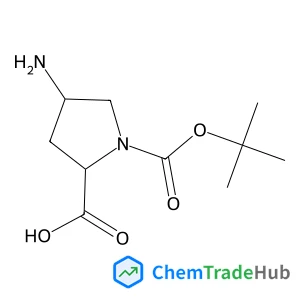
(2R,4R)-1-Boc-4-Aminopyrrolidine-2-carboxylic acid
CAS Number:
132622-98-1
Molecular Formula:
C10H18N2O4
Recommended Suppliers






Disclaimer
This page provides academic journal information for reference and research purposes only. We are not affiliated with any journal publishers and do not handle publication submissions. For publication-related inquiries, please contact the respective journal publishers directly.
If you notice any inaccuracies in the information displayed, please contact us at support@chemtradehub.com. We will promptly review and address your concerns.