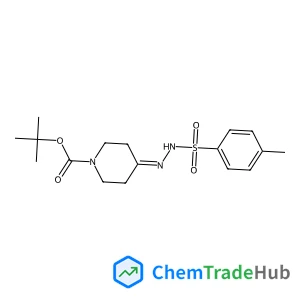
tert-Butyl 4-(2-(p-Tolylsulfonyl)hydrazono)piperidine-1-carboxylate
CAS Number:
1046478-89-0
Molecular Formula:
C17H25N3O4S
Ian M. Henderson, Ryan C. Hayward
Metallo-supramolecular assemblies of polymeric, particulate, or small-molecule building blocks based on 2,2′:6′,2′′-terpyridine most commonly rely on chemical substitution of this ligand at the 4′ position. Here, we investigate the effects that this modification to the ligand have on the kinetic stabilities of bis transition metal complexes, and therefore the lifetime of supramolecular bonds that it forms. The decay of aqueous cobalt(II) and iron(II) complexes in the presence of excesses of competing metal ions is studied by ultraviolet visible (UV-vis) absorption spectroscopy, and rate constants for the decay of amino-, ether-, and non-substituted ligands are determined. Remarkably, for cobalt(II), amino substituents lead to rapid oxidation in air to kinetically inert cobalt(III) complexes, while ether substituents yield decay constants three- to six-fold larger than unsubstituted complexes. Ether linkages apparently weaken cobalt complexes by inductive withdrawal of electrons, while amino substituents donate electron density, thus lowering the oxidation potential of the complexes. For iron(II), both ether- and amino-linked complexes decay at least an order of magnitude faster than unsubstituted complexes. Our results highlight the importance of considering linking chemistry when designing dynamic supramolecular assemblies based on terpyridine ligands, as it yields significant, and occasionally dramatic, changes in the kinetic stabilities of these complexes.
Chengyuan Zhang, Dayi Pan, Kui Luo, Ning Li, Chunhua Guo, Xiuli Zheng, Zhongwei Gu
DOI: 10.1039/C4PY00601A
Claudio De Rosa, Finizia Auriemma, Oreste Tarallo, Rocco Di Girolamo, Enrico M. Troisi, Simona Esposito, Dario Liguori, Fabrizio Piemontesi, Gianni Vitale, Giampiero Morini
DOI: 10.1039/C6PY01950A
Hui Zhou, Jiesheng Li, Ming Hui Chua, Hong Yan, Beng Zhong Tang, Jianwei Xu
DOI: 10.1039/C4PY00518J
Jinying Peng, Chun Tian, Lifen Zhang, Zhenping Cheng, Xiulin Zhu
DOI: 10.1039/C6PY02133F
Mariolino Carta, Matthew Croad, Keith Bugler, Kadhum J. Msayib, Neil B. McKeown
DOI: 10.1039/C4PY00608A
Shuang Li, Xianyu Deng, Lei Feng, Xincheng Miao, Kuangyi Tang, Qianqian Li, Zhen Li
DOI: 10.1039/C6PY01733A
Hongjun Yang, Zhongrui Wang, Yulei Zheng, Wenyan Huang, Xiaoqiang Xue, Bibiao Jiang
DOI: 10.1039/C7PY00174F
Yang Wu, Yanyan Zhou, Jian Zhu, Wei Zhang, Xiangqiang Pan, Zhengbiao Zhang, Xiulin Zhu
DOI: 10.1039/C4PY00732H
Francesca Cicogna, Serena Coiai, Paola Rizzarelli, Sabrina Carroccio, Cristian Gambarotti, Ilaria Domenichelli, Chengcheng Yang, Nadka Tz. Dintcheva, Giovanni Filippone, Calogero Pinzino, Elisa Passaglia
DOI: 10.1039/C4PY00641K
Mariolino Carta, Richard Malpass-Evans, Matthew Croad, Yulia Rogan, Michael Lee, Ian Rose, Neil B. McKeown
DOI: 10.1039/C4PY00609G
When considering alternatives to 1-(4-Chlorophenyl)-N-hydroxymethanimine (CAS: 3...
This compound should be stored in a cool, dry place away from direct sunlight. I...
3-(4-Bromophenyl)-5-(2-fluorophenyl)-1,2,4-oxadiazole is synthesized through a m...
5-Chloro-2-(4-chlorophenyl)-4-methyl-6-[3-(1-piperidinyl)propoxy]pyrimidine (CAS...
2-Chloro-4-(difluoromethoxy)pyridine is used in the pharmaceutical industry for ...
3-Chloro-6-methylpyridazine (CAS: 1121-79-5) is classified under the Globally Ha...
Several alternatives can be used in the synthesis of Methyl 4,5-dimethyl-2-nitro...
Alternatives to (2E,2'E)-3,3'-(1,4-Phenylene)bisacrylaldehyde include other acry...
3-Amino-5-chloropyridin-2-ol hydrochloride is an organic compound with the CAS n...
When handling 6,7-Difluoro-2,3-dihydro-4H-chromen-4-one, it is essential to wear...

Polymer Chemistry welcomes submissions in all areas of polymer science that have a strong focus on macromolecular chemistry. Manuscripts may cover a broad range of fields, yet no direct application focus is required.