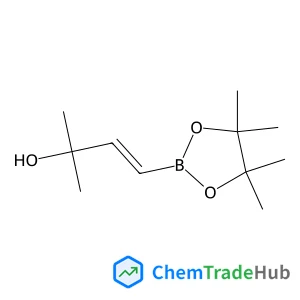
(E)-2-methyl-4-(4,4,5,5-tetramethyl-1,3,2-dioxaborolan-2-yl)but-3-en-2-ol
CAS Number:
581802-26-8
Molecular Formula:
C11H21BO3
Pengcheng Jiang, Shanping Chen, Hongrui Qi, Guo-Jun Deng
A novel method for the formation of 2-arylsulfanylphenols from thiols and cyclohexanones is described. Iodine was used as an effective catalyst for this kind of transformation. Cyclohexanones were used as a phenol source via a dehydrogenation and tautomerization reaction.

Journal of Chemical Sciences

Colloid Journal

Bioorganic & Medicinal Chemistry

Medicinal Chemistry Research

Main Group Chemistry

Electroanalysis

Acta Metallurgica Sinica-English Letters

Critical Reviews in Solid State and Materials Sciences

Journal of the Indian Institute of Science

Bioorganic & Medicinal Chemistry Letters
Samuel Aleksanian, Behnoush Khorsand, Rolf Schmidt, Jung Kwon Oh
DOI: 10.1039/C2PY20154B
Hakan Durmaz, Amitav Sanyal, Gurkan Hizal, Umit Tunca
DOI: 10.1039/C1PY00471A
DOI: 10.1039/C2PY00520D
Fei Cheng, Edward M. Bonder, Ami Doshi, Frieder Jäkle
DOI: 10.1039/C2PY00556E
Ching Hsuan Lin, Sheng Lung Chang, Ting Yi Shen, Yu Sin Shih, Hong Tze Lin, Chih Feng Wang
DOI: 10.1039/C2PY00449F
Myriam Pire, Cédric Lorthioir, Evdokia K. Oikonomou, Sophie Norvez, Ilias Iliopoulos, Benoît Le Rossignol, Ludwik Leibler
DOI: 10.1039/C2PY00591C
Kemal Arda Günay, Nicolas Schüwer, Harm-Anton Klok
DOI: 10.1039/C2PY20162C
Guillaume Delaittre, Maud Save, Marianne Gaborieau, Patrice Castignolles, Jutta Rieger, Bernadette Charleux
DOI: 10.1039/C2PY20084H
Pieter Espeel, Fabienne Goethals, Milan M. Stamenović, Lionel Petton, Filip E. Du Prez
DOI: 10.1039/C2PY00565D
When considering alternatives to 1-(4-Chlorophenyl)-N-hydroxymethanimine (CAS: 3...
This compound should be stored in a cool, dry place away from direct sunlight. I...
3-(4-Bromophenyl)-5-(2-fluorophenyl)-1,2,4-oxadiazole is synthesized through a m...
5-Chloro-2-(4-chlorophenyl)-4-methyl-6-[3-(1-piperidinyl)propoxy]pyrimidine (CAS...
2-Chloro-4-(difluoromethoxy)pyridine is used in the pharmaceutical industry for ...
3-Chloro-6-methylpyridazine (CAS: 1121-79-5) is classified under the Globally Ha...
Several alternatives can be used in the synthesis of Methyl 4,5-dimethyl-2-nitro...
Alternatives to (2E,2'E)-3,3'-(1,4-Phenylene)bisacrylaldehyde include other acry...
3-Amino-5-chloropyridin-2-ol hydrochloride is an organic compound with the CAS n...
When handling 6,7-Difluoro-2,3-dihydro-4H-chromen-4-one, it is essential to wear...

Green Chemistry provides a unique forum for the publication of innovative research on the development of alternative green and sustainable technologies. The scope of Green Chemistry is based on, but not limited to, the definition proposed by Anastas and Warner (Green Chemistry: Theory and Practice, P T Anastas and J C Warner, Oxford University Press, Oxford, 1998). Green chemistry is the utilisation of a set of principles that reduces or eliminates the use or generation of hazardous substances in the design, manufacture and application of chemical products. Green Chemistry is at the frontiers of this continuously-evolving interdisciplinary science and publishes research that attempts to reduce the environmental impact of the chemical enterprise by developing a technology base that is inherently non-toxic to living things and the environment. Submissions on all aspects of research relating to the endeavour are welcome. The journal publishes original and significant cutting-edge research that is likely to be of wide general appeal. To be published, work must present a significant advance in green chemistry. Papers must contain a comparison with existing methods and demonstrate advantages over those methods before publication can be considered. For more information please see this Editorial. Coverage includes the following, but is not limited to: Design (e.g. biomimicry, design for degradation/recycling/reduced toxicity…) Reagents & Feedstocks (e.g. renewables, CO2, solvents, auxiliary agents, waste utilization…) Synthesis (e.g. organic, inorganic, synthetic biology…) Catalysis (e.g. homogeneous, heterogeneous, enzyme, whole cell…) Process (e.g. process design, intensification, separations, recycling, efficiency…) Energy (e.g. renewable energy, fuels, photovoltaics, fuel cells, energy storage, energy carriers…) Applications (e.g. electronics, dyes, consumer products, coatings, pharmaceuticals, preservatives, building materials, chemicals for industry/agriculture/mining…) Impact (e.g. safety, metrics, LCA, sustainability, (eco)toxicology…) Green chemistry is, by definition, a continuously-evolving frontier. Therefore, the inclusion of a particular material or technology does not, of itself, guarantee that a paper is suitable for the journal. To be suitable, the novel advance should have the potential for reduced environmental impact relative to the state of the art. Green Chemistry does not normally deal with research associated with 'end-of-pipe' or remediation issues.