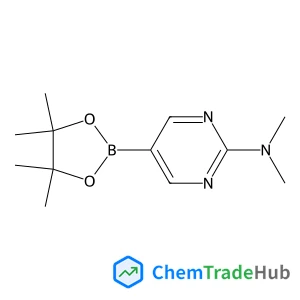
N,N-Dimethyl-5-(4,4,5,5-tetramethyl-1,3,2-dioxaborolan-2-yl)-2-pyrimidinamine
CAS Number:
1032759-30-0
Molecular Formula:
C12H20BN3O2
The first page of this article is displayed as the abstract.
Ferda Hacıvelioğlu
DOI: 10.1039/C7PY00189D
Marco Albuszis, Peter J. Roth, Werner Pauer, Hans-Ulrich Moritz
DOI: 10.1039/C4PY00709C
Sigen A, Qian Xu, Dezhong Zhou, Yongsheng Gao, Jeddah Marie Vasquez, Udo Greiser, Wenguang Liu
DOI: 10.1039/C6PY01719C
Jing Zhang, Pu Xiao, Fabrice Morlet-Savary, Bernadette Graff, Jean Pierre Fouassier, Jacques Lalevée
DOI: 10.1039/C4PY00770K
Xiaodong Liu, Qinghua Xu, Lifen Zhang, Zhenping Cheng, Xiulin Zhu
DOI: 10.1039/C7PY00366H
Gérald Lopez, Marc Guerre, Bruno Améduri, Jean-Pierre Habas, Vincent Ladmiral
DOI: 10.1039/C7PY00580F
Shaojian Lin, Anindita Das, Patrick Theato
DOI: 10.1039/C6PY01996J
Parvesh Wadhwani, Rouven Müller
DOI: 10.1039/C6PY02108E
Marc Guerre, Mona Semsarilar, Franck Godiard, Bruno Améduri, Vincent Ladmiral
DOI: 10.1039/C6PY02203K
Chih-Chia Cheng, Jyun-Jie Huang, Zhi-Sheng Liao, Shan-You Huang, Zhong Xin
DOI: 10.1039/C7PY00182G
When considering alternatives to 1-(4-Chlorophenyl)-N-hydroxymethanimine (CAS: 3...
This compound should be stored in a cool, dry place away from direct sunlight. I...
3-(4-Bromophenyl)-5-(2-fluorophenyl)-1,2,4-oxadiazole is synthesized through a m...
5-Chloro-2-(4-chlorophenyl)-4-methyl-6-[3-(1-piperidinyl)propoxy]pyrimidine (CAS...
2-Chloro-4-(difluoromethoxy)pyridine is used in the pharmaceutical industry for ...
3-Chloro-6-methylpyridazine (CAS: 1121-79-5) is classified under the Globally Ha...
Several alternatives can be used in the synthesis of Methyl 4,5-dimethyl-2-nitro...
Alternatives to (2E,2'E)-3,3'-(1,4-Phenylene)bisacrylaldehyde include other acry...
3-Amino-5-chloropyridin-2-ol hydrochloride is an organic compound with the CAS n...
When handling 6,7-Difluoro-2,3-dihydro-4H-chromen-4-one, it is essential to wear...

Polymer Chemistry welcomes submissions in all areas of polymer science that have a strong focus on macromolecular chemistry. Manuscripts may cover a broad range of fields, yet no direct application focus is required.