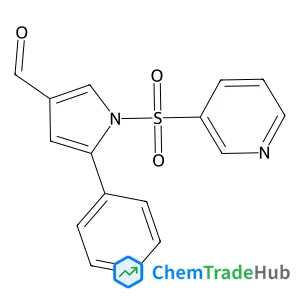
5-Phenyl-1-(pyridin-3-ylsulfonyl)-1H-pyrrole-3-carbaldehyde
CAS Number:
881676-90-0
Molecular Formula:
C16H12N2O3S
Myriam Pire, Cédric Lorthioir, Evdokia K. Oikonomou, Sophie Norvez, Ilias Iliopoulos, Benoît Le Rossignol, Ludwik Leibler
The crosslinking of epoxidized natural rubber with dodecanedioic acid and the mechanism of its acceleration by 1,2-dimethylimidazole (DMI) are investigated using nuclear magnetic resonance spectroscopy. Solid-state NMR experiments (1H, 1H → 13C cross-polarization and 13C direct polarization) are used to analyse crosslinked samples, whereas 13C solution NMR provides information about liquid epoxidized rubber species. 13C solid-state NMR demonstrates the ester nature of the crosslinks, and confirms that DMI acts through the formation of imidazolium dicarboxylate species, well dispersed in the elastomeric matrix. After synthesis of a low molecular weight epoxidized rubber and subsequent reaction with a monofunctional carboxylic acid in the presence of DMI, a solution NMR study reveals that the imidazolium dicarboxylate would react preferentially at the less substituted side of the epoxy site.
Jaipal Gupta, Daniel J. Keddie, Chaoying Wan, David M. Haddleton, Tony McNally
DOI: 10.1039/C6PY00522E
Nana Sun, Dongdong Qi, Jianzhuang Jiang
DOI: 10.1039/C4PY00512K
Ferda Hacıvelioğlu
DOI: 10.1039/C7PY00189D
Claudio De Rosa, Finizia Auriemma, Oreste Tarallo, Rocco Di Girolamo, Enrico M. Troisi, Simona Esposito, Dario Liguori, Fabrizio Piemontesi, Gianni Vitale, Giampiero Morini
DOI: 10.1039/C6PY01950A
Beiyue Shao, Xinju Zhu, Kyle N. Plunkett, David A. Vanden Bout
DOI: 10.1039/C6PY01871H
Chao Yin, Wenli Song, Rongcui Jiang, Wenbo Hu, Qingming Shen, Xiang Li, Jie Li, Quli Fan
DOI: 10.1039/C4PY00376D
Khama Rani Ghosh, Sukanta Kumar Saha
DOI: 10.1039/C4PY00673A
Xue Jiang, Guolin Lu, Huang Xiaoyu
DOI: 10.1039/C6PY02004F
When considering alternatives to 1-(4-Chlorophenyl)-N-hydroxymethanimine (CAS: 3...
This compound should be stored in a cool, dry place away from direct sunlight. I...
3-(4-Bromophenyl)-5-(2-fluorophenyl)-1,2,4-oxadiazole is synthesized through a m...
5-Chloro-2-(4-chlorophenyl)-4-methyl-6-[3-(1-piperidinyl)propoxy]pyrimidine (CAS...
2-Chloro-4-(difluoromethoxy)pyridine is used in the pharmaceutical industry for ...
3-Chloro-6-methylpyridazine (CAS: 1121-79-5) is classified under the Globally Ha...
Several alternatives can be used in the synthesis of Methyl 4,5-dimethyl-2-nitro...
Alternatives to (2E,2'E)-3,3'-(1,4-Phenylene)bisacrylaldehyde include other acry...
3-Amino-5-chloropyridin-2-ol hydrochloride is an organic compound with the CAS n...
When handling 6,7-Difluoro-2,3-dihydro-4H-chromen-4-one, it is essential to wear...

Polymer Chemistry welcomes submissions in all areas of polymer science that have a strong focus on macromolecular chemistry. Manuscripts may cover a broad range of fields, yet no direct application focus is required.