












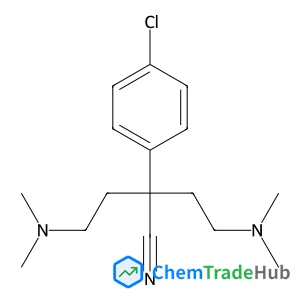
2-(4-Chlorophenyl)-4-(dimethylamino)-2-(2-(dimethylamino)ethyl)butanenitrile
CAS Number:
1246816-57-8
Molecular Formula:
C16H24ClN3
Rohitkumar G. Gore, Lauren Myles, Marcel Spulak, Ian Beadham, Teresa M. Garcia, Stephen J. Connon, Nicholas Gathergood
Imidazolium Brønsted acidic catalysts substituted with ester/amides have been assessed for both antimicrobial toxicity and biodegradation. Low toxicity to a screen of 20 microbial strains (12 fungi and 8 bacteria) was demonstrated. Imidazolium salts incorporating either ester or amide groups at N-1, C-2, C-4 and C-5 did not pass the readily biodegradable test (ISO 14593). Catalyst selection based on Traffic Signal Light classification of performance, (eco)toxicity, and efficient synthesis is described.
Yong Qiao, Jincui An
DOI: 10.1039/C5AN02564H
Pengxiang Wang, Luyan Wang, Mei Ding, Meishan Pei, Wenjuan Guo
DOI: 10.1039/C9AN01288E
Kamila Kołacińska
DOI: 10.1039/C5AN02522B
Vanessa G. Santos, Marcos A. Pudenzi, Clécio F. Klitzke, Heliara L. Nascimento, Rosana C. L. Pereira, Wagner L. Bastos, Marcos N. Eberlin
DOI: 10.1039/C5AN02333E
Cunyu Yan, Jason W. Schmidberger, Fabio Parmeggiani, Shaneela A. Hussain, Nicholas J. Turner, Sabine L. Flitsch, Perdita Barran
DOI: 10.1039/C6AN00617E
Lu Zhou, Jun Zhou, Zhao Feng, Fuyan Wang, Shushen Xie, Shizhong Bu
DOI: 10.1039/C6AN00003G
Meili Zhao, Zhifu Deng, Jian Tang, Xiufen Zhou, Zhi Chen, Xutian Li, Liting Yang
DOI: 10.1039/C5AN02565F
J. Sarkar, A. Kumar
DOI: 10.1039/C6AN00356G
Takahiro Kanamori, Takashi Funatsu, Makoto Tsunoda
DOI: 10.1039/C5AN02617B
Magdalena Matczuk, Joanna Legat, Andrei R. Timerbaev, Maciej Jarosz
DOI: 10.1039/C6AN00276E
When handling 4-(2-Furylmethyl)thiomorpholine 1,1-dioxide (CAS: 79206-94-3), it ...
When handling 4-Chloro-N-[2-(4-morpholinyl)ethyl]benzamide (CAS: 71320-77-9), it...
Waste containing this compound (CAS: 62921-74-8) should be handled according to ...
Waste containing (S)-Methyl 2-amino-3-cyclohexylpropanoate should be collected i...
This compound can be synthesized using a multi-step process involving the conjug...
There are several alternatives to (2E)-3-(3,4-Dichlorophenyl)acrylic acid in syn...
Ethyl 6-(2-nitrophenyl)imidazo[2,1-b][1,3]thiazole-3-carboxylate (CAS: 925437-84...
Waste containing 2-(1,3-Thiazol-2-yl)ethanamine (CAS: 18453-07-1) should be coll...
Methyl 5-iodo-2-methylbenzoate can be synthesized through the iodination of meth...
5-Chloro[1,2,4]triazolo[1,5-a]pyridine is commonly synthesized via the condensat...

Green Chemistry provides a unique forum for the publication of innovative research on the development of alternative green and sustainable technologies. The scope of Green Chemistry is based on, but not limited to, the definition proposed by Anastas and Warner (Green Chemistry: Theory and Practice, P T Anastas and J C Warner, Oxford University Press, Oxford, 1998). Green chemistry is the utilisation of a set of principles that reduces or eliminates the use or generation of hazardous substances in the design, manufacture and application of chemical products. Green Chemistry is at the frontiers of this continuously-evolving interdisciplinary science and publishes research that attempts to reduce the environmental impact of the chemical enterprise by developing a technology base that is inherently non-toxic to living things and the environment. Submissions on all aspects of research relating to the endeavour are welcome. The journal publishes original and significant cutting-edge research that is likely to be of wide general appeal. To be published, work must present a significant advance in green chemistry. Papers must contain a comparison with existing methods and demonstrate advantages over those methods before publication can be considered. For more information please see this Editorial. Coverage includes the following, but is not limited to: Design (e.g. biomimicry, design for degradation/recycling/reduced toxicity…) Reagents & Feedstocks (e.g. renewables, CO2, solvents, auxiliary agents, waste utilization…) Synthesis (e.g. organic, inorganic, synthetic biology…) Catalysis (e.g. homogeneous, heterogeneous, enzyme, whole cell…) Process (e.g. process design, intensification, separations, recycling, efficiency…) Energy (e.g. renewable energy, fuels, photovoltaics, fuel cells, energy storage, energy carriers…) Applications (e.g. electronics, dyes, consumer products, coatings, pharmaceuticals, preservatives, building materials, chemicals for industry/agriculture/mining…) Impact (e.g. safety, metrics, LCA, sustainability, (eco)toxicology…) Green chemistry is, by definition, a continuously-evolving frontier. Therefore, the inclusion of a particular material or technology does not, of itself, guarantee that a paper is suitable for the journal. To be suitable, the novel advance should have the potential for reduced environmental impact relative to the state of the art. Green Chemistry does not normally deal with research associated with 'end-of-pipe' or remediation issues.
![Pyrazolo[1,5-a]pyridine-3-carbothioamide structure](https://static.chemtradehub.com/structs/885/885275-44-5-aae0.webp "Pyrazolo[1,5-a]pyridine-3-carbothioamide structure")








