












Thermo-responsive polymer aided spheroid culture in cryogel based platform for high throughput drug screening
Literature Information
Publication Date
2016-03-30
DOI
10.1039/C6AN00356G
Impact Factor
4.616
Authors
J. Sarkar, A. Kumar
View Original
Abstract
In high throughput cell culture, the paradigm is now shifting from 2D to 3D systems. However, in 3D cell culture systems, it is important that the cells form spheroids with robust cell–cell interactions. We fabricated poly(N-isopropylacrylamide-co-gelatin) cryogel scaffolds for cell culture and inserted them into open-ended 96-well plates that formed a drainage and leakage protected, easy to handle high throughput platform. This platform was used to screen for the optimal concentration of poly(N-isopropylacrylamide) (pNIPAAm) as an external aid to the formation of cellular spheroids. It was found that hepatic cells (Hep G2) seeded in the presence of 0.03% pNIPAAm formed better hepatic spheroids in terms of morphology (as assessed by microscopic analysis and formation of bile canaliculi-like structures) and functionality by day 5 of culture. An increase of 44.22%, 15.75%, 36.44%, 32.05% and 27.02% was observed in glucose consumption (1.925 mM per day per 104 cells), albumin synthesis (164.18 ng per day per 104 cells), CYP1A1 (304.92 pg per min per 104 cells), CYP2A6 (441.23 nM per min per 104 cells) and phase II metabolic activity (386.18 nM per min−1 per 104 cells), respectively, upon using 0.03% pNIPAAm, as compared to the 3D control. The platform was tested with other cells such as breast and lung cancer cells and found to be compatible. The cell spheroids were subjected to drug toxicity screening in cryogel based open-ended platforms. It was observed that the spheroids were more resistant to anticancer drugs, as compared to 2D and 3D controls, with approximately 11%–67% increase in the IC50 values of tamoxifen and paclitaxel. The platform also showed dose dependent and reproducible responses to drugs.
Related Literature
A diastereo- and enantioselective synthesis of α-substituted anti-α,β-diaminophosphonic acid derivatives
Jeremy C. Wilt, Maren Pink, Jeffrey N. Johnston
2008-08-06
Communication
DOI: 10.1039/B808393B
Controlled formation of porous magnetic nanorodsvia a liquid/liquid solvothermal method
Oscar Bomati-Miguel, Aldo F. Rebolledo, Pedro Tartaj
2008-07-07
Communication
DOI: 10.1039/B805239E
B-Alkyl Suzuki couplings for the stereoselective synthesis of substituted pyrans
Gregory W. O’Neil, Alois Fürstner
2008-07-16
Communication
DOI: 10.1039/B806898D
Gold mediated glycosylations: selective activation of propargyl 1,2-orthoesters in the presence of aglycones containing a propargyl moiety
Gopalsamy Sureshkumar, Srinivas Hotha
2008-07-21
Communication
DOI: 10.1039/B806707D
Fine control over the morphology and structure of mesoporous silica nanomaterials by a dual-templating approach
Junhui He
2008-07-28
Communication
DOI: 10.1039/B807787H
Facile one pot synthesis of a range of reversible addition–fragmentation chain transfer (RAFT) agents
Jared Skey, Rachel K. O’Reilly
2008-07-25
Communication
DOI: 10.1039/B804260H
Directing single-walled carbon nanotubes to self-assemble at water/oil interfaces and facilitate electron transfer
Yuanjian Zhang, Yanfei Shen, Daniel Kuehner, Shuixing Wu, Zhongmin Su, Shen Ye, Li Niu
2008-07-17
Communication
DOI: 10.1039/B805789C
Enhancement of the electrocatalytic activity of gold nanoparticlesvia NaBH4 treatment
Jagotamoy Das, Srikanta Patra, Haesik Yang
2008-07-29
Communication
DOI: 10.1039/B806984K
Cyclometallated platinum(ii) complexes incorporating ethynyl–flavoneligands: switching between triplet and singlet emission induced by selective binding of Pb2+ ions
Pierre-Henri Lanoë, Jean-Luc Fillaut, Loïc Toupet, J. A. Gareth Williams, Hubert Le Bozec, Véronique Guerchais
2008-07-16
Communication
DOI: 10.1039/B806935B
Selective mono reduction of bis-phosphine oxides under mild conditions
Maria J. Petersson, Wendy A. Loughlin, Ian D. Jenkins
2008-07-30
Communication
DOI: 10.1039/B807695B
You might also like
Compound Q&A
What precautions should be taken when handling 4-(2-Furylmethyl)thiomorpholine 1,1-dioxide (CAS: 79206-94-3)?
When handling 4-(2-Furylmethyl)thiomorpholine 1,1-dioxide (CAS: 79206-94-3), it ...
79206-94-34-(2-Furylmethyl)thi...
Compound Q&A
What precautions should be taken when handling 4-Chloro-N-[2-(4-morpholinyl)ethyl]benzamide (CAS: 71320-77-9)?
When handling 4-Chloro-N-[2-(4-morpholinyl)ethyl]benzamide (CAS: 71320-77-9), it...
71320-77-94-Chloro-N-[2-(4-mor...
Compound Q&A
How should waste containing 2-[2-(2-Methoxyethoxy)ethoxy]ethyl 4-methylbenzenesulfonate (CAS: 62921-74-8) be handled?
Waste containing this compound (CAS: 62921-74-8) should be handled according to ...
62921-74-82-[2-(2-Methoxyethox...
Compound Q&A
How should waste containing (S)-Methyl 2-amino-3-cyclohexylpropanoate be handled?
Waste containing (S)-Methyl 2-amino-3-cyclohexylpropanoate should be collected i...
40056-18-6(S)-Methyl 2-amino-3...
Compound Q&A
How is 5-({4-[(2S,4R)-4-Hydroxy-2-methyltetrahydro-2H-pyran-4-yl]-2-thienyl}sulfanyl)-1-methyl-1,3-dihydro-2H-indol-2-one (CAS: 166882-70-8) typically synthesized?
This compound can be synthesized using a multi-step process involving the conjug...
166882-70-85-({4-[(2S,4R)-4-Hyd...
Compound Q&A
Are there alternatives to (2E)-3-(3,4-Dichlorophenyl)acrylic acid (CAS: 7312-27-8) in synthesis?
There are several alternatives to (2E)-3-(3,4-Dichlorophenyl)acrylic acid in syn...
7312-27-8(2E)-3-(3,4-Dichloro...
Compound Q&A
How should Ethyl 6-(2-nitrophenyl)imidazo[2,1-b][1,3]thiazole-3-carboxylate (CAS: 925437-84-9) be stored?
Ethyl 6-(2-nitrophenyl)imidazo[2,1-b][1,3]thiazole-3-carboxylate (CAS: 925437-84...
925437-84-9Ethyl 6-(2-nitrophen...
Compound Q&A
How should waste containing 2-(1,3-Thiazol-2-yl)ethanamine (CAS: 18453-07-1) be handled?
Waste containing 2-(1,3-Thiazol-2-yl)ethanamine (CAS: 18453-07-1) should be coll...
18453-07-12-(1,3-Thiazol-2-yl)...
Compound Q&A
How is Methyl 5-iodo-2-methylbenzoate (CAS: 103440-54-6) typically synthesized?
Methyl 5-iodo-2-methylbenzoate can be synthesized through the iodination of meth...
103440-54-6Methyl 5-iodo-2-meth...
Compound Q&A
How is 5-Chloro[1,2,4]triazolo[1,5-a]pyridine (CAS: 1427399-34-5) typically synthesized?
5-Chloro[1,2,4]triazolo[1,5-a]pyridine is commonly synthesized via the condensat...
1427399-34-55-Chloro[1,2,4]triaz...
Source Journal
Analyst

CiteScore:
7.8
Self-citation Rate:
5.6%
Articles per Year:
653
Analyst publishes analytical and bioanalytical research that reports premier fundamental discoveries and inventions, and the applications of those discoveries, unconfined by traditional discipline barriers.
Recommended Compounds
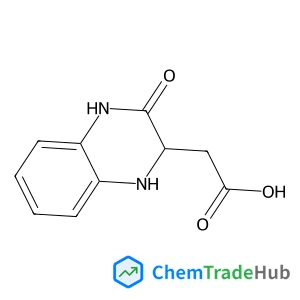
(3-Oxo-1,2,3,4-tetrahydro-2-quinoxalinyl)acetic acid
CAS Number:
136584-14-0
Molecular Formula:
C10H10N2O3

Recommended Suppliers






Disclaimer
This page provides academic journal information for reference and research purposes only. We are not affiliated with any journal publishers and do not handle publication submissions. For publication-related inquiries, please contact the respective journal publishers directly.
If you notice any inaccuracies in the information displayed, please contact us at support@chemtradehub.com. We will promptly review and address your concerns.